Christoph Schuringa – författare
Visar alla böcker från författaren Christoph Schuringa. Handla med fri frakt och snabb leverans.
5 produkter
5 produkter
1 192 kr
Skickas inom 7-10 vardagar
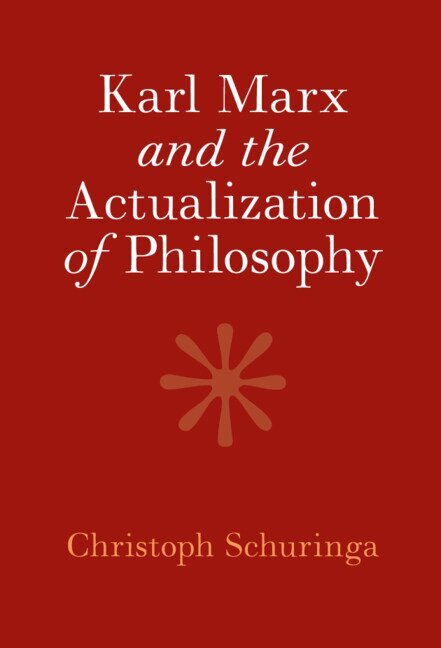
It is indisputable that Marx began his intellectual trajectory as a philosopher, but it is often thought that he subsequently turned away from philosophy. In this book, Christoph Schuringa proposes a radically different reading of Marx's intellectual project and demonstrates that from his earliest writings his aim was the 'actualization' of philosophy. Marx, he argues, should be understood not as turning away from philosophy, but as seeking to make philosophy a practical force in the world. By analysing a series of texts from across Marx's output, Schuringa shows that Marx progressively overcame what he called 'self-sufficient philosophy', not in order to leave philosophy behind but to bring it into its own. This involves a major reinterpretation of Marx's relationship to his ancestors Aristotle, Kant and Hegel, and shows that philosophy, as it actualizes itself, far from being merely a body of philosophical doctrine, figures as an instrument of the revolution.
632 kr
Skickas inom 10-15 vardagar
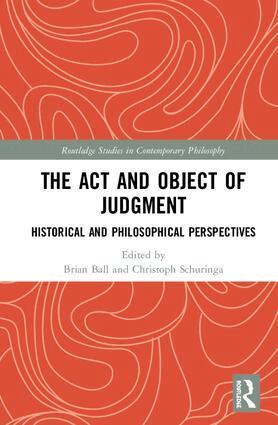
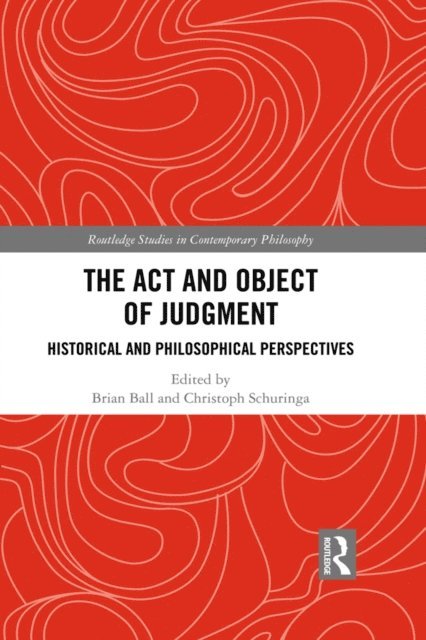
This book presents 12 original essays on historical and contemporary philosophical discussions of judgment. The central issues explored in this volume can be separated into two groups namely, those concerning the act and object of judgment. What kind of act is judgment? How is it related to a range of other mental acts, states, and dispositions? Where and how does assertive force enter in? Is there a distinct category of negative judgments, or are these simply judgments whose objects are negative? Concerning the object of judgment: How many objects are there of a given judgment? One, as on the dual relation theory of Frege and Moore? Or many as in Russell’s later multiple relation theory? If there is a single object, is it a proposition? And if so, is it a force-neutral, abstract entity that might equally figure as the object of a range of intentional attitudes? Or is it somehow constitutively tied to the act itself? These and related questions are approached from a variety of historical and contemporary perspectives. This book sheds new light on current controversies by drawing on the details of the distinct intellectual contexts in which previous philosophers’ positions about the nature of judgment were formulated. In turn, new directions in present-day research promise to raise novel interpretive prospects and challenges in the history of philosophy.
2 113 kr
Skickas inom 10-15 vardagar
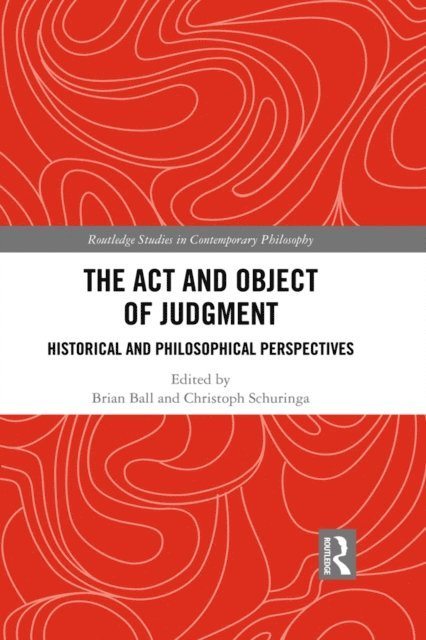
This book presents 12 original essays on historical and contemporary philosophical discussions of judgment. The central issues explored in this volume can be separated into two groups namely, those concerning the act and object of judgment. What kind of act is judgment? How is it related to a range of other mental acts, states, and dispositions? Where and how does assertive force enter in? Is there a distinct category of negative judgments, or are these simply judgments whose objects are negative? Concerning the object of judgment: How many objects are there of a given judgment? One, as on the dual relation theory of Frege and Moore? Or many as in Russell’s later multiple relation theory? If there is a single object, is it a proposition? And if so, is it a force-neutral, abstract entity that might equally figure as the object of a range of intentional attitudes? Or is it somehow constitutively tied to the act itself? These and related questions are approached from a variety of historical and contemporary perspectives. This book sheds new light on current controversies by drawing on the details of the distinct intellectual contexts in which previous philosophers’ positions about the nature of judgment were formulated. In turn, new directions in present-day research promise to raise novel interpretive prospects and challenges in the history of philosophy.
Social History of Analytic Philosophy
How Politics Has Shaped an Apolitical Philosophy
Inbunden, Engelska, 2025
298 kr
Skickas
Analytic philosophy is the leading form of philosophy in the English-speaking world. What explains its continued success? Christoph Schuringa argues that its enduring power can only be understood by examining its social history. Analytic philosophy tends to think of itself as concerned with eternal questions, transcending the changing scenes of history. It thinks of itself as apolitical. This book, however, convincingly shows that the opposite is true.The origins of analytic philosophy are in a set of distinct movements, shaped by high-ly specific sets of political and social forces. Only after the Second World War were these disparate, often dynamic movements joined together to make 'analytic philosophy' as we know it. In the climate of McCarthyism, analytic philosophy was robbed of political force.To this day, analytic philosophy is the ideology of the status quo. It may seem arcane and largely removed from the real world, but it is a crucial component in upholding liberalism, through its central role in elite educational institutions. As Schuringa concludes, the apparently increasing friendliness of analytic philosophers to rival approaches in philosophy should be understood as a form of colonization; thanks to its hegemonic status, it reformats all it touches in service of its own imperatives, going so far as to colonize decolonial efforts in the discipline.
Social History of Analytic Philosophy
How Politics Has Shaped an Apolitical Philosophy
Häftad, Engelska, 2026
205 kr
Kommande
Analytic philosophy is the leading form of philosophy in the English-speaking world. What explains its continued success? Christoph Schuringa argues that its enduring power can only be understood by examining its social history. Analytic philosophy tends to think of itself as concerned with eternal questions, transcending the changing scenes of history. It thinks of itself as apolitical. This book, however, convincingly shows that the opposite is true.The origins of analytic philosophy are in a set of distinct movements, shaped by high-ly specific sets of political and social forces. Only after the Second World War were these disparate, often dynamic movements joined together to make 'analytic philosophy' as we know it. In the climate of McCarthyism, analytic philosophy was robbed of political force.To this day, analytic philosophy is the ideology of the status quo. It may seem arcane and largely removed from the real world, but it is a crucial component in upholding liberalism, through its central role in elite educational institutions. As Schuringa concludes, the apparently increasing friendliness of analytic philosophers to rival approaches in philosophy should be understood as a form of colonization; thanks to its hegemonic status, it reformats all it touches in service of its own imperatives, going so far as to colonize decolonial efforts in the discipline.