Cliff Brown - Böcker
Visar alla böcker från författaren Cliff Brown. Handla med fri frakt och snabb leverans.
5 produkter
5 produkter
1 088 kr
Tillfälligt slut
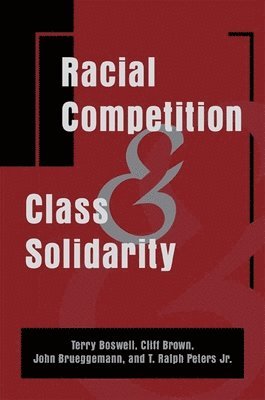
Looks at union organizing and strikes that were either strengthened by interracial cooperation or defeated by racial competition during the period between the Civil War and the Civil Rights Movement.It sometimes seems that racial conflict is an intractable impediment to class solidarity in the United States. Yet in a time of economic depression and overt racism, the unions of the CIO did, on a number of occasions, forge interracial solidarity among industrial workers of the 1930s and 1940s. This book explores the role of racism and racial solidarity in union organizing efforts or strikes during the period between the Civil War and the Civil Rights Movement, covering both those conditions and actions that enabled unions to realize interracial solidarity and those more common circumstances in which union organizing was defeated by racial competition.The authors combine theories of racial competition, specifically split labor market theory, with game theory models of collective action to compare the patterns of race relations that accompanied nine American labor organizing drives and strikes. They conclude that racial competition thwarted solidarity when minorities were recent immigrants or where employers used racist paternalism. Where conditions were more favorable, unions overcame racial divisions by institutionalizing their rhetoric about racial equality in the form of black organizers and black union officials, in what came to be known as the "miners' formula." This formula worked, and the CIO unions today remain among the country's most integrated institutions and most powerful advocates of working class interests.
382 kr
Tillfälligt slut
Looks at union organizing and strikes that were either strengthened by interracial cooperation or defeated by racial competition during the period between the Civil War and the Civil Rights Movement.It sometimes seems that racial conflict is an intractable impediment to class solidarity in the United States. Yet in a time of economic depression and overt racism, the unions of the CIO did, on a number of occasions, forge interracial solidarity among industrial workers of the 1930s and 1940s. This book explores the role of racism and racial solidarity in union organizing efforts or strikes during the period between the Civil War and the Civil Rights Movement, covering both those conditions and actions that enabled unions to realize interracial solidarity and those more common circumstances in which union organizing was defeated by racial competition.The authors combine theories of racial competition, specifically split labor market theory, with game theory models of collective action to compare the patterns of race relations that accompanied nine American labor organizing drives and strikes. They conclude that racial competition thwarted solidarity when minorities were recent immigrants or where employers used racist paternalism. Where conditions were more favorable, unions overcame racial divisions by institutionalizing their rhetoric about racial equality in the form of black organizers and black union officials, in what came to be known as the "miners' formula." This formula worked, and the CIO unions today remain among the country's most integrated institutions and most powerful advocates of working class interests.
Racial Conflicts and Violence in the Labor Market
Roots in the 1919 Steel Strike
Inbunden, Engelska, 1998
2 230 kr
Skickas inom 10-15 vardagar
This book focuses on community-level race relations during the 1919 Steel Strike, when intense job competition contributed to racial conflict among the nation's steel workers. As the Great Migration brought thousands of black workers to northern cities, their lower labor costs generated racially split labor markets in the industrial sector. Further, the discriminatory policies of labor unions forced many blacks to serve as strike breakers during periods of class conflict. As a result, the migration heightened racial conflict and undercut important union organizing initiatives. The 1919 Steel Strike illustrates how racial divisions crippled many American unions, a pattern that helps to explain the demise of organized labor during the 1920's. No previous studies of the 1919 Steel Strike have systematically compared community processes to determine how local events shaped the strike's outcome. Despite the failure of the 1919 Steel Strike, the varied experiences of workers in different communities reveal much about the causes of racial conflict and the possibilities of interracial solidarity. This study finds that patterns of black migration, local government repression of labor, the organizational strength of local unions, and employers' efforts to inflame racial tension all help to explain community-level variation in interracial solidarity and conflict. (Ph. D. dissertation, Emory University, 1996; revised with new preface)
Racial Conflicts and Violence in the Labor Market
Roots in the 1919 Steel Strike
Häftad, Engelska, 2015
736 kr
Skickas inom 10-15 vardagar
This book focuses on community-level race relations during the 1919 Steel Strike, when intense job competition contributed to racial conflict among the nation's steel workers. As the Great Migration brought thousands of black workers to northern cities, their lower labor costs generated racially split labor markets in the industrial sector. Further, the discriminatory policies of labor unions forced many blacks to serve as strike breakers during periods of class conflict. As a result, the migration heightened racial conflict and undercut important union organizing initiatives. The 1919 Steel Strike illustrates how racial divisions crippled many American unions, a pattern that helps to explain the demise of organized labor during the 1920's. No previous studies of the 1919 Steel Strike have systematically compared community processes to determine how local events shaped the strike's outcome. Despite the failure of the 1919 Steel Strike, the varied experiences of workers in different communities reveal much about the causes of racial conflict and the possibilities of interracial solidarity. This study finds that patterns of black migration, local government repression of labor, the organizational strength of local unions, and employers' efforts to inflame racial tension all help to explain community-level variation in interracial solidarity and conflict. (Ph. D. dissertation, Emory University, 1996; revised with new preface)
239 kr
Skickas inom 3-6 vardagar