Craig Santos Perez - Böcker
Visar alla böcker från författaren Craig Santos Perez. Handla med fri frakt och snabb leverans.
18 produkter
18 produkter
2 401 kr
Skickas inom 10-15 vardagar
This breakthrough book examines dynamic intersections of poetics and geography. Gathering the essays of an international cohort whose work converges at the crossroads of poetics and the material world, Geopoetics in Practice offers insights into poetry, place, ecology, and writing the world through a critical-creative geographic lens.This collection approaches geopoetics as a practice by bringing together contemporary geographers, poets, and artists who contribute their research, methodologies, and creative writing. The 24 chapters, divided into the sections “Documenting,” “Reading,” and “Intervening,” poetically engage discourses about space, power, difference, and landscape, as well as about human, non-human, and more-than-human relationships with Earth. Key explorations of this edited volume include how poets engage with geographical phenomena through poetry and how geographers use creativity to explore space, place, and environment. This book makes a major contribution to the geohumanities and creative geographies by presenting geopoetics as a practice that compels its agents to take action. It will appeal to academics and students in the fields of creative writing, literature, geography, and the environmental and spatial humanities, as well as to readers from outside of the academy interested in where poetry and place overlap.
631 kr
Skickas inom 10-15 vardagar
This breakthrough book examines dynamic intersections of poetics and geography. Gathering the essays of an international cohort whose work converges at the crossroads of poetics and the material world, Geopoetics in Practice offers insights into poetry, place, ecology, and writing the world through a critical-creative geographic lens.This collection approaches geopoetics as a practice by bringing together contemporary geographers, poets, and artists who contribute their research, methodologies, and creative writing. The 24 chapters, divided into the sections “Documenting,” “Reading,” and “Intervening,” poetically engage discourses about space, power, difference, and landscape, as well as about human, non-human, and more-than-human relationships with Earth. Key explorations of this edited volume include how poets engage with geographical phenomena through poetry and how geographers use creativity to explore space, place, and environment. This book makes a major contribution to the geohumanities and creative geographies by presenting geopoetics as a practice that compels its agents to take action. It will appeal to academics and students in the fields of creative writing, literature, geography, and the environmental and spatial humanities, as well as to readers from outside of the academy interested in where poetry and place overlap.
413 kr
Skickas inom 11-20 vardagar
Navigating CHamoru Poetry focuses on Indigenous CHamoru (Chamorro) poetry from the Pacific Island of Guåhan (Guam). Poet and scholar Craig Santos Perez brings critical attention to a diverse and intergenerational collection of CHamoru poetry and scholarship. Throughout this book, Perez develops an Indigenous literary methodology called “wayreading” to navigate the complex relationship between CHamoru poetry, cultural identity, decolonial politics, diasporic migrations, and native aesthetics. Perez argues that contemporary CHamoru poetry articulates new and innovative forms of indigeneity rooted in CHamoru customary arts and values, while also routed through the profound and traumatic histories of missionization, colonialism, militarism, and ecological imperialism.This book shows that CHamoru poetry has been an inspiring and empowering act of protest, resistance, and testimony in the decolonization, demilitarization, and environmental justice movements of Guåhan. Perez roots his intersectional cultural and literary analyses within the fields of CHamoru studies, Pacific Islands studies, Native American studies, and decolonial studies, using his research to assert that new CHamoru literature has been—and continues to be—a crucial vessel for expressing the continuities and resilience of CHamoru identities. This book is a vital contribution that introduces local, national, and international readers and scholars to contemporary CHamoru poetry and poetics.
1 248 kr
Skickas inom 7-10 vardagar
Navigating CHamoru Poetry focuses on Indigenous CHamoru (Chamorro) poetry from the Pacific Island of Guåhan (Guam). Poet and scholar Craig Santos Perez brings critical attention to a diverse and intergenerational collection of CHamoru poetry and scholarship. Throughout this book, Perez develops an Indigenous literary methodology called “wayreading” to navigate the complex relationship between CHamoru poetry, cultural identity, decolonial politics, diasporic migrations, and native aesthetics. Perez argues that contemporary CHamoru poetry articulates new and innovative forms of indigeneity rooted in CHamoru customary arts and values, while also routed through the profound and traumatic histories of missionization, colonialism, militarism, and ecological imperialism.This book shows that CHamoru poetry has been an inspiring and empowering act of protest, resistance, and testimony in the decolonization, demilitarization, and environmental justice movements of Guåhan. Perez roots his intersectional cultural and literary analyses within the fields of CHamoru studies, Pacific Islands studies, Native American studies, and decolonial studies, using his research to assert that new CHamoru literature has been—and continues to be—a crucial vessel for expressing the continuities and resilience of CHamoru identities. This book is a vital contribution that introduces local, national, and international readers and scholars to contemporary CHamoru poetry and poetics.
1 097 kr
Skickas inom 7-10 vardagar
In this anthology of contemporary eco-literature, the editors have gathered an ensemble of a hundred emerging, mid-career, and established Indigenous writers from Polynesia, Melanesia, Micronesia, and the global Pacific diaspora. This book itself is an ecological form with rhizomatic roots and blossoming branches. Within these pages, the reader will encounter a wild garden of genres, including poetry, chant, short fiction, novel excerpts, creative nonfiction, visual texts, and even a dramatic play—all written in multilingual offerings of English, Pacific languages, pidgin, and translation. Seven main themes emerge: "Creation Stories and Genealogies," "Ocean and Waterscapes," "Land and Islands," "Flowers, Plants, and Trees," "Animals and More-than-Human Species," "Climate Change," and "Environmental Justice." This aesthetic diversity embodies the beautiful bio-diversity of the Pacific itself.The urgent voices in this book call us to attention—to action!—at a time of great need. Pacific ecologies and the lives of Pacific Islanders are currently under existential threat due to the legacy of environmental imperialism and the ongoing impacts of climate change. While Pacific writers celebrate the beauty and cultural symbolism of the ocean, islands, trees, and flowers, they also bravely address the frightening realities of rising sea levels, animal extinction, nuclear radiation, military contamination, and pandemics.Indigenous Pacific Islander Eco-Literatures reminds us that we are not alone; we are always in relation and always ecological. Humans, other species, and nature are interrelated; land and water are central concepts of identity and genealogy; and Earth is the sacred source of all life, and thus should be treated with love and care. With this book as a trusted companion, we are inspired and empowered to reconnect with the world as we navigate towards a precarious yet hopeful future.
341 kr
Skickas inom 7-10 vardagar
In this anthology of contemporary eco-literature, the editors have gathered an ensemble of a hundred emerging, mid-career, and established Indigenous writers from Polynesia, Melanesia, Micronesia, and the global Pacific diaspora. This book itself is an ecological form with rhizomatic roots and blossoming branches. Within these pages, the reader will encounter a wild garden of genres, including poetry, chant, short fiction, novel excerpts, creative nonfiction, visual texts, and even a dramatic play—all written in multilingual offerings of English, Pacific languages, pidgin, and translation. Seven main themes emerge: "Creation Stories and Genealogies," "Ocean and Waterscapes," "Land and Islands," "Flowers, Plants, and Trees," "Animals and More-than-Human Species," "Climate Change," and "Environmental Justice." This aesthetic diversity embodies the beautiful bio-diversity of the Pacific itself.The urgent voices in this book call us to attention—to action!—at a time of great need. Pacific ecologies and the lives of Pacific Islanders are currently under existential threat due to the legacy of environmental imperialism and the ongoing impacts of climate change. While Pacific writers celebrate the beauty and cultural symbolism of the ocean, islands, trees, and flowers, they also bravely address the frightening realities of rising sea levels, animal extinction, nuclear radiation, military contamination, and pandemics.Indigenous Pacific Islander Eco-Literatures reminds us that we are not alone; we are always in relation and always ecological. Humans, other species, and nature are interrelated; land and water are central concepts of identity and genealogy; and Earth is the sacred source of all life, and thus should be treated with love and care. With this book as a trusted companion, we are inspired and empowered to reconnect with the world as we navigate towards a precarious yet hopeful future.
295 kr
Skickas inom 7-10 vardagar
New CHamoru Literature highlights an intergenerational selection of eighteen emerging, mid-career, and established CHamoru authors, including an extended feature on master storyteller Peter R. Onedera. As Onedera explains in his essay, “The Dilemma of an Official Word,” Chamorro, Chamoru, CHamoru are different spellings of the same “description used in reference to Guam’s indigenous people and those in the Marianas archipelago for thousands of years.” Within the pages of this rich collection, you will find diverse genres, including poetry, chant, fiction, creative nonfiction, and playwriting. The pieces are composed predominantly in English; however, the opening chant is in the CHamoru language (with translation by the author), other pieces are multilingual, and one poem is composed in CHamoru creole English. The themes range from genealogy to identity, colonialism to cultural revitalization, ecological connection to environmental injustice, love to sexual abuse, and belonging to diaspora. This anthology will introduce readers to the Mariana archipelago and the vibrancy of CHamoru literature, culture, histories, migrations, politics, memories, traumas, and dreams.
431 kr
Skickas inom 7-10 vardagar
An Ocean of Wonder: The Fantastic in the Pacific brings together fifty writers and artists from across Moananuiākea working in myriad genres across media, ranging from oral narratives and traditional wonder tales to creative writing as well as visual artwork and scholarly essays. Collectively, this anthology features the fantastic as present-day Indigenous Pacific world-building that looks to the past in creating alternative futures, and in so doing reimagines relationships between peoples, environments, deities, nonhuman relatives, history, dreams, and storytelling. Wonder is activated by curiosity, humility in the face of mystery, and engagement with possibilities. We see wonder and the fantastic as general modes of expression that arenot confined to realism. As such, the fantastic encompasses fantasy, science fiction, magic realism, fabulation, horror, fairy tale, utopia, dystopia, and speculative fiction. We include Black, feminist, and queer futurisms, Indigenous wonderworks, Hawaiian moʻolelo kamahaʻo and moʻolelo āiwaiwa, Sāmoan fāgogo, and other non-mimetic genres from specific cultures, because we recognize that their refusal to adopt restrictive Euro-American definitions of reality is whatinspires and enables the fantastic to flourish.As artistic, intellectual, and culturally based expressions that encode and embody Indigenous knowledge, the multimodal moʻolelo in this collection upend monolithic, often exoticizing, and demeaning stereotypes of the Pacific and situate themselves in conversation with critical understandings of the global fantastic, Indigenous futurities, social justice, and decolonial and activist storytelling.In this collection, Oceanic ideas and images surround and connect to Hawaiʻi, which is for the three coeditors, a piko (center); at the same time, navigating both juxtaposition and association, the collection seeks to articulate pilina (relationships) across genres, locations, time, and media and to celebrate the multiplicity and relationality of the fantastic in Oceania.
295 kr
Skickas inom 7-10 vardagar
Here Was Once the Sea features poetry, fiction, and nonfiction guest edited by Rina Garcia Chua, Esther Vincent Xueming, and Ann Ang. While many of these works are comprised mostly of anglophone texts, which reflects the aspirations of regional writers to speak across borders and to the globe at large, several native languages appear on these pages. Here, Southeast Asia refers to the constituent nations of the Association of Southeast Asian Nations (ASEAN), namely, Brunei, Cambodia, Indonesia, Laos, Malaysia, Myanmar, Philippines, Singapore, Thailand, and Vietnam, as well as their associated diasporas. The writers and the peoples of the region live and remember more profoundly than we know. Their work explores the ecological across a multiscalar spectrum, featuring both geological landscapes and visceral botanical or animal entanglements, inheriting histories and spiritualities that defy and disrupt modern epistemologies. Together they represent a chorus of offerings, first and foremost to the land and the sea; and secondly to you, our readers, as an invitation to attend to the urgencies and travails of our homes. These are the stories we share and the stories we carry in our pasiking (basket) as we follow movements towards our destinies. These are the stories that sing of hope—for ourselves and for our world; ones that we whisper silently to ourselves as we touch our lips to the familiar earth and wait for the incoming monsoon rain to fall gently on our backs, our fields, our rivers.
268 kr
Skickas inom 3-6 vardagar
from unincorporated territory [lukao] is the fourth book in native Chamorro poet Craig Santos Perez’s ongoing series about his homeland, the Western Pacific Island of Guåhan (Guam), and his current home, Hawai i. He utilizes eco-poetic, decolonial, diasporic, indigenous, documentary, epic, and avant-garde modes to weave stories of creation, birth, migration, food sovereignty, and parenting. This work not only protests the devastating impacts of colonialism, militarism, and environmental injustice across the Pacific, it also expresses a vision of a sustainable and hopeful future.
170 kr
Skickas inom 7-10 vardagar
From Unincorporated Territory [hacha] is the first book of native Chamorro poet Craig Santos Perez’s ongoing series about his homeland, the Western Pacific Island of Guåhan (Guam). Perez weaves avant-garde, eco-poetic, indigenous, documentary, multilingual, and abstract expressionist modes to tell the complex story of Guam’s people, culture, history, politics, and ecologies. Since its original publication in 2008, [hacha] has received positive reviews, and it has been taught in universities throughout Asia, the Pacific, the United States, Canada, and Europe. This new and revised edition aims to bring the book to a new generation of readers.
170 kr
Skickas inom 7-10 vardagar
With Habitat Threshold, Craig Santos Perez has crafted a timely collection of eco-poetry that explores his ancestry as a native Pacific Islander, the ecological plight of his homeland, and his fears for the future. The book begins with the birth of the author’s daughter, capturing her growth and childlike awe at the wonders of nature. As it progresses, Perez confronts the impacts of environmental injustice, the ravages of global capitalism, toxic waste, animal extinction, water rights, human violence, mass migration, and climate change. Throughout, he mourns lost habitats and species, and confronts his fears for the future world his daughter will inherit. Amid meditations on calamity, this work does not stop at the threshold of elegy. Instead, the poet envisions a sustainable future in which our ethics are shaped by the indigenous belief that the earth is sacred and all beings are interconnected—a future in which we cultivate love and “carry each other towards the horizon of care.”Through experimental forms, free verse, prose, haiku, sonnets, satire, and a method he calls “recycling,” Perez has created a diverse collection filled with passion. Habitat Threshold invites us to reflect on the damage done to our world and to look forward, with urgency and imagination, to the possibility of a better future.
216 kr
Skickas inom 7-10 vardagar
Winner of the National Book Award for Poetry, this collection of experimental and visual poems dives into the history and culture of the poet’s homeland, Guam. This book is the fifth collection in Craig Santos Perez’s ongoing from unincorporated territory series about the history of his homeland, the western Pacific island of Guåhan (Guam), and the culture of his indigenous Chamoru people. “Åmot” is the Chamoru word for “medicine,” commonly referring to medicinal plants. Traditional Chamoru healers were known as yo’åmte; they gathered åmot in the jungle and recited chants and invocations of taotao’mona, or ancestral spirits, in the healing process. Through experimental and visual poetry, Perez explores how storytelling can become a symbolic form of åmot, offering healing from the traumas of colonialism, militarism, migration, environmental injustice, and the death of elders.
189 kr
Skickas inom 7-10 vardagar
A collection of previously published poems by renowned National Book Award-winning Chamoru poet Craig Santos Perez. The seventh book from award-winning Chamoru author Craig Santos Perez, Call This Mutiny brings together poems that were originally published in journals and anthologies from 2008 to 2023. Throughout these selected poems, Perez offers critical explorations of native cultures, decolonial politics, colonial histories, and the entangled ecologies of his homeland of Guam, his current home of Hawaiʻi, and the larger Pacific region in relation to the Global South and the Indigenous Fourth World. Perez’s poetry draws on the power of storytelling to share Indigenous history and culture and to offer healing from the trauma of colonialism and injustice. As he writes, “If we can write the ocean, we will never be silenced.”
157 kr
Skickas inom 5-8 vardagar
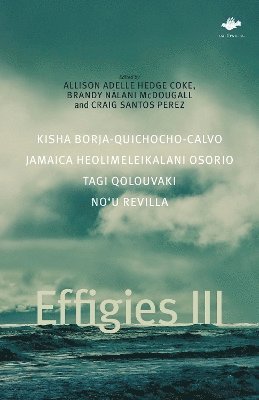
The Effigies series has woven a vibrant tapestry of indigenous poets from Native North America and the Pacific. As the third in this series, this anthology continues this weaving with the work of four emerging Pacific islander women poets from Guam, Hawai’i, and Fiji. Despite their distant origins, all these writers explore culture, history, politics, genealogy, feminism, and the environment. They each have their own unique style, ranging from the lyric to the avant-garde. Overall, they represent the next resurgent wave of empowered and decolonial Pacific writers.No‘u Revilla (Kanaka ‘Ōiwi), Jamaica Heolimeleikalani Osorio (Kanaka ‘Ōiwi), Kisha Borja-Quichocho-Calvo (Chamoru), and Tagi Quolouvaki (Fijian, Tongan) take readers into the vast Pacific ocean to swim beyond the reef in high tide, out to where the water meets the sky, only to circle back to the islands to taste the tears and sweat in coconut and guava, the smell of frangipani on the wind. Amidst such beauty, these poets also carry us into darkness with tremendous power and vulnerability, laying bare the ravages of colonialism—the brutal occupation of country, the violence waged against Native women and girls, the erosion of language and ancestral memory, and the forced disconnections from land, ocean, and other healing lifeways. Effigies III features four debut books that fearlessly journey through these home-islands in ways that will transform and empower.
248 kr
Skickas inom 3-6 vardagar
With the Saina as his figurative vessel-a ship built in modern times as an exact replica of the swift outriggers designed and sailed by the Chamorro people until banned by their oppressors-Craig Santos Perez deftly navigates the complexities in his bracing exploration of the personal, historical, cultural, and natural elements of his native Guam and its people. As the title-from unincorporated territory [saina]-suggests, by understanding where we are from, we can best determine where we are going. Perez collages primary texts and oral histories of the colonial domination and abuse brought by the Spanish, the Japanese, the United States, and the capitalist entertainment/travel industry, with intimate stories of his childhood experiences on Guam, his family's immigration to the US, and the evocatively fragmentary myths of his ancestors. Resonant too in Perez's title, and throughout this work, is this poet's evocation of the unincorporated and unfathomed elements of our natures, as he seeks the means to access an expansiveness that remains inexpressible in any language. Perez is not afraid to press language beyond the territories of 'the known' as he investigates both the anguish and the possibilities that horizon as one attempts to communicate the spoken and unspoken languages of one's native people, while fully appreciating the suffering inherent in every word he will use that is pronounced in, and thus pronounces, the language of their oppressors.
268 kr
Skickas inom 3-6 vardagar
Craig Santos Perez, a native Chamoru from the Pacific Island of Guåhan (Guam), has lived for two decades away from his homeland. This new collection maps the emotional and geographic cartographies of his various migrations, departures, and arrivals. Through a variety of poetic forms, the poet highlights the importance of origins and customs amidst new American cultures and terrains. Furthermore, this book draws attention to, and protests, the violent currents of colonialism and militarism currently threatening Guåhan, a "strategic" US territory since 1898. The poet memorializes what his people have lost and insists that we must protect and defend what we have left of home.This collection will engage those interested in Pacific literature, multicultural, indigenous poetry, mixed-genre, multilingual experiments, ecopoetics, and those who want to explore intersections between poetry, politics, history, and culture.
1 068 kr
Skickas inom 7-10 vardagar
“This collection feels medicinal and miraculous all at once. . . This is not just ‘nature writing.’ This is cosmic writing.”—Robert Moor, bestselling author of On Trails: An ExplorationFor readers of Sand Talk, Braiding Sweetgrass, and Sounds Wild and BrokenFrom the Center for Humans and Nature, publisher of the award-winning anthology series Kinship, comes a new anthology series on the Elementals, a five-volume collection of essays, poetry, and stories that illuminate the dynamic relationships between people and place, human and nonhuman life, mind and the material world, and the living energies that make all life possible.For millennia, humans have sought to identify and understand the most essential aspects of nature. Of enduring fascination are the four material elements: Earth, Air, Water, and Fire. All living beings owe their own existence and well-being to these everlasting movements of matter and flows of energy. Inspired by these powerful categories, the Elementals series asks: What can the vital forces of Earth, Air, Water, and Fire teach us about being human in a more-than-human world?Elementals explores how people from various cultures across the planet have worked with these powerful forces of change and regeneration to shape landscapes and deepen personal and place-based relationships. More than 90 contributors―including Tyson Yunkaporta, Lyanda Fern Lynn Haupt, Sean Hill, David George Haskell, and Robin Wall Kimmerer―invite readers to consider the ways the elementals flow through our relations with a more-than-human world.Contents:Earth, Vol. 1: Earth is living matter, place, and planet; soil, ground, and home. This volume offers earthy perspectives and elemental paths toward an ethic of interdependence, connection, and care for planet, place, and relations.Air, Vol. 2: Infinite and always in motion, constituent of everything, air is unutterably old, and its spirit carries with it the story of everything. This volume, in its creative exploration of this most ethereal yet indispensable of elements, provides breathing room for the imagination to thrive.Water, Vol. 3: As a living presence, the circulation and flow of healthy waters make life on Earth possible and defines our very existence. This volume invites us to ponder the traditions, perspectives, and aspirations linked to this vital element.Fire, Vol. 4: Fire remains wild, increasingly so today, but its domestication changed the course of human evolution. This volume asks what the many manifestations of fire might be imparting to us now, and how fire may be beckoning us to keep and tend to our elemental relations with care.An Elemental Life, Vol. 5: If the elements are kin to one other, then what does it mean to live in kinship with the elements? This volume brings the elements into confluence with one another, exploring diverse practices of what it means to live elementally.With compelling stories and insightful reflections, Elementals reveals how people are working with, adapting to, and cocreating relational depth and ecological diversity by respectfully attending to the forces that shape our everyday worlds: Earth, Air, Water, Fire.Proceeds from sales of Elementals benefit the nonprofit organization Center for Humans & Nature, home to a press and farm that explore in-depth and diverse perspectives about what it means to be human in an interconnected world. Humans & Nature Press shares ideas that build community and inspire action. Humans & Nature Farm is a place where ideas take root. The Center is a place to experience human connection with nature and consider our responsibilities to the whole community of life.