Craig W.H. Luther - Böcker
Visar alla böcker från författaren Craig W.H. Luther. Handla med fri frakt och snabb leverans.
2 produkter
2 produkter
First Day on the Eastern Front
Germany Invades the Soviet Union, June 22, 1941
Inbunden, Engelska, 2019
428 kr
Tillfälligt slut
Sunday, June 22, 1941: three million German soldiers invaded the Soviet Union as part of Hitler’s long-planned Operation Barbarossa, which aimed to destroy the Soviet Union, secure its land as lebensraum for the Third Reich, and enslave its Slavic population. From launching points in newly acquired Poland, in three prongs—North, Central, South—German forces stormed western Russia, virtually from the Baltic to the Black Sea. By late fall, the invasion had foundered against Russian weather, terrain, and resistance, and by December, it had failed at the gates of Moscow, but early on, as the Germans sliced through Russian territory and soldiers with impunity, capturing hundreds of thousands, it seemed as though Russia would fall. In the spirit of Martin Middlebrook’s classic First Day on the Somme, Craig Luther narrates the events of June 22, 1941, a day when German military might was at its peak and seemed as though it would easily conquer the Soviet Union, a day the common soldiers would remember for its tension and the frogs bellowing in the Polish marshlands. It was a day when the German blitzkrieg decimated Soviet command and control within hours and seemed like nothing would stop it from taking Moscow. Luther narrates June 22—one of the pivotal days of World War II—from high command down to the tanks and soldiers at the sharp end, covering strategy as well as tactics and the vivid personal stories of the men who crossed the border into the Soviet Union that fateful day, which is the Eastern Front in microcosm, representing the years of industrial-scale warfare that followed and the unremitting hostility of Germans and Soviets.
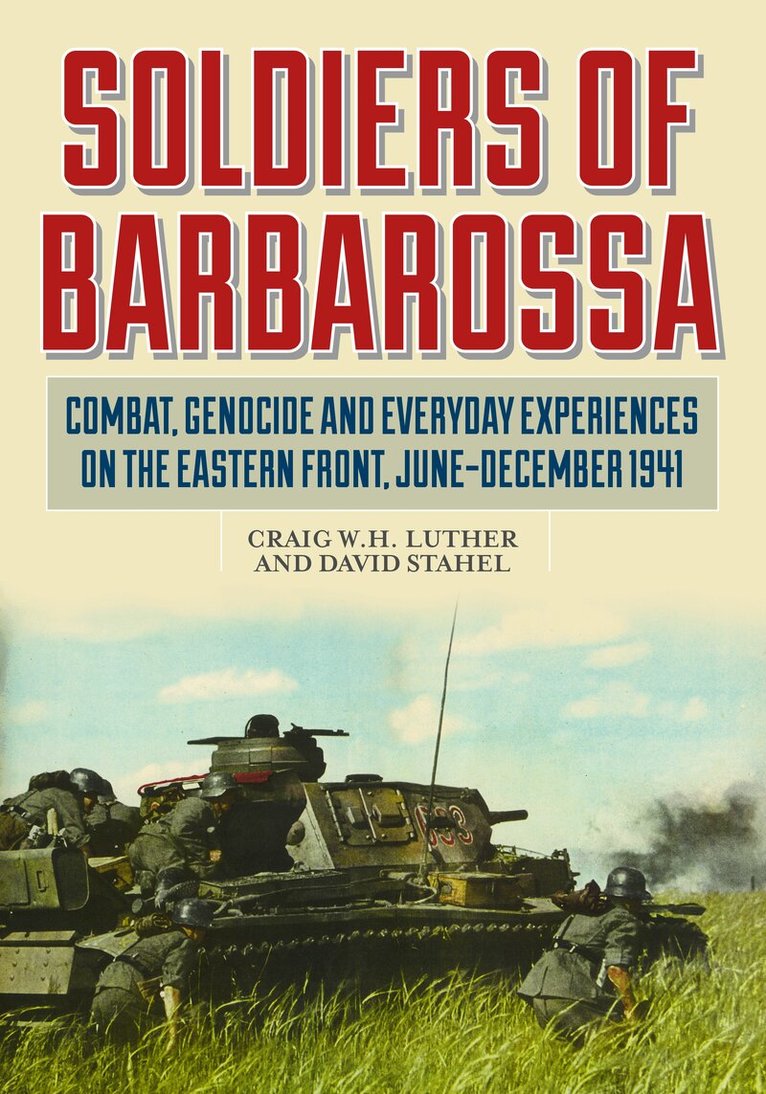
Soldiers of Barbarossa
Combat, Genocide, and Everyday Experiences on the Eastern Front, June–December 1941
Inbunden, Engelska, 2021
428 kr
Skickas inom 5-8 vardagar
In June 1941, the jaws of the German war machine clamped onto the Soviet Union, with German soldiers—the Third Reich’s teeth—slicing through the Red Army, encircling and killing and capturing. Before the end of the year, the Red Army halted the German blitzkrieg and saved the Soviet Union. It was a defining moment of World War II and a defining moment of military history—a defining moment of what it meant to go to war in the twentieth century, with an army designed to devastate, to kill, to enslave butting heads with an army decapitated by Stalin’s purges. For the next six months, German armies fought toward Moscow but ultimately failed to seize that objective, from the Black Sea in the south to Leningrad in the north. More than just a pivotal moment of World War II, more than just the beginning of the Eastern Front, the campaign toward Moscow—Germans versus Soviets in a no-holds-barred battle for the soul of Europe—speaks to what it meant to be a soldier in World War II. (Far more soldiers, German and Russian, fought and died on the Eastern Front than the entire U.S. war effort.) In a book drawing from hundreds of soldiers’ accounts, and thousands of letter and diaries, Stahel and Luther tell the story of Operation Barbarossa but also the story of men at war in the twentieth century.