Daniel Bertrand Monk - Böcker
Visar alla böcker från författaren Daniel Bertrand Monk. Handla med fri frakt och snabb leverans.
7 produkter
7 produkter
612 kr
Skickas inom 10-15 vardagar
"Who’s Afraid of ISIS?" eschews familiar debates about the status of ISIS as an existential threat to the West, with the aim of submitting those types of arguments to a reasoned examination of the political place of anxiety itself. This collection concerns itself with the doxologies that attend such arguments, or with that which, as Bourdieu wrote, "goes without saying becomes it comes without saying" and so become the unexamined points of departure for contentions about ISIS that may, for that very reason, hold entire life worlds together. This book was originally published as a special issue of Critical Studies on Security.
363 kr
Skickas inom 7-10 vardagar
In case studies focusing on contemporary crises spanning Africa, the Middle East, and Eastern Europe, the scholars in this volume examine the dominant prescriptive practices of late neoliberal post-conflict interventions—such as statebuilding, peacebuilding, transitional justice, refugee management, reconstruction, and redevelopment—and contend that the post-conflict environment is in fact created and sustained by this international technocratic paradigm of peacebuilding. Key international stakeholders—from activists to politicians, humanitarian agencies to financial institutions—characterize disparate sites as “weak,” “fragile,” or “failed” states and, as a result, prescribe peacebuilding techniques that paradoxically disable effective management of post-conflict spaces while perpetuating neoliberal political and economic conditions. Treating all efforts to represent post-conflict environments as problematic, the goal becomes understanding the underlying connection between post-conflict conditions and the actions and interventions of peacebuilding technocracies.
375 kr
Skickas inom 7-10 vardagar
In An Aesthetic Occupation Daniel Bertrand Monk unearths the history of the unquestioned political immediacy of “sacred” architecture in the conflict between Palestinians and Israelis. Monk combines groundbreaking archival research with theoretical insights to examine in particular the Mandate era-the period in the first half of the twentieth century when Britain held sovereignty over Palestine. While examining the relation between monuments and mass violence in this context, he documents Palestinian, Zionist, and British attempts to advance competing arguments concerning architecture’s utility to politics.Succumbing neither to the view that monuments are autonomous figures onto which political meaning has been projected, nor to the obverse claim that in Jerusalem shrines are immediate manifestations of the political, Monk traces the reciprocal history of both these positions as well as describes how opponents in the conflict debated and theorized their own participation in its self-representation. Analyzing controversies over the authenticity of holy sites, the restorations of the Dome of the Rock, and the discourse of accusation following the Buraq, or Wailing Wall, riots of 1929, Monk discloses for the first time that, as combatants looked to architecture and invoked the transparency of their own historical situation, they simultaneously advanced-and normalized-the conflict’s inability to account for itself.This balanced and unique study will appeal to anyone interested in Israel or Zionism, the Palestinians, the Middle East conflict, Jerusalem, or its monuments. Scholars of architecture, political theory, and religion, as well as cultural and critical studies will also be informed by its arguments.
2 073 kr
Skickas inom 10-15 vardagar
"Who’s Afraid of ISIS?" eschews familiar debates about the status of ISIS as an existential threat to the West, with the aim of submitting those types of arguments to a reasoned examination of the political place of anxiety itself. This collection concerns itself with the doxologies that attend such arguments, or with that which, as Bourdieu wrote, "goes without saying becomes it comes without saying" and so become the unexamined points of departure for contentions about ISIS that may, for that very reason, hold entire life worlds together. This book was originally published as a special issue of Critical Studies on Security.
130 kr
Skickas inom 7-10 vardagar
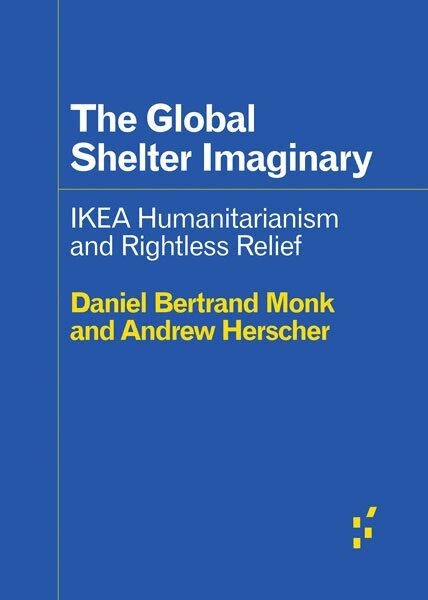
Examines how the humanitarian order advances a message of moral triumph and care while abandoning the dispossessedPrompted by a growing number of refugees and other displaced people, intersections of design and humanitarianism are proliferating. From the IKEA Foundation’s Better Shelter to Airbnb’s Open Homes program, the consumer economy has engaged the global refugee crisis with seemingly new tactics that normalize an institutionally sanctioned politics of evasion. Exploring “the global shelter imaginary,” this book charts the ways shelter functions as a form of rightless relief that expels recognition of the rights of the displaced and advances political paradoxes of displacement itself.
200 kr
Tillfälligt slut
Evil Paradises shows us the face of conspicuous consumption gone mad, exploring new developments that are being built from extreme global wealth. Although the case studies - which are drawn from around the world - read like science fiction, they are in fact all real. They include a gilded archipelago of private islands in Dubai and a two million acre private national park owned by Ted Turner. With an introduction by Mike Davis and contributions from Rebecca Solnit, Jon Wiener and others, this collection reveals the dark side of modern capitalism and the current building boom.
213 kr
Skickas inom 5-8 vardagar
It is all worse than we think. It is even worse than Mike Davis, for whom “every day is judgment day” (The Nation), could have imagined. The contributions to this volume are explorations of what Davis—in typical wry fashion—once referred to as the field of “disaster studies.” Collectively, they show how our “disaster imaginary” has been rendered inadequate by the existing order’s ability to feed off and coopt our resistance to it.Contemporary mass protests are now subsumed as instances of an established, profitable politics of rage. Geopolitical conflict poses not as a threat to hegemonic power but rather serves the interests of a global market which capitalizes on lucrative, permanent war. Climate change itself, if it was ever thought to be a universalizing phenomenon, is now treated as an extensive market opportunity by global risk insurance conglomerates and predatory lenders who bet against any rescue of the planet.Such catastrophic developments resist the language we use to describe and deconstruct them. The contributions to this volume seek to reimagine our understanding of disaster, and, following the example of Davis himself, to refuse outdated models of political transcendence as vigorously as they reject narratives of resignation.