Darlene Harbour Unrue - Böcker
Visar alla böcker från författaren Darlene Harbour Unrue. Handla med fri frakt och snabb leverans.
5 produkter
5 produkter
489 kr
Skickas inom 5-8 vardagar
Between 1920 and 1958 Katherine Anne Porter published more than sixty-five book review, many of which are now largely inaccessible. Although several such pieces have appeared in earlier collections of Porter's nonfiction writings, never have so many of Porter's reviews—nearly fifty—been made available in a single volume. Collectively the review reveal Porter's opinions on topics ranging from the nature of art and the place of the artist in politics and society to feminism and the role of female artists. Particularly evident in the reviews are the critical principles that guided her own work as well as her judgments of the works of other writers.In her introductory essay Darlene Harbour Unrue provides important biographical information on Porter, traces her career as a reviewer, and links critical assumptions in the reviews to the themes and techniques of Porter's fiction. Other scholars as well have regarded Porter's critical reviews as valuable tools both for analyzing the fiction and for constructing a portrait of Porter the artist, primarily because Porter produced so little fiction (three collections of short stories and novellas, Flowering Judas, The Leaning Tower, and Pale Horse, Pale Rider, and a novel, Ship of Fools). In the preface to the first collection of her nonfiction writings, The Days Before, Porter herself urged readers to look closely at her nonfiction, for there they would discover "the shape, direction, and connective tissue of a continuous, central interest and preoccupation of a lifetime."Most of the reviews—which appeared in such publications as the New York Herald Tribune, the New York Times, the Nation, and New Masses—she apparently undertook for financial reasons, but occasionally she would agree to review a friend's latest offering. She published no reviews after the success of her best-selling novel, Ship of Fools.Porter's scope as a reviewer was impressively broad. Because she lived in Mexico City during the revolution, had known Diego Rivera, and had studied "primitive" Mexican art, she was often called on to review books on Mexican art and on the revolution. Porter also reviewed many books by or about women. Her reviews of the Short Novels of Colette and Katharine Anthony's translation of Catherine the Great's memoirs are particularly noteworthy for her comments about women artists and her expression of admiration for women who flout traditional roles.These collected reviews illustrate the evolution of one of the most important American writers of the twentieth century and will interest not only Porter scholars but also anyone who appreciates her fiction.
560 kr
Skickas inom 5-8 vardagar
My stories are fragments of a larger plan, Katherine Anne Porter once wrote. And on another occasion she praised a critic who perceived that all her work, from the very beginning, was part of an "unbroken progression, all related."In Truth and Vision in Katherine Anne Porter's Fiction, Darlene Unrue examines the encompassing themes that underlie Porter's shorter fiction and that combined to create the haunting events of her complex metaphorical novel, Ship of Fools. Porter believed that men and women are compelled toward discovering the truth about their existence, but that the nature of our world makes those truths difficult to discern. In her writing, Unrue finds, Porter explored not only this basic human need to confront the truth, but also the bewilderment and suffering that are so often the results of failing to fulfill that need.Often in Porter's fiction the movement toward truth is obstructed by the hollow beliefs and illusions that abound in the world—by the seductions of ideology and dogmatic religion, by romantic love or the vision of a golden past. Clinging to such illusions, using them to lend a false coherence to their lives, Porter's characters are led away from the hard realization that truth requires accepting the existence of the unknowable at the center of life, and that what is knowable lies within themselves.Drawing on essays, reviews, letters, and notes, as well as on the intricate fabric of the fiction, this study traces Porter's pursuit of the truth through the creation of a body of fiction in which, from fragments of life, she could assemble an honest vision of the world.
397 kr
Skickas inom 7-10 vardagar
From the moment Katherine Anne Porter arrived on the American literary scene in 1922, the public was intrigued with her life. Yet she herself revealed only scant facts of her background and often gave conflicting accounts. She maintained, though, that a germ of her own experience lay at the core of everything she wrote. In Katherine Anne Porter: The Life of an Artist, Darlene Harbour Unrue finds that Porter's deceptions were a screen for deep personal turmoil. With unprecedented access to archival and personal papers, Unrue brings much new information to light. Porter's maternal grandmother was institutionalized; Porter had more marriages than she acknowledged; she lost babies to miscarriage, abortion, and stillbirth, and she grieved over her failed motherhood. Ever present were her fears of exile and insanity. Despite these constant fears, Porter (1890-1980) lived an extraordinary life that vaulted her from poverty and obscurity to wealth and the fame of being a best-selling author. She experienced or observed many of the major events of the twentieth century. So often on the move, she lived in Greenwich Village during its heyday as a hotbed of radical politics and experimental art, in Mexico during the cultural revolution of the 1920s, in Europe during the rise of Nazism, and in America during the Cold War. Thirteen years old when she first rode in an automobile and saw an airplane, she was invited in her last decade to observe and write about the launching of the final Apollo space ship. Asked to summarize her own life, Porter was fond of quoting Madame Du Barry: ""My life has been incredible. I don't believe a word of it!"" Darlene Harbour Unrue is a professor of English at the University of Nevada in Las Vegas. She has written several books on Katherine Anne Porter, including Understanding Katherine Anne Porter and Truth and Vision in Katherine Anne Porter's Fiction.
1 251 kr
Skickas inom 10-15 vardagar
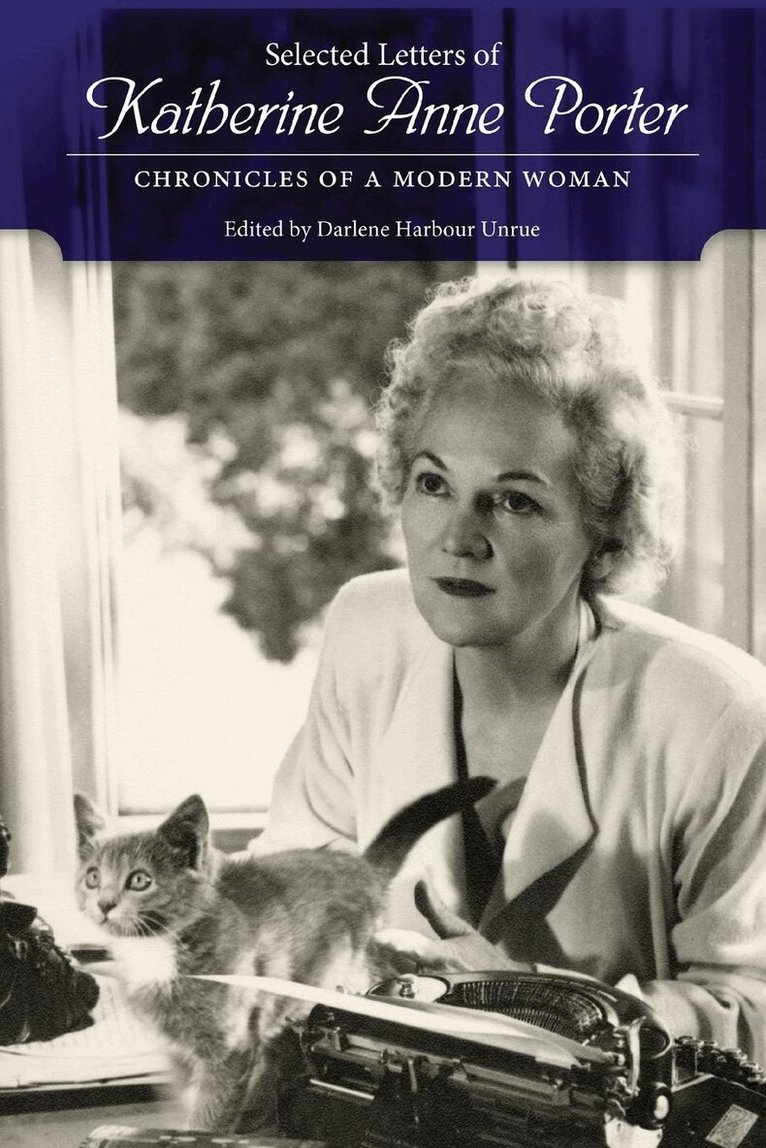
Katherine Anne Porter (1890-1980) produced a relatively small body of fiction, but she wrote thousands and thousands of letters. The present selection of 135 unexpurgated letters, written to seventy-four different persons, begins with a 1916 letter written from a tuberculosis sanatorium in Texas and ends with a 1979 letter dictated to an unnamed nursing-home attendant in Maryland. Different from any previous selection, this body of letters does not omit Porter's frank criticism of fellow writers and spans her entire life. Within that circumscription is the chronicle of Porter, a twentieth-century woman searching for love while she struggles to become the writer she is sure she can be. Porter's letters vividly showcase the twentieth century as the writer observes it from her historical vantage points--tuberculosis sanatoria and the influenza pandemic of 1918; the leftist community in Greenwich Village in the 1920s; the Mexican cultural revolution of the 1920s and early 1930s; the expatriate community in Paris in the 1930s; the rise of Nazism in Europe between the World Wars; the Second World War and its concomitant suppression of civil liberties; Hollywood and the university circuit as a haven for financially strapped writers in the 1940s and 1950s; the Cold War and its competition for supremacy in space; the Women's Rights and the Civil Rights movements; and the evolution and demise of literary modernism.
389 kr
Skickas inom 10-15 vardagar
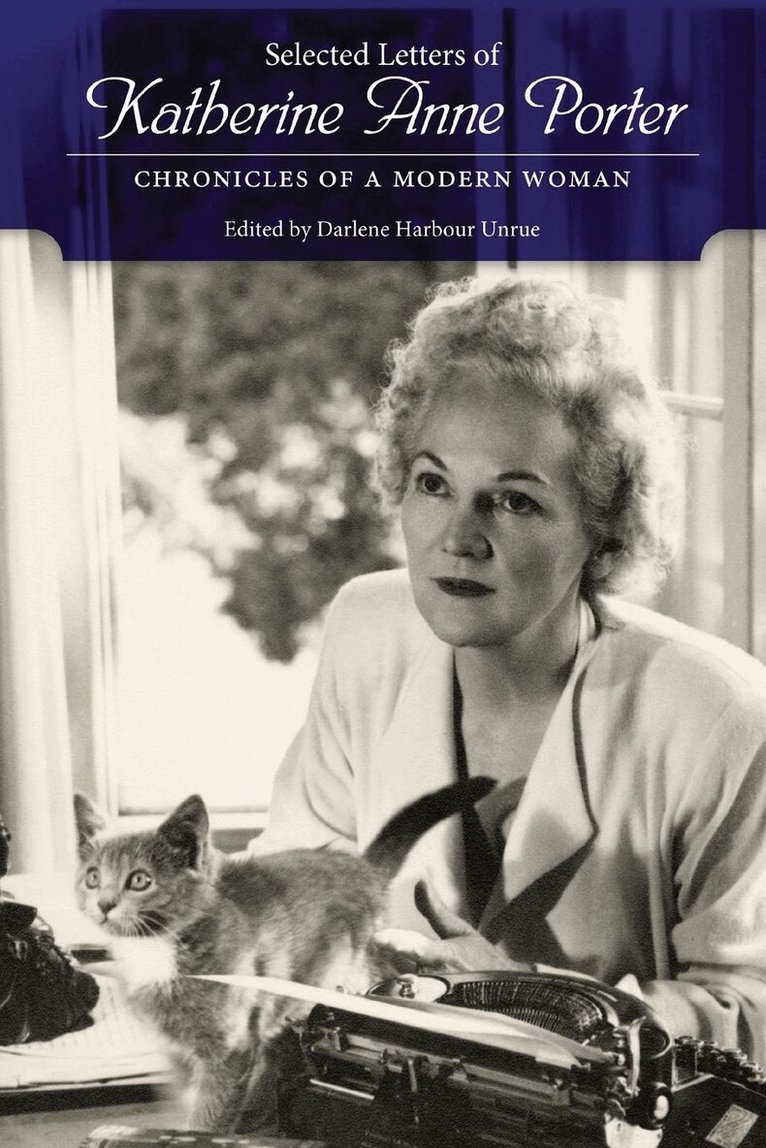
Katherine Anne Porter (1890-1980) produced a relatively small body of fiction, but she wrote thousands and thousands of letters. The present selection of 135 unexpurgated letters, written to seventy-four different persons, begins with a 1916 letter written from a tuberculosis sanatorium in Texas and ends with a 1979 letter dictated to an unnamed nursing-home attendant in Maryland. Different from any previous selection, this body of letters does not omit Porter's frank criticism of fellow writers and spans her entire life. Within that circumscription is the chronicle of Porter, a twentieth-century woman searching for love while she struggles to become the writer she is sure she can be. Porter's letters vividly showcase the twentieth century as the writer observes it from her historical vantage points--tuberculosis sanatoria and the influenza pandemic of 1918; the leftist community in Greenwich Village in the 1920s; the Mexican cultural revolution of the 1920s and early 1930s; the expatriate community in Paris in the 1930s; the rise of Nazism in Europe between the World Wars; the Second World War and its concomitant suppression of civil liberties; Hollywood and the university circuit as a haven for financially strapped writers in the 1940s and 1950s; the Cold War and its competition for supremacy in space; the Women's Rights and the Civil Rights movements; and the evolution and demise of literary modernism.