David Domke – författare
Visar alla böcker från författaren David Domke. Handla med fri frakt och snabb leverans.
3 produkter
3 produkter
Inbunden, Engelska, 2007
805 kr
Skickas inom 5-8 vardagar
In The God Strategy, David Domke and Kevin Coe offer a timely and dynamic study of the rise of religion in American politics, examining the public messages of political leaders over the past seventy-five years--from the 1932 election of Franklin Roosevelt to the early stages of the 2008 presidential race. They conclude that U.S. politics today is defined by a calculated, deliberate, and partisan use of faith that is unprecedented in modern politics. Sectarian influences and expressions of faith have always been part of American politics, the authors observe, but a profound change occurred beginning with the election of Ronald Reagan in 1980. What has developed since is a no-holds-barred religious politics that seeks to attract voters, identify and attack enemies, and solidify power. Domke and Coe identify a set of religious signals sent by both Republicans and Democrats in speeches, party platforms, proclamations, visits to audiences of faith, and even celebrations of Christmas. Sometimes these signals are intended for the eyes and ears of all Americans, and other times they are distinctly targeted to specific segments of the population. It's an approach that has been remarkably successful, utilized first and most extensively by the Republican Party to capture unprecedented power and then adopted by the Democratic Party, most notably by Bill Clinton in the 1990s and by a wide range of Democrats in the 2006 elections. "For U.S. politicians today, having faith isn't enough; it must be displayed, carefully and publicly. This is a stark transformation in recent decades," write Domke and Coe. With innovative, accessible research and analytical verve, they document how this has occurred, who has done it and why, and what it means for the American experiment in democracy.
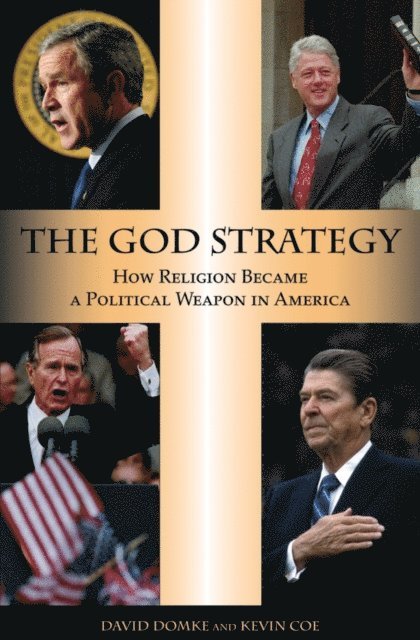
Häftad, Engelska, 2010
305 kr
Skickas inom 5-8 vardagar
This volume offers a timely and dynamic study of the rise of religion in American politics, examining the public messages of political leaders over the past seventy-five years. The authors show that U.S. politics today is defined by a calculated, deliberate, and partisan use of faith that is unprecedented in modern politics. Beginning with the election of Ronald Reagan in 1980, America has seen a no-holds-barred religious politics that seeks to attract voters, identify and attack enemies, and solidify power. Domke and Coe identify a set of religious signals sent by both Republicans and Democrats in speeches, party platforms, proclamations, visits to audiences of faith, and even celebrations of Christmas. The updated edition of this ground-breaking book includes a new preface, an updated analysis of the last Bush administration, as well as a new final chapter on the Jeremiah Wright controversy, the candidacies of Mike Huckabee and Sarah Palin, and Barack Obama's victory.
Häftad, Engelska, 2004
279 kr
Skickas inom 5-8 vardagar
The political fundamentalism, offered up by the Bush administration after 9/11, capitalised upon the fear felt by many Americans. In essence, it is a conservative-religious ideology, but via strategic communication choices, it was transformed into a policy agenda that feels political rather than religious. These communications dominated public discourse and public opinion for months on end and came at a significant cost for democracy.The administration had help spreading its messages. The mainstream press consistently echoed the administration's communications - thereby disseminating, reinforcing and embedding the administration's fundamentalist worldview and helping to keep at bay Congress and any substantive public questioning. This book analyzes hundreds of administration communications and news stories from September 2001 to Iraq in spring 2003 to examine how this occurred and what it means for U.S. politics and the global landscape.