David. H Wolpert – författare
Visar alla böcker från författaren David. H Wolpert. Handla med fri frakt och snabb leverans.
12 produkter
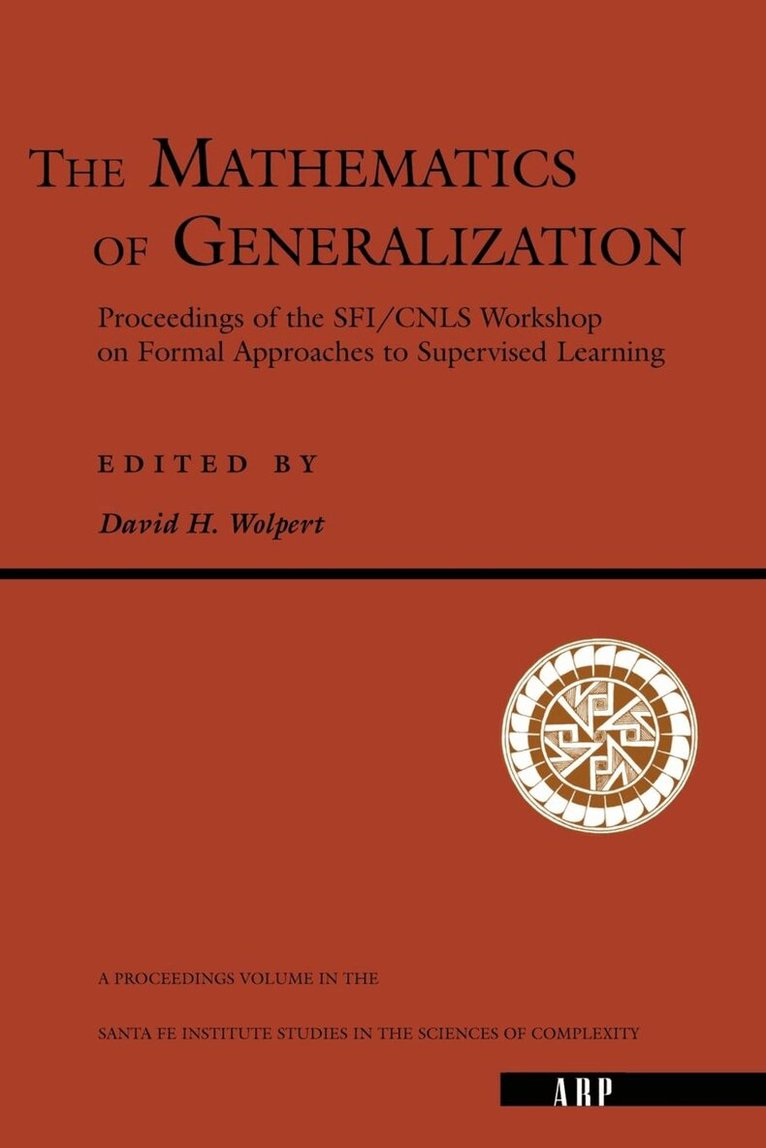
Mathematics Of Generalization
Häftad, 1995
1012 kr
Lägg i varukorg
This book provides different mathematical frameworks for addressing supervised learning. It is based on a workshop held under the auspices of the Center for Nonlinear Studies at Los Alamos and the Santa Fe Institute in the summer of 1992.
Mathematics Of Generalization
Inbunden, 2019
2504 kr
Lägg i varukorg
This book provides different mathematical frameworks for addressing supervised learning. It is based on a workshop held under the auspices of the Center for Nonlinear Studies at Los Alamos and the Santa Fe Institute in the summer of 1992.
Mathematics Of Generalization
E-bok, 2018
1204 kr
Lägg i varukorg
This book provides different mathematical frameworks for addressing supervised learning. It is based on a workshop held under the auspices of the Center for Nonlinear Studies at Los Alamos and the Santa Fe Institute in the summer of 1992.
Mathematics Of Generalization
E-bok, 2018
1231 kr
Lägg i varukorg
This book provides different mathematical frameworks for addressing supervised learning. It is based on a workshop held under the auspices of the Center for Nonlinear Studies at Los Alamos and the Santa Fe Institute in the summer of 1992.
Energetics of Computing in Life and Machines
Av David H Wolpert, Chris Kempes m. fl.
Inbunden, 2019
357 kr
Lägg i varukorg
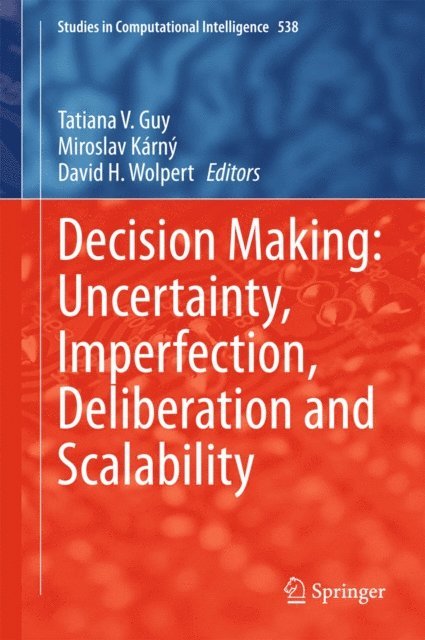
Decision Making: Uncertainty, Imperfection, Deliberation and Scalability
Av Tatiana V. Guy, Miroslav Kárný m. fl.
Inbunden, 2015
1130 kr
Lägg i varukorg
This volume focuses on uncovering the fundamental forces underlying dynamic decision making among multiple interacting, imperfect and selfish decision makers.The chapters are written by leading experts from different disciplines, all considering the many sources of imperfection in decision making, …
Decision Making: Uncertainty, Imperfection, Deliberation and Scalability
Av David H. Wolpert, Miroslav Karny m. fl.
E-bok, 2015
1502 kr
Lägg i varukorg
This volume focuses on uncovering the fundamental forces underlying dynamic decision making among multiple interacting, imperfect and selfish decision makers. The chapters are written by leading experts from different disciplines, all considering the many sources of imperfection in decision making, …
Decision Making: Uncertainty, Imperfection, Deliberation and Scalability
Av Tatiana V. Guy, Miroslav Kárný m. fl.
Häftad, 2016
1130 kr
Lägg i varukorg
This volume focuses on uncovering the fundamental forces underlying dynamic decision making among multiple interacting, imperfect and selfish decision makers.The chapters are written by leading experts from different disciplines, all considering the many sources of imperfection in decision making, …
Decision Making with Imperfect Decision Makers
Av Tatiana Valentine Guy, Miroslav Kárný m. fl.
Inbunden, 2011
1692 kr
Lägg i varukorg
Prescriptive Bayesian decision making has reached a high level of maturity and is well-supported algorithmically. However, experimental data shows that real decision makers choose such Bayes-optimal decisions surprisingly infrequently, often making decisions that are badly sub-optimal. So prevalent …
Decision Making with Imperfect Decision Makers
Av David H. Wolpert, Miroslav Karny m. fl.
E-bok, 2011
2174 kr
Lägg i varukorg
Prescriptive Bayesian decision making has reached a high level of maturity and is well-supported algorithmically. However, experimental data shows that real decision makers choose such Bayes-optimal decisions surprisingly infrequently, often making decisions that are badly sub-optimal. So prevalent …
Decision Making with Imperfect Decision Makers
Av Tatiana Valentine Guy, Miroslav Kárný m. fl.
Häftad, 2016
1692 kr
Lägg i varukorg
Prescriptive Bayesian decision making has reached a high level of maturity and is well-supported algorithmically. However, experimental data shows that real decision makers choose such Bayes-optimal decisions surprisingly infrequently, often making decisions that are badly sub-optimal. So prevalent …