David J. Benson – författare
Visar alla böcker från författaren David J. Benson. Handla med fri frakt och snabb leverans.
8 produkter
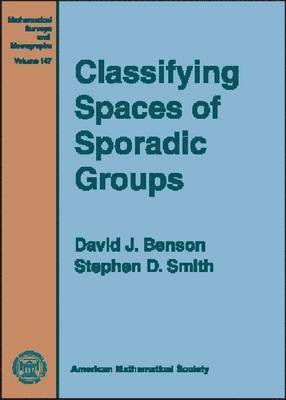
Classifying Spaces of Sporadic Groups
Av David J. Benson, Stephen D. Smith
Inbunden, 2008
1546 kr
Lägg i varukorg
For each of the 26 sporadic finite simple groups, the authors construct a 2-completed classifying space using a homotopy decomposition in terms of classifying spaces of suitable 2-local subgroups. This construction leads to an additive decomposition of the mod 2 group cohomology. The authors also …
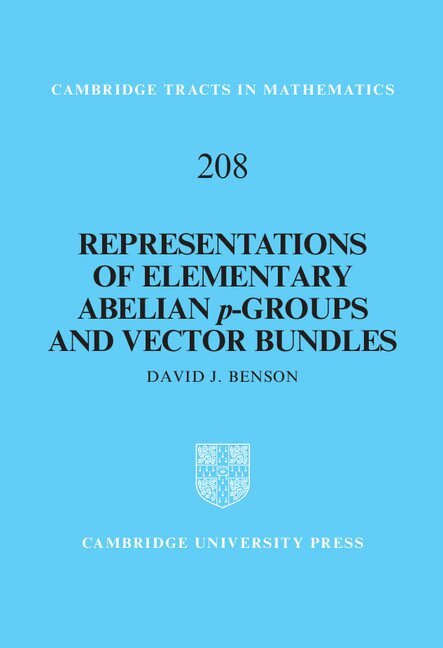
Representations of Elementary Abelian p-Groups and Vector Bundles
Inbunden, 2016
1944 kr
Lägg i varukorg
Questions about modular representation theory of finite groups can often be reduced to elementary abelian subgroups. This is the first book to offer a detailed study of the representation theory of elementary abelian groups, bringing together information from many papers and journals, as well as …
Arbitrary Lagrangian Eulerian and Fluid-Structure Interaction
Numerical Simulation
Av David J. Benson, M'hamed Souli
E-bok, 2013
2265 kr
Lägg i varukorg
This book provides the fundamental basics for solving fluid structure interaction problems, and describes different algorithms and numerical methods used to solve problems where fluid and structure can be weakly or strongly coupled. These approaches are illustrated with examples arising from …
Arbitrary Lagrangian Eulerian and Fluid-Structure Interaction
Numerical Simulation
Av David J. Benson, M'hamed Souli
E-bok, 2013
2216 kr
Lägg i varukorg
This book provides the fundamental basics for solving fluid structure interaction problems, and describes different algorithms and numerical methods used to solve problems where fluid and structure can be weakly or strongly coupled. These approaches are illustrated with examples arising from …
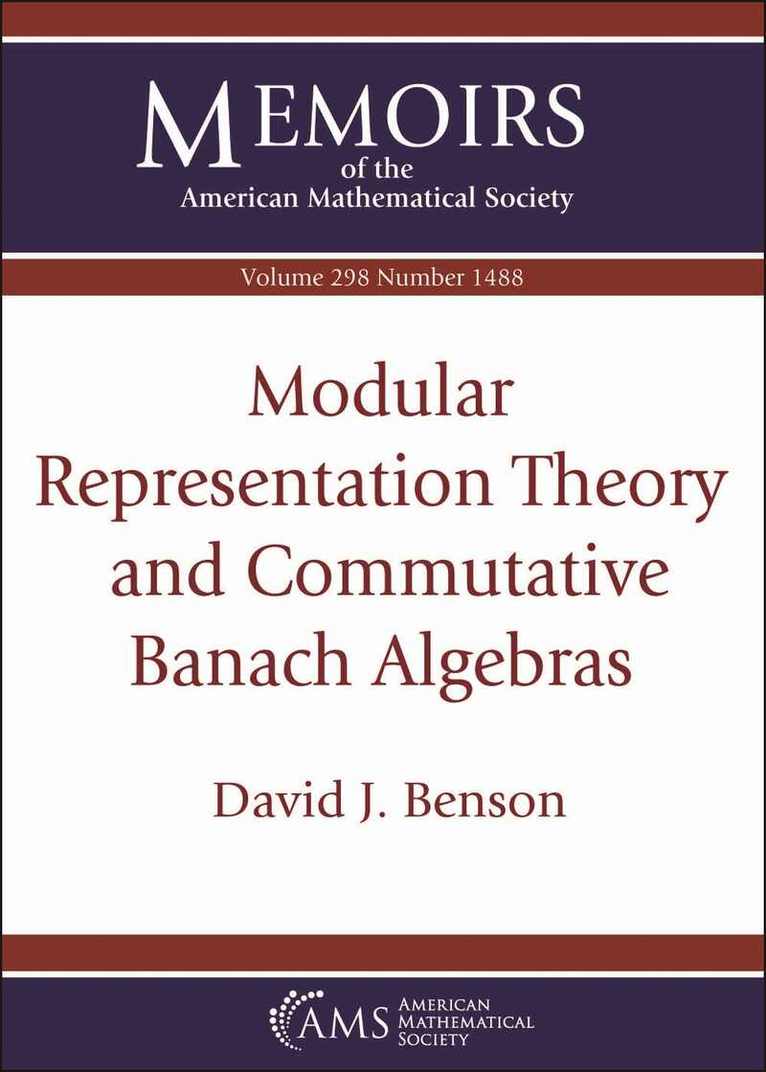
Modular Representation Theory and Commutative Banach Algebras
Häftad, 2024
1032 kr
Lägg i varukorg
The Memoirs of the AMS is devoted to the publication of new research in all areas of pure and applied mathematics. The Memoirs is designed particularly to publish long papers of groups of cognate papers in book form, and is under the supervision of the Editorial Committee of the AMS journal …
Arbitrary Lagrangian Eulerian and Fluid-Structure Interaction
Numerical Simulation
Av M'hamed Souli, David J. Benson
Inbunden, 2010
1925 kr
Lägg i varukorg
This book provides the fundamental basics for solving fluid structure interaction problems, and describes different algorithms and numerical methods used to solve problems where fluid and structure can be weakly or strongly coupled.These approaches are illustrated with examples arising from …
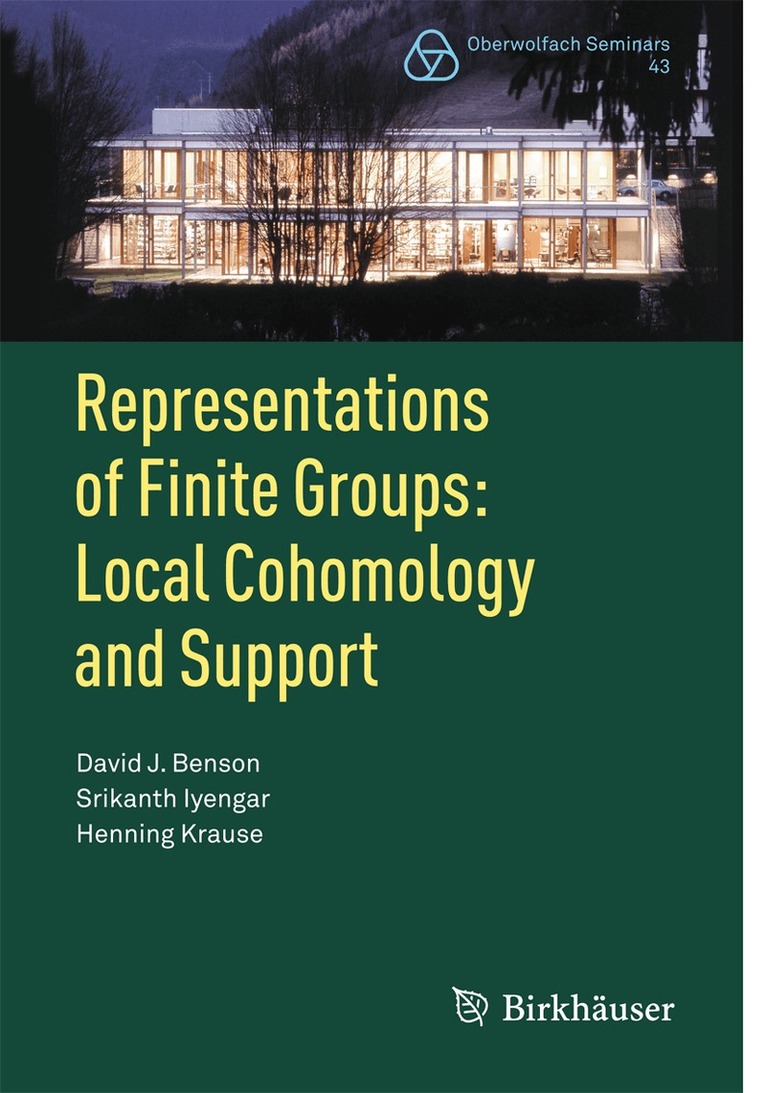
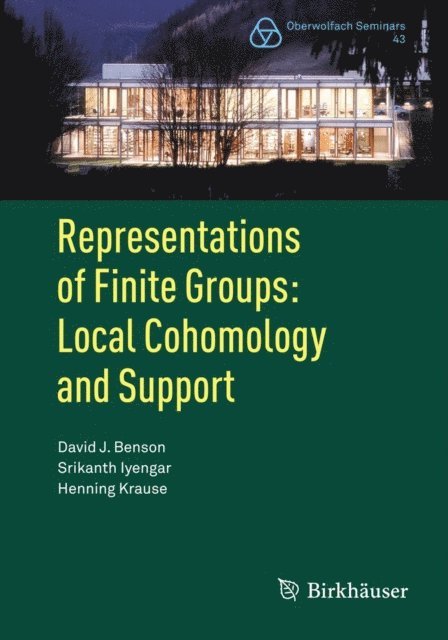
Representations of Finite Groups: Local Cohomology and Support
Av David J. Benson, Srikanth Iyengar m. fl.
Häftad, 2011
334 kr
Lägg i varukorg
The seminar focuses on a recent solution, by the authors, of a long standing problem concerning the stable module category (of not necessarily finite dimensional representations) of a finite group. The proof draws on ideas from commutative algebra, cohomology of groups, and stable homotopy theory. …
Representations of Finite Groups: Local Cohomology and Support
Av Henning Krause, Srikanth Iyengar m. fl.
E-bok, 2011
431 kr
Lägg i varukorg
The seminar focuses on a recent solution, by the authors, of a long standing problem concerning the stable module category (of not necessarily finite dimensional representations) of a finite group. The proof draws on ideas from commutative algebra, cohomology of groups, and stable homotopy theory. …