David L. Sloss - Böcker
Visar alla böcker från författaren David L. Sloss. Handla med fri frakt och snabb leverans.
7 produkter
7 produkter
1 565 kr
Skickas inom 5-8 vardagar
This book grows out of the work of a study group convened by the American Branch of the International Law Association. The group had a mandate to examine threats to the rules-based international order and possible responses. The several chapters in the book-all of which are written by distinguished international law scholars--generally support the conclusion that the rules-based international order confronts significant challenges, but it is not unraveling--at least, not yet. Climate change is the biggest wild card in trying to predict the future. If the world's major powers--especially the United States and China--cooperate with each other to combat climate change, then other threats to the rules-based order should be manageable. If the world's major powers fail to address the climate crisis by 2040 or 2050, the other threats addressed in this volume may come to be seen as trivial in comparison.The book consists of fourteen chapters, plus an introduction. Three chapters address specific threats to the rules-based international order: climate change, autonomous weapons, and cyber weapons. Eight chapters address particular substantive areas of international law: jus ad bellum, jus in bello, trade law, investment law, anti-bribery law, human rights law, international criminal law, and migration law. The remaining chapters provide a range of perspectives on the past evolution and likely future development of the rules-based international order as a whole.
1 216 kr
Skickas inom 5-8 vardagar
This book provides the first detailed history of the Constitution's treaty supremacy rule. It describes a process of invisible constitutional change. The treaty supremacy rule was a bedrock principle of constitutional law for more than 150 years. It provided that treaties are supreme over state law and that courts have a constitutional duty to apply treaties that conflict with state laws. The rule ensured that state governments did not violate U.S. treaty obligations without authorization from the federal political branches. In 1945, the United States ratified the UN Charter, which obligates nations to promote human rights for all without distinction as to race. In 1950, a California court applied the Charters human rights provisions along with the traditional supremacy rule to invalidate a state law that discriminated against Japanese nationals. The implications were shocking: the decision implied that the United States had abrogated Jim Crow laws throughout the South by ratifying the UN Charter. Conservatives reacted by lobbying for a constitutional amendment, known as the Bricker Amendment, to abolish the treaty supremacy rule. The amendment never passed, but Bricker's supporters achieved their goals through de facto constitutional change. Before 1945, the treaty supremacy rule was a mandatory constitutional rule that applied to all treaties. The de facto Bricker Amendment converted the rule into an optional rule that applies only to self-executing treaties. Under the modern rule, state governments are allowed to violate national treaty obligationsincluding international human rights obligationsthat are embodied in non-self-executing treaties.
1 702 kr
Skickas inom 7-10 vardagar
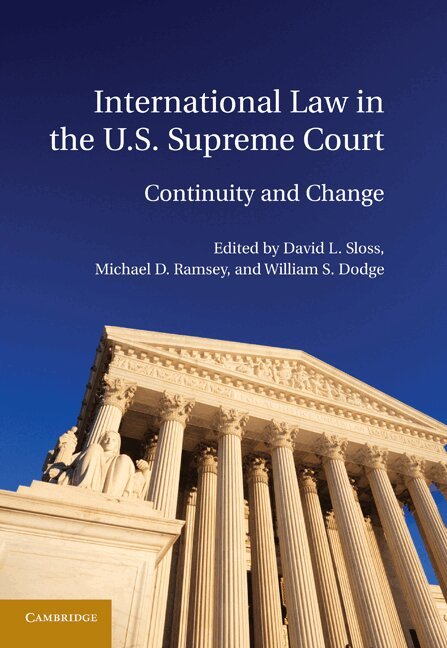
From its earliest decisions in the 1790s, the US Supreme Court has used international law to help resolve major legal controversies. This book presents a comprehensive account of the Supreme Court's use of international law from its inception to the present day. Addressing treaties, the direct application of customary international law and the use of international law as an interpretive tool, this book examines all the cases or lines of cases in which international law has played a material role, showing how the Court's treatment of international law both changed and remained consistent over the period. Although there was substantial continuity in the Supreme Court's international law doctrine through the end of the nineteenth century, the past century has been a time of tremendous doctrinal change. Few aspects of the Court's international law doctrine remain the same in the twenty-first century as they were two hundred years ago.
1 036 kr
Skickas inom 7-10 vardagar
The Constitution divides power between the government and We the People. It grants We the People an affirmative, collective right to exercise control over the government through our elected representatives. The Supreme Court has abused its power of judicial review and subverted popular control of the government. The Court's doctrine divides constitutional law into rights issues and structural issues. Structural constitutional doctrine ignores the Constitution's division of power between the government and We the People. The Court's rights doctrines fail to recognize that the Constitution grants the People an affirmative, collective right to exercise control over our government. People v. The Court presents an indictment of the Supreme Court's constitutional doctrine. It also provides a set of proposals for revolutionary changes in the practice of judicial review that are designed to enable We the People to reclaim our rightful place as sovereigns in a democratic, constitutional order.
319 kr
Skickas inom 7-10 vardagar
The Constitution divides power between the government and We the People. It grants We the People an affirmative, collective right to exercise control over the government through our elected representatives. The Supreme Court has abused its power of judicial review and subverted popular control of the government. The Court's doctrine divides constitutional law into rights issues and structural issues. Structural constitutional doctrine ignores the Constitution's division of power between the government and We the People. The Court's rights doctrines fail to recognize that the Constitution grants the People an affirmative, collective right to exercise control over our government. People v. The Court presents an indictment of the Supreme Court's constitutional doctrine. It also provides a set of proposals for revolutionary changes in the practice of judicial review that are designed to enable We the People to reclaim our rightful place as sovereigns in a democratic, constitutional order.
588 kr
Skickas inom 7-10 vardagar
From its earliest decisions in the 1790s, the US Supreme Court has used international law to help resolve major legal controversies. This book presents a comprehensive account of the Supreme Court's use of international law from its inception to the present day. Addressing treaties, the direct application of customary international law and the use of international law as an interpretive tool, this book examines all the cases or lines of cases in which international law has played a material role, showing how the Court's treatment of international law both changed and remained consistent over the period. Although there was substantial continuity in the Supreme Court's international law doctrine through the end of the nineteenth century, the past century has been a time of tremendous doctrinal change. Few aspects of the Court's international law doctrine remain the same in the twenty-first century as they were two hundred years ago.
300 kr
Skickas inom 10-15 vardagar
A look inside the weaponization of social media, and an innovative proposal for protecting Western democracies from information warfare.When Facebook, Twitter, YouTube, and Instagram were first introduced to the public, their mission was simple: they were designed to help people become more connected to each other. Social media became a thriving digital space by giving its users the freedom to share whatever they wanted with their friends and followers. Unfortunately, these same digital tools are also easy to manipulate. As exemplified by Russia's interference in the 2016 U.S. presidential election, authoritarian states can exploit social media to interfere with democratic governance in open societies. Tyrants on Twitter is the first detailed analysis of how Chinese and Russian agents weaponize Facebook, Instagram, Twitter, and YouTube to subvert the liberal international order. In addition to examining the 2016 U.S. election, David L. Sloss explores Russia's use of foreign influence operations to threaten democracies in Europe, as well as China's use of social media and other digital tools to meddle in Western democracies and buttress autocratic rulers around the world. Sloss calls for cooperation among democratic governments to create a new transnational system for regulating social media to protect Western democracies from information warfare. Drawing on his professional experience as an arms control negotiator, he outlines a novel system of transnational governance that Western democracies can enforce by harmonizing their domestic regulations. And drawing on his academic expertise in constitutional law, he explains why that system—if implemented by legislation in the United States—would be constitutionally defensible, despite likely First Amendment objections. With its critical examination of information warfare and its proposal for practical legislative solutions to fight back, this book is essential reading in a time when disinformation campaigns threaten to undermine democracy.