David W. Brady – författare
Visar alla böcker från författaren David W. Brady. Handla med fri frakt och snabb leverans.
13 produkter
13 produkter
Inbunden, Engelska, 2019
2 151 kr
Skickas inom 10-15 vardagar
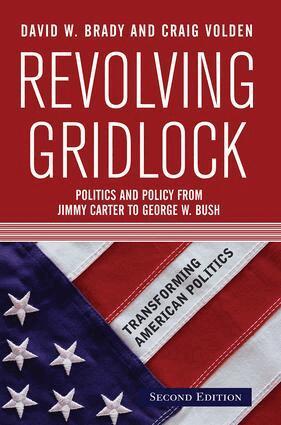
Despite the early prospects for bipartisan unity on terrorism initiatives, government gridlock continues on most major issues in the wake of the 2004 elections. In this fully revised edition, political scientists David W. Brady and Craig Volden demonstrate that gridlock is not a product of divided government, party politics, or any of the usual scapegoats. It is, instead, an instrumental part of American government, built into our institutions and sustained by leaders acting rationally not only to achieve set goals but to thwart foolish inadvertencies. Looking at key legislative issues from the divided government under Reagan, through Clinton's Democratic government to complete unified Republican control under George W. Bush, the authors clearly and carefully analyze important crux points in lawmaking: the swing votes, the veto, the filibuster, and the rise of tough budget politics. They show that when it comes to government gridlock, it doesn't matter who's in the White House or who's in control of Congress; it's as American as apple pie, and its results may ultimately be as sweet in ensuring stability and democracy.
Inbunden, Engelska, 1988
1 413 kr
Skickas inom 10-15 vardagar
A Stanford University Press classic.
Häftad, Engelska, 1991
327 kr
Skickas inom 5-8 vardagar
A Stanford University Press classic.
Inbunden, Engelska, 2000
1 522 kr
Skickas inom 10-15 vardagar
For two decades, extending from the early 1970s to the early 1990s, elections to the U.S. House of Representatives were highly predictable. More than 90 percent of incumbents would seek reelection and more than 90 percent of those incumbents would win—by larger vote margins than in earlier decades. The once-dependable presidential coattail effect diminished, as one-quarter to one-third of all voters split their tickets, supporting presidential and House candidates of different parties. These trends helped the Democrats retain control of the House even while Republican presidential candidates won five of six elections beginning in 1968. An era of "incumbency and insulation" seemed firmly in place.Then came the 1994 midterm elections. The Republicans gained 52 seats in the House, taking control for the first time in 40 years. Incumbency appeared to have lost its semi-magical status as three dozen incumbents fell. Insulation, too, appeared to have failed, with all the losing incumbents being Democrats, most of them from districts where President Clinton had run poorly in 1992. But did 1994 herald a new era, or was it an aberration?In some ways, the 1996 elections, which reelected President Clinton, ratified the 1994 upheaval. Republicans retained control of the House, despite the decline of ticket-splitting as more voters aligned their presidential and House voting decisions. The 1998 election results added to the picture of a new era in congressional elections as the presidential party gained seats in a midterm election for the first time since 1934.Most of the essays in this volume closely examine these recent elections, documenting the erosion of incumbency and insulation, but pointing out important continuities as well. Other essays address the electoral consequences of political change in the South, majority-minority redistricting, PAC contributions, and the changing image of Congress.
Häftad, Engelska, 2000
367 kr
Skickas inom 5-8 vardagar
For two decades, extending from the early 1970s to the early 1990s, elections to the U.S. House of Representatives were highly predictable. More than 90 percent of incumbents would seek reelection and more than 90 percent of those incumbents would win—by larger vote margins than in earlier decades. The once-dependable presidential coattail effect diminished, as one-quarter to one-third of all voters split their tickets, supporting presidential and House candidates of different parties. These trends helped the Democrats retain control of the House even while Republican presidential candidates won five of six elections beginning in 1968. An era of "incumbency and insulation" seemed firmly in place.Then came the 1994 midterm elections. The Republicans gained 52 seats in the House, taking control for the first time in 40 years. Incumbency appeared to have lost its semi-magical status as three dozen incumbents fell. Insulation, too, appeared to have failed, with all the losing incumbents being Democrats, most of them from districts where President Clinton had run poorly in 1992. But did 1994 herald a new era, or was it an aberration?In some ways, the 1996 elections, which reelected President Clinton, ratified the 1994 upheaval. Republicans retained control of the House, despite the decline of ticket-splitting as more voters aligned their presidential and House voting decisions. The 1998 election results added to the picture of a new era in congressional elections as the presidential party gained seats in a midterm election for the first time since 1934.Most of the essays in this volume closely examine these recent elections, documenting the erosion of incumbency and insulation, but pointing out important continuities as well. Other essays address the electoral consequences of political change in the South, majority-minority redistricting, PAC contributions, and the changing image of Congress.
Inbunden, Engelska, 2002
2 458 kr
Skickas inom 10-15 vardagar
In recent decades, political scientists have produced an enormous body of scholarship dealing with the U.S. Congress, and in particular congressional organization. However, most of this research has focused on Congress in the twentieth century—especially the post-New Deal era—and the long history of Congress has been largely neglected. The contributors to this book demonstrate that this inattention to congressional history has denied us many rich opportunities to more fully understand the evolution and functioning of the modern Congress. In striking contrast to the modern era, which is marked by only modest partisan realignment and institutional change, the period preceding the New Deal was a time of rapid and substantial change in Congress. During the nation's first 150 years, parties emerged, developed, and realigned; the standing rules of the House and Senate expanded and underwent profound changes; the workload of Congress increased dramatically; and both houses grew considerably in size. Studying history is valuable in large part because it allows scholars to observe greater variation in many of the parameters of their theories, and to test their core assumptions. A historical approach pushes scholars to recognize and confront the limits of their theories, resulting in theories that have increased validity and broader applicability. Thus, incorporating history into political science gives us a more dynamic view of Congress than the relatively static picture that emerges from a strict focus on recent periods. Each contributor engages one of three general questions that have animated the literature on congressional politics in recent years: What is the role of party organizations in policy making? In what ways have congressional process and procedure changed over the years? How does congressional process and procedure affect congressional politics and policy?
Häftad, Engelska, 2002
584 kr
Skickas inom 5-8 vardagar
In recent decades, political scientists have produced an enormous body of scholarship dealing with the U.S. Congress, and in particular congressional organization. However, most of this research has focused on Congress in the twentieth century—especially the post-New Deal era—and the long history of Congress has been largely neglected. The contributors to this book demonstrate that this inattention to congressional history has denied us many rich opportunities to more fully understand the evolution and functioning of the modern Congress. In striking contrast to the modern era, which is marked by only modest partisan realignment and institutional change, the period preceding the New Deal was a time of rapid and substantial change in Congress. During the nation's first 150 years, parties emerged, developed, and realigned; the standing rules of the House and Senate expanded and underwent profound changes; the workload of Congress increased dramatically; and both houses grew considerably in size. Studying history is valuable in large part because it allows scholars to observe greater variation in many of the parameters of their theories, and to test their core assumptions. A historical approach pushes scholars to recognize and confront the limits of their theories, resulting in theories that have increased validity and broader applicability. Thus, incorporating history into political science gives us a more dynamic view of Congress than the relatively static picture that emerges from a strict focus on recent periods. Each contributor engages one of three general questions that have animated the literature on congressional politics in recent years: What is the role of party organizations in policy making? In what ways have congressional process and procedure changed over the years? How does congressional process and procedure affect congressional politics and policy?
Inbunden, Engelska, 2007
1 954 kr
Skickas inom 10-15 vardagar
This work addresses the development of congressional practices and institutions and ties the changes to key political and economic events. In connecting political and economic events with changes in Congress, the authors examine the political economy of the history of Congress. They draw upon history to offer insights about contemporary issues such as party polarization, filibuster reform, direct election of politicians, intercameral bargaining, and the role of committees in the political process. Through this approach the authors help us to understand how politics and economics interact to affect Congress.
Häftad, Engelska, 2007
474 kr
Skickas inom 5-8 vardagar
This work addresses the development of congressional practices and institutions and ties the changes to key political and economic events. In connecting political and economic events with changes in Congress, the authors examine the political economy of the history of Congress. They draw upon history to offer insights about contemporary issues such as party polarization, filibuster reform, direct election of politicians, intercameral bargaining, and the role of committees in the political process. Through this approach the authors help us to understand how politics and economics interact to affect Congress.
Häftad, Engelska, 2005
588 kr
Skickas inom 10-15 vardagar
Despite the early prospects for bipartisan unity on terrorism initiatives, government gridlock continues on most major issues in the wake of the 2004 elections. In this fully revised edition, political scientists David W. Brady and Craig Volden demonstrate that gridlock is not a product of divided government, party politics, or any of the usual scapegoats. It is, instead, an instrumental part of American government,built into our institutions and sustained by leaders acting rationally not only to achieve set goals but to thwart foolish inadvertencies. Looking at key legislative issues from the divided government under Reagan, through Clinton's Democratic government to complete unified Republican control under George W. Bush, the authors clearly and carefully analyze important crux points in lawmaking: the swing votes, the veto, the filibuster, and the rise of tough budget politics. They show that when it comes to government gridlock, it doesn't matter who's in the White House or who's in control of Congress it's as American as apple pie, and its results may ultimately be as sweet in ensuring stability and democracy.
Häftad, Engelska, 2008
361 kr
Skickas inom 10-15 vardagar
A Brookings Institution Press and the Hoover Institution publicationAmerica's polarized politics are largely disconnected from mainstream public preferences. This disconnect poses fundamental dangers for the representativeness and accountability of government, as well as the already withering public trust in it. As the 2008 presidential race kicks into gear, the political climate certainly will not become less polarized. With important issues to addressincluding immigration policy, health care, and the funding of the Iraq warit is critical that essential policies not be hostage to partisan political battles.Building upon the findings of the first volume of Red and Blue Nation? (Brookings, 2006), which explored the extent of political polarization and its potential causes, this new volume delves into the consequences of the gulf between ""red states"" and ""blue states."" The authors examine the impact of these political divisions on voter behavior, Congressional law-making, judicial selection, and foreign policy formation. They shed light on hotly debated institutional reform proposalsincluding changes to the electoral system and the congressional rules of engagementand ultimately present research-supported policies and reforms for alleviating the underlying causes of political polarization.While most discussion of polarization takes place in separate spheres of journalism and academia, Red and Blue Nation? brings together a unique set of voices with a wide variety of perspectives to enrich our understanding of the issue. Written in a broad, accessible style, it is a resource for anyone interested in the future of electoral politics in America.Contributors include Marc Hetherington and John G. Geer (Vanderbilt University), Deborah Jordan Brooks (Dartmouth College), Martin P. Wattenberg (University of California, Irvine), Barbara Sinclair and Joel D. Aberbach (UCLA), Christopher H. Foreman (University of Maryland), Keith Krehbiel (Stanford University), Sarah A. Binder, Benjamin Wittes, Jonathan Rauch, and William A. Ga
Häftad, Engelska, 2006
306 kr
Skickas inom 10-15 vardagar
A Brookings Institution Press and the Hoover Institution publicationAnalysts and pundits increasingly perceive a widening gulf between ""red states"" and ""blue states."" Yet the research to support that perception is scattered and sometimes difficult to parse. America's polarized politics, it is said, poses fundamental dangers for democratic and accountable government. Heightened partisanship is thought to degrade deliberation in Congress and threaten the integrity of other institutions, from the courts to the media. But, how deep do the country's political divisions actually run? Are they truly wreaking havoc upon the social fabric? Has America become a house divided? This important new book, Red and Blue Nation?, gets to the bottom of this perplexing issue.The first of two volumes cosponsored by Brookings and the Hoover Institution carefully considers the extent to which polarized views among political leaders and activists are reflected in the population at large. It pays particular attention to factors such as the increased influence of religion and the changing nature of the media. The authors show that while the severity of the country's ""culture wars"" is often overstated, significant fissures have opened. In Red and Blue Nation? leading journalists and scholars combine their different insights to enrich our understanding of the issue, offering thoughtful analyses of the underlying problems. This comprehensive and accessible discussion of the polarization debate will be an essential resource for policymakers, scholars, and anyone interested in the health of American public discourse.Contributors include Alan I. Abramowitz (Emory University), David W. Brady (Hoover Institution), Peter Beinart (The New Republic), Sarah A. Binder (Brookings Institution), James Campbell (State University of New York at Buffalo), Carl Cannon (National Journal), E.J. Dionne, Jr. (Brookings Institution), Gregg Easterbrook (Brookings Institution), Thomas B. Edsall (Washington Post), Morris P. Fiorina (Hoover Institution), William A. Galston
Inbunden, Engelska, 2025
781 kr
Skickas inom 5-8 vardagar
At the time Jimmy Carter was inaugurated as the 39th president of the United States, the Democratic Party had been enjoying a half-century of sustained electoral advantage. It had long controlled Congress and dominated measures of party identification. When Carter defeated Gerald Ford in 1976, 40% of Americans called themselves Democrats and another 12% told survey takers they leaned towards the party. To win the election of 1976, Carter just needed to hold the voters that started out on his side. Nearly fifty years later, American politics has inverted itself. Close electoral competition is the norm, and politics are at a stalemate. Brady and Parker call the existing deadlock the era of party parity, an age of division unseen since the late-nineteenth century. This book explains this profound shift in electoral politics. Drawing on fresh datasets and long-running surveys, the authors trace the decline of the Democratic majority and consider how this decline differed from past realignments. They show why modern American presidential elections are always close and argue that the rise of Donald Trump largely reinforced preexisting trends. Their work represents a significant contribution to the scholarly literature on party identification and realignment.