• Fri frakt över 249 kr
  • •
  • Snabba leveranser
  • •
  • Billiga böcker
Kundservice

Du är på sajten för privatpersoner.

Företag, bibliotek eller offentlig verksamhet?

Du handlar på classic.bokus.com, där alla dina funktioner finns intakta.
Till classic.bokus.com
Bokus logotyp. Gå till startsidan.
  • Erbjudanden
  • Nyheter
  • Student
  • Topplistor
  • Barn & ungdom
  • Bokus Play
  • E-böcker
  • Pocketböcker
  • Spel & pussel

10% rabatt på allt med kod: NYSTART10 →

Sidfot

Mina sidor

    Hjälp

    • Kundservice
    • Vanliga frågor och svar
    • Frakt och leverans
    • Retur vid ångerrätt
    • Reklamera vara
    • Betalning
    • Köpvillkor
    • Allmänna villkor
    • Information om webbplatsens tillgänglighet

    Om Bokus

    • Om oss
    • Pressrum
    • För studenter
    • För företag
    • För bibliotek och offentlig verksamhet
    • För leverantörer
    • Hållbarhet

    Populärt

    • Aktuella erbjudanden
    • Presentkort
    • Studentlitteratur
    • Nya böcker
    • Topplistor
    • Signerade böcker
    • Engelska böcker

    Inspiration

    • Boktips
    • BookTok
    • Populära bokserier
    • Barnbokskaraktärer
    • Populära författare
    Logotyp för Bokus
    Följ oss på Facebook (extern länk)Följ oss på Instagram (extern länk)Följ oss på YouTube (extern länk)Följ oss på TikTok (extern länk)
    bokus @ CookiesAnpassa cookiesIntegritetspolicyKöpvillkor
    Till Citymail hemsida (extern länk)Till Budbee hemsida (extern länk)Till Postnord hemsida (extern länk)Till Schenker hemsida (extern länk)Till Early Bird hemsida (extern länk)Till Walleys hemsida (extern länk)
    1. Samhälle och politik
    2. Politik och statsskick
    3. Centralt styre och förvaltning

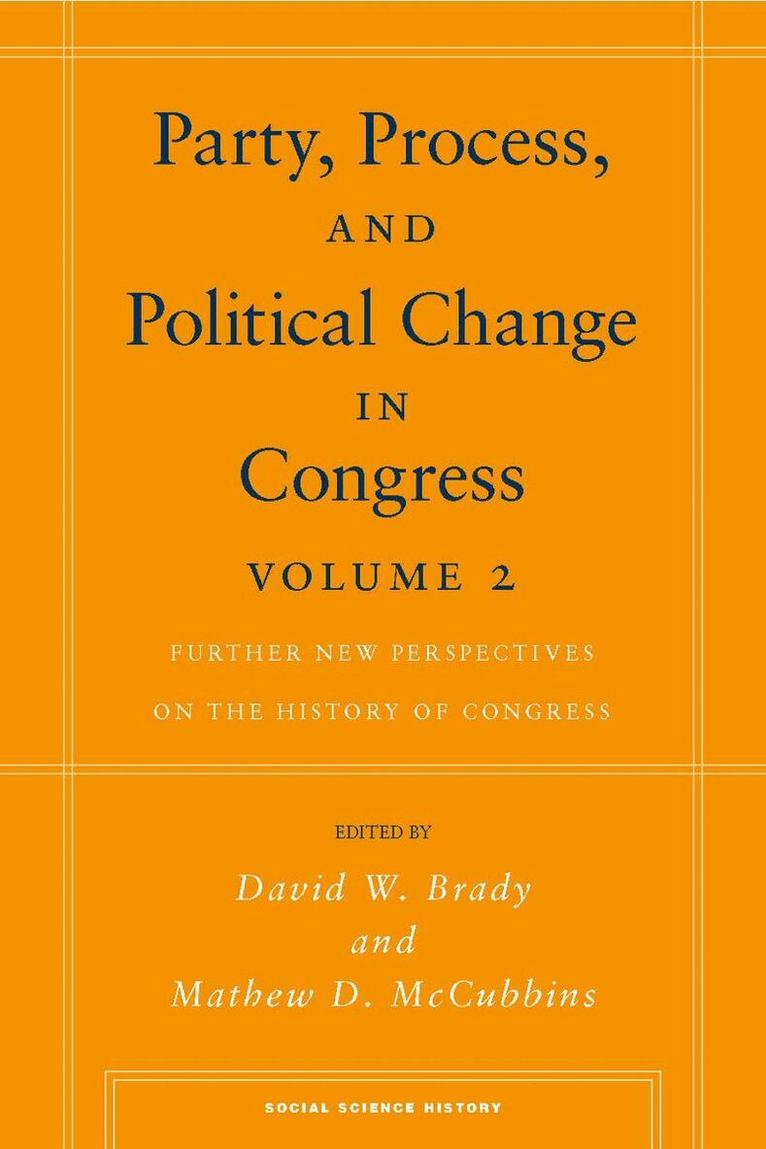
    Party, Process, and Political Change in Congress, Volume 2

    Further New Perspectives on the History of Congress

    AvDavid W. Brady,Mathew D. McCubbins

    Häftad, Engelska, 2007

    Del i serien Social Science History

    486 kr

    Beställningsvara. Skickas inom 5-8 vardagar. Fri frakt över 249 kr.

    Beskrivning

    This work addresses the development of congressional practices and institutions and ties the changes to key political and economic events. In connecting political and economic events with changes in Congress, the authors examine the political economy of the history of Congress. They draw upon history to offer insights about contemporary issues such as party polarization, filibuster reform, direct election of politicians, intercameral bargaining, and the role of committees in the political process. Through this approach the authors help us to understand how politics and economics interact to affect Congress.

    Produktinformation

    • Utgivningsdatum:2007-08-16
    • Mått:152 x 229 x 29 mm
    • Vikt:712 g
    • Format:Häftad
    • Språk:Engelska
    • Serie:Social Science History
    • Antal sidor:536
    • Förlag:Stanford University Press
    • ISBN:9780804755917

    Utforska kategorier

    • Centralt styre och förvaltning inom Samhälle och politik
    • Konstitution: stat och regering inom Samhälle och politik
    • Statsvetenskap och politisk teori inom Samhälle och politik

    Mer om författaren

    David W. Brady is Bowen H. and Janice Arthur McCoy Professor of Political Science and Leadership Values at Stanford University. His books include Revolving Gridlock (1998), Critical Elections in the U.S. House of Representatives (Stanford, 1988), and Party, Process, and Political Change in Congress (Stanford, 2002). Mathew D. McCubbins is Professor of Political Science at the University of California, San Diego. His books include The Logic of Delegation, Legislative Leviathan, and Party, Process, and Political Change in Congress (Stanford, 2002).

    Recensioner i media

    "Theoretically and historically sophisticated, data rich, and often methodologically advanced. Congressional scholars will find this volume to be of inestimable value."—CHOICE "Once again, Brady and McCubbins have done a masterful job of producing a volume that is distinguished by the quality of the authors and the quality of the chapters. Each and every chapter brings theory and practice to bear to explain how and why important aspects of congressional structure, process, and policy making have changed over time. As in the first volume, the results fill gaping holes in our understanding of Congress and its role in representative government." —Joseph Cooper, Johns Hopkins University "This book should be of considerable interest to scholars of Congress and American political development. Among its contributors are some of the very best in the field, along with younger scholars who are rapidly making names for themselves."—Keith Dougherty, University of Georgia

    Innehållsförteckning

    • Contents List of Contributors000 List of Equations000 List of Figures and Tables000 1.American Political Geography David Brady and Mathew D. McCubbins000 Part IExternal Influences on Congress Section 1Progressive Era 2.What Did the Direct Primary Do to Party Loyalty in Congress? Stephen Ansolabehere, Shigeo Hirano, and James M. Snyder Jr.000 3.The Effects of Presidential Elections on Party Control of the Senate under Indirect and Direct Elections Erik J. Engstrom and Samuel Kernell000 4.The Dynamics of Senate Voting: Ideological Shirking and the 17th Amendment William Bernhard and Brian R. Sala000 5.The Electoral Connection: Career Building and Constituency Representation in the U.S. Senate in the Age of Indirect Elections Wendy J. Schiller000 6.The First "Southern Strategy": The Republican Party and Contested-Election Cases in the Late 19th-Century House Jeffery A. Jenkins000 Section 2Postwar Period 7.Explaining the Ideological Polarization of the Congressional Parties since the 1970s Gary C. Jacobson000 8.One D Is Not Enough: Measuring Conditional Party Government, 1887\-2002 John H. Aldrich, David W. Rohde, and Michael W. Tofias000 9.Who Parties? Floor Voting, District Ideology, and Electoral Margins Brandice Canes-Wrone, Julia Rabinovich, and Craig Volden000 Part IIInternal Changes in Congress Section 119th-Century Development of Congress 10.Architect or Tactician? Henry Clay and the Institutional Development of the U.S. House of Representatives Charles Stewart III000 11.Committee Composition in the Absence of a Strong Speaker Chris Den Hartog and Craig Goodman000 12.Roll-Call Behavior and Career Advancement: Analyzing Committee Assignments from Reconstruction to the New Deal Craig Goodman and Timothy P. Nokken000 13.The Evolution of Agenda-Setting Institutions in Congress: Path Dependency in House and Senate Institutional Development Jason M. Roberts and Steven S. Smith000 Section 2Progressive Era 14.Filibuster Reform in the Senate, 1913\-1917 Gregory Koger000 15.Cloture Reform Reconsidered Gregory J. Wawro and Eric Schickler000 16.Candidates, Parties, and the Politics of U.S. House Elections across Time Jamie L. Carson and Jason M. Roberts000 17.Speaker David Henderson and the Partisan Era of the U.S. House Charles J. Finocchiaro and David W. Rohde000 Section 3Postwar Period 18.The Motion to Recommit in the House: The Creation, Evisceration, and Restoration of a Minority Right Donald R. Wolfensberger000 19.The Motion to Recommit in the U.S. House of Representatives Gary W. Cox, Chris Den Hartog, and Mathew D. McCubbins000 20.The Motion to Recommit: More Than an Amendment? D. Roderick Kiewiet and Kevin Roust000 21.An Evolving End Game: Partisan Collusion in Conference Committees, 1953\-2003 Robert Parks Van Houweling000 Section 4Postbellum Trends 22.Bicameral Resolution in Congress, 1863\-2002 Elizabeth Rybicki000 23.The Electoral Disconnection: Roll-Call Behavior in Lame-Duck Sessions of the House of Representatives, 1879\-1933 Timothy P. Nokken000 Part IIIPolicy 24.Measuring Significant Legislation, 1877\-1948 Joshua D. Clinton and John S. Lapinksi000 25.The Fugitive Slave Act of 1850: An Instrumental Interpretation Jeffrey Rogers Hummel and Barry R. Weingast000 26.Power Rejected: Congress and Bankruptcy in the Early Republic Erik Berglof and Howard Rosenthal000 Afterword David Brady and Mathew D. McCubbins000 Notes000 References000 Index000