David W. Lightfoot - Böcker
Visar alla böcker från författaren David W. Lightfoot. Handla med fri frakt och snabb leverans.
7 produkter
7 produkter
1 656 kr
Skickas inom 3-6 vardagar
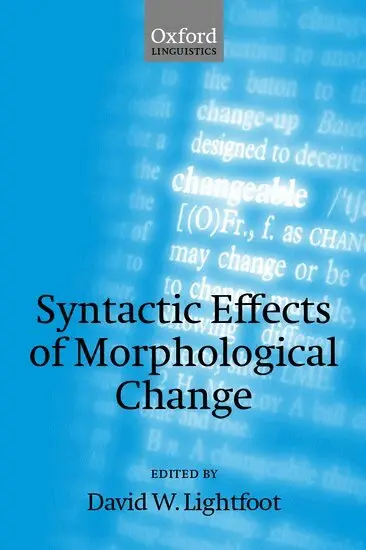
This book presents the latest thinking on the nature and causes of language change. The authors consider how far changes in morphology (e.g. inflectional word endings) cause changes in syntax (e.g. word order). They examine such phenomena from the perspective of current syntactic and psycholinguistic theory, in particular addressing the issues raised by the hypothesis that grammatical change is driven by how children acquire language. Theoretical questions are discussed in the context of change in a wide variety of languages over a range of periods. The authors are distinguished scholars from the USA, Canada, Japan, Brazil, Australia, Portugal, Italy, Greece, and the UK.
814 kr
Skickas inom 5-8 vardagar
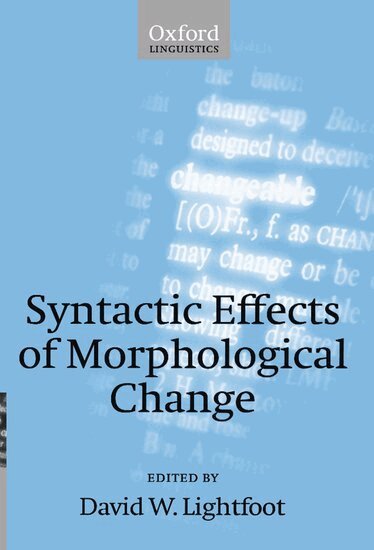
David Lightfoot's collection explores a central aspect of language change: the nature and degree to which changes in morphology (inflectional word endings, for example) cause changes in syntax (for example, in word order). The 22 contributors consider such phenomena within the context of Chomsky's minimalist revision of his principles (of universal grammar) and parameters (of individual languages) theory. They also address some of the main unanswered problems associated with Professor Lightfoot's hypothesis that all grammatical change is driven by the way in which children acquire language. These questions are discussed in the context of a wide range of languages by distinguished scholars from around the world.There are 21 chapters divided into 4 parts: Morphologically Driven Changes, Indirect Links Between Morphology and Syntax, Independent Changes in Movement Operations, and Computer Simulations.
458 kr
Skickas inom 5-8 vardagar
694 kr
Skickas inom 7-10 vardagar
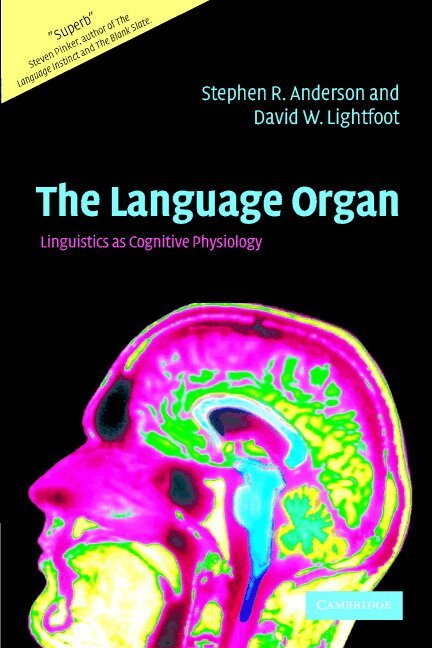
The Language Organ treats human language as the manifestation of a faculty of the mind, a mental organ whose nature is determined by human biology and whose functional properties should be explored just as physiology explores the functional properties of physical organs. It surveys the nature of the language faculty in its various aspects: the systems of sounds, words, and syntax, the development of language in the child and historically, and what is known about its relation to the brain. It discusses the kinds of work that can be carried out in these areas that will contribute to an understanding of the human language organ. This book will appeal to students and researchers in linguistics, and is written to be accessible to colleagues in other disciplines dealing with language as well as to readers with an interest in general science and the nature of the human mind.
984 kr
Skickas inom 7-10 vardagar
The Language Organ treats human language as the manifestation of a faculty of the mind, a mental organ whose nature is determined by human biology and whose functional properties should be explored just as physiology explores the functional properties of physical organs. It surveys the nature of the language faculty in its various aspects: the systems of sounds, words, and syntax, the development of language in the child and historically, and what is known about its relation to the brain. It discusses the kinds of work that can be carried out in these areas that will contribute to an understanding of the human language organ. This book will appeal to students and researchers in linguistics, and is written to be accessible to colleagues in other disciplines dealing with language as well as to readers with an interest in general science and the nature of the human mind.
2 567 kr
Skickas inom 5-8 vardagar
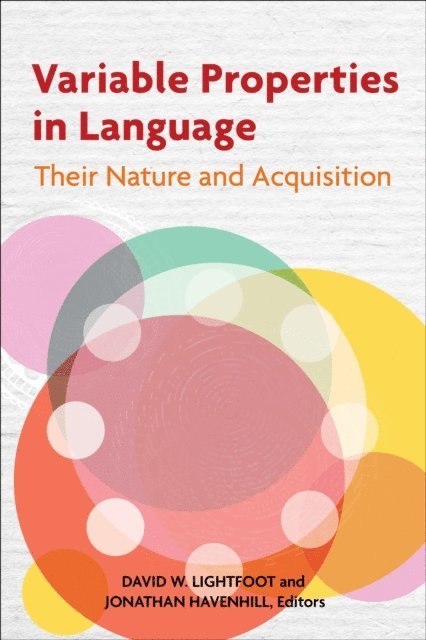
This edited volume, based on papers presented at the 2017 Georgetown University Round Table on Language and Linguistics (GURT), approaches the study of language variation from a variety of angles. Language variation research asks broad questions such as, "Why are languages' grammatical structures different from one another?" as well as more specific word-level questions such as, "Why are words that are pronounced differently still recognized to be the same words?" Too often, research on variation has been siloed based on the particular question—sociolinguists do not talk to historical linguists, who do not talk to phoneticians, and so on. This edited volume seeks to bring discussions from different subfields of linguistics together to explore language variation in a broader sense and acknowledge the complexity and interwoven nature of variation itself.
972 kr
Skickas inom 5-8 vardagar
This edited volume, based on papers presented at the 2017 Georgetown University Round Table on Language and Linguistics (GURT), approaches the study of language variation from a variety of angles. Language variation research asks broad questions such as, "Why are languages' grammatical structures different from one another?" as well as more specific word-level questions such as, "Why are words that are pronounced differently still recognized to be the same words?" Too often, research on variation has been siloed based on the particular question—sociolinguists do not talk to historical linguists, who do not talk to phoneticians, and so on. This edited volume seeks to bring discussions from different subfields of linguistics together to explore language variation in a broader sense and acknowledge the complexity and interwoven nature of variation itself.