• Fri frakt över 249 kr
  • •
  • Snabba leveranser
  • •
  • Billiga böcker
Kundservice

Du är på sajten för privatpersoner.

Företag, bibliotek eller offentlig verksamhet?

Du handlar på classic.bokus.com, där alla dina funktioner finns intakta.
Till classic.bokus.com
Bokus logotyp. Gå till startsidan.
  • Erbjudanden
  • Nyheter
  • Student
  • Topplistor
  • Barn & ungdom
  • Bokus Play
  • E-böcker
  • Pocketböcker
  • Spel & pussel

10% rabatt på allt med kod: NYSTART10 →

Sidfot

Mina sidor

    Hjälp

    • Kundservice
    • Vanliga frågor och svar
    • Frakt och leverans
    • Retur vid ångerrätt
    • Reklamera vara
    • Betalning
    • Köpvillkor
    • Allmänna villkor
    • Information om webbplatsens tillgänglighet

    Om Bokus

    • Om oss
    • Pressrum
    • För studenter
    • För företag
    • För bibliotek och offentlig verksamhet
    • För leverantörer
    • Hållbarhet

    Populärt

    • Aktuella erbjudanden
    • Presentkort
    • Studentlitteratur
    • Nya böcker
    • Topplistor
    • Signerade böcker
    • Engelska böcker

    Inspiration

    • Boktips
    • BookTok
    • Populära bokserier
    • Barnbokskaraktärer
    • Populära författare
    Logotyp för Bokus
    Följ oss på Facebook (extern länk)Följ oss på Instagram (extern länk)Följ oss på YouTube (extern länk)Följ oss på TikTok (extern länk)
    bokus @ CookiesAnpassa cookiesIntegritetspolicyKöpvillkor
    Till Citymail hemsida (extern länk)Till Budbee hemsida (extern länk)Till Postnord hemsida (extern länk)Till Schenker hemsida (extern länk)Till Early Bird hemsida (extern länk)Till Walleys hemsida (extern länk)
    1. Språk och ordböcker
    2. Språkvetenskap och lingvistik

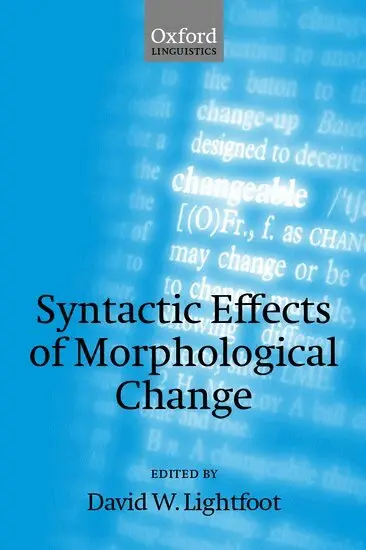
    Syntactic Effects of Morphological Change

    AvDavid W. Lightfoot

    Häftad, Engelska, 2002

    966 kr

    Beställningsvara. Skickas inom 5-8 vardagar. Fri frakt över 249 kr.

    Beskrivning

    David Lightfoot's collection explores a central aspect of language change: the nature and degree to which changes in morphology (inflectional word endings, for example) cause changes in syntax (for example, in word order). The 22 contributors consider such phenomena within the context of Chomsky's minimalist revision of his principles (of universal grammar) and parameters (of individual languages) theory. They also address some of the main unanswered problems associated with Professor Lightfoot's hypothesis that all grammatical change is driven by the way in which children acquire language. These questions are discussed in the context of a wide range of languages by distinguished scholars from around the world.There are 21 chapters divided into 4 parts: Morphologically Driven Changes, Indirect Links Between Morphology and Syntax, Independent Changes in Movement Operations, and Computer Simulations.


    Produktinformation

    • Utgivningsdatum:2002-06-27
    • Mått:158 x 234 x 23 mm
    • Vikt:606 g
    • Format:Häftad
    • Språk:Engelska
    • Antal sidor:424
    • Förlag:OUP OXFORD
    • ISBN:9780199250691

    Utforska kategorier

    • Språkvetenskap och lingvistik inom Språk och ordböcker

    Mer om författaren

    David W. Lightfoot is Dean of the Graduate School at Georgetown University. Until recently he was Professor of Linguistics and Associate Director of the Neural and Cognitive Science Program at the University of Maryland with a joint appointment as Professor of Linguistics at the University of Reading. His books include Principles of Diachronic Syntax (CUP 1979), The Language Lottery: Toward a Biology of Grammars (MIT Press, 1982), How to Set Parameters: Arguments from Language Change (MIT Press, 1991), and The Development of Language: Acquisition, Change, and Evolution (Blackwell, 1999).

    Innehållsförteckning

    • 1. Introduction ; PART I: MORPHOLOGICALLY DRIVEN CHANGES ; 2. The History of the Future ; 3. Case and Middle English Genitive Noun Phrases ; 4. Split Constituents Within NP in the History of English: Commentary on Allen ; 5. Inflectional Morphology and the Loss of Verb-Second in English ; 6. The Rise of the to Dative in Middle English ; 7. Double Objects and Morphological Triggers for Syntactic Case ; 8. Cue-Based Change: Inflection and Subjects in the History of Portuguese Infinitives ; 9. Loss of Verbal Morphology and the Status of Referential Null Subjects in Brazilian Portuguese ; 10. Loss of Overt Wh-Movement in Old Japanese ; 11. Changes in Subject Case Marking in Icelandic ; PART II: INDIRECT LINKS BETWEEN MORPHOLOGY AND SYNTAX ; 12. A Reinterpretation of the loss of verb-second in Welsh ; 13. The Loss of IP-Scrambling in Portuguese: Clause Structure, Word Order Variation and Change ; PART III: INDEPENDENT CHANGES IN MOVEMENT OPERATIONS ; 14. Residual V-to-I ; 15. Syntax and Morphology are Different: Commentary on Jonas ; 16. Verb-Object Order in Old English: Variation as Grammatical Competition ; 17. VO or OV? That's the Underlying Question: Commentary on Pintzuk ; 18. Movement, Morphology, and Learnability ; 19. Object Shift and Holmberg's Generalization in the History of Norwegian ; PART IV: COMPUTER SIMULATIONS ; 20. The Computational Study of Diachronic Linguistics ; 21. Grammar Competition and Language Change