Debbora Battaglia - Böcker
Visar alla böcker från författaren Debbora Battaglia. Handla med fri frakt och snabb leverans.
3 produkter
3 produkter
On the Bones of the Serpent
Person, Memory, and Mortality in Sabarl Island Society
Häftad, Engelska, 1990
300 kr
Skickas inom 7-10 vardagar
Sabarl island—created, in myth, from the bones of a serpent—is a coral atoll in the Louisiade archipelago of Papua New Guinea. The Sabarl speak of themselves as true "islanders": persons separated from the means of both physical and social survival. The Sabarl struggle for continuity—of the physical and social person and of social relations, of cultureal values, of paternal influence in a matrilineal society—is the subject of Debbora Battaglia's sensitive ethnography of loss and reconstruction: the first major work on cultural responses to mortality in the southern Massim culture area and an important contribution to studies of personhood in Melanesia. The creative focus of Sabarl cultural life is a series of mortuary feasts and rituals known as segaiya. In assembling and disassembling commemorative food and objects in segaiya exchanges, Sabarl also assemble and disassemble the critical social relations such objects stand for. These commemorative acts create a collective memory yet also a collective experience of forgetting social bonds that are of no future use to the living. Sabarl anticipate this disaggregation in patterns of everyday life, which reveal the importance of categorical distinctions mapped in beliefs about the physical and metaphysical person. Using remembrance and forgetting as an analytic lens, Battaglia is able to ask questions critical to understanding Melanesian social process. One of the "new ethnographies" addressing the limits of ethnographic representation and the fragmented nature of knowledge from an indigenous perspective, her finely wrought study explores the dynamics of cultural practices in which decontruction is integral to construction, allowing a new perspective on the ephermeral nature of sociality in Melanesia and new insight into the efficacy of cultural images more generally.
271 kr
Skickas inom 7-10 vardagar
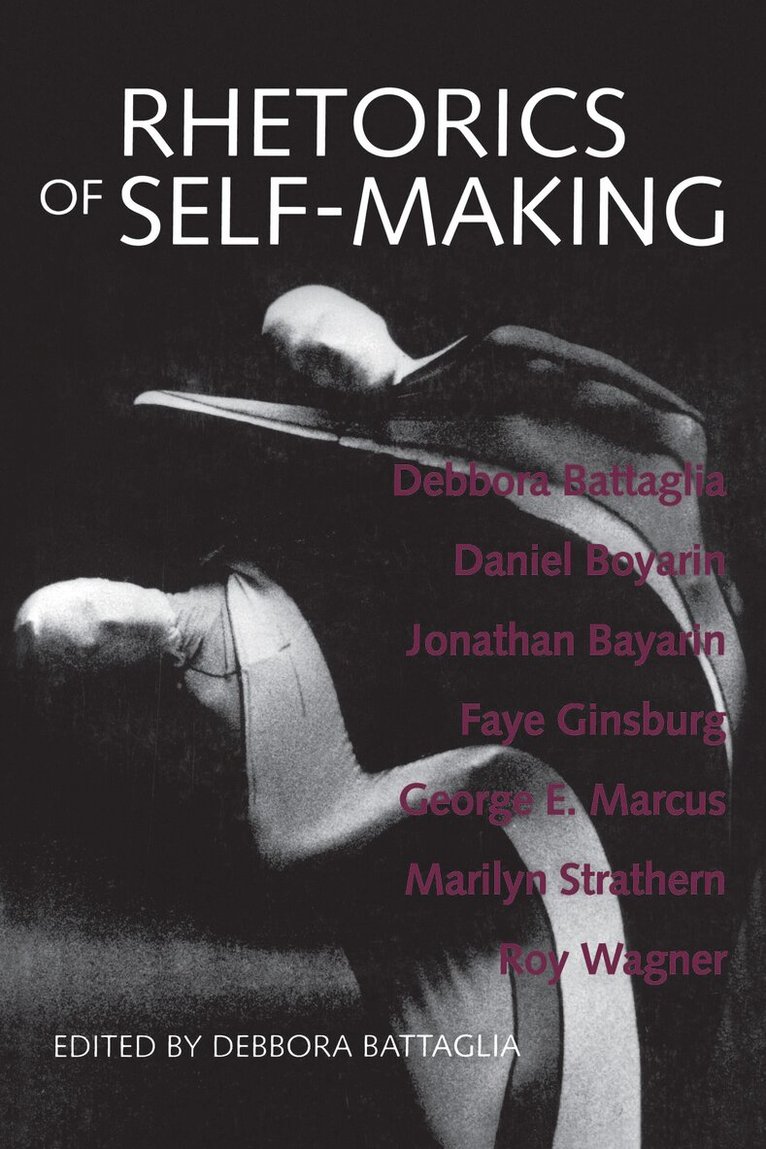
Departing from an essentialist concept of the self, this highly original volume advances the cross-cultural study of selfhood with three contributions to the literature: First, it approaches the self as an ideological process, arguing that selfhood is culturally situated and emergent in social practices of persuasion. Second, it demonstrates how postmodernity problematizes the experience and concept of the self. Finally, the book challenges the pervasive practice of equating an individuated self with the Western world and a relational self with the non-Western world. Contributions cover a broad range of topics--from the development of the eccentric self to the ritual circumcision of Jewish males.
363 kr
Skickas inom 7-10 vardagar
Anthropologists have long sought to engage and describe foreign or “alien” societies, yet few have considered the fluid communities centered around a shared belief in alien beings and UFO sightings and their effect on popular and expressive culture. Opening up a new frontier for anthropological study, the contributors to E.T. Culture take these communities seriously. They demonstrate that an E.T. orientation toward various forms of visitation-including alien beings, alien technologies, and uncanny visions-engages primary concepts underpinning anthropological research: host and visitor, home and away, subjectivity and objectivity. Taking the point of view of those who commit to sci-fi as sci-fact, contributors to this volume show how discussions and representations of otherworldly beings express concerns about racial and ethnic differences, the anxieties and fascination associated with modern technologies, and alienation from the inner workings of government.Drawing on social science, science studies, linguistics, popular and expressive culture, and social and intellectual history, the writers of E.T. Culture unsettle the boundaries of science, magic, and religion as well as those of technological and human agency. They consider the ways that sufferers of “unmarked” diseases such as Chronic Fatigue Syndrome come to feel alien to both the “healthy” world and the medical community incapable of treating them; the development of alien languages like Klingon; attempts to formulate a communications technology-such as that created for the spaceship Voyager-that will reach alien beings; the pilgrimage spirit of UFO seekers; the out-of-time experiences of Nobel scientists; the embrace of the alien within Japanese animation and fan culture; and the physical spirituality of the RaËlian religious network.Contributors. Debbora Battaglia, Richard Doyle, Joseph Dumit, Mizuko Ito, Susan Lepselter, Christopher Roth, David Samuels