Deborah James - Böcker
Visar alla böcker från författaren Deborah James. Handla med fri frakt och snabb leverans.
18 produkter
18 produkter
337 kr
Skickas inom 7-10 vardagar
This volume presents for the first time the selected photographs of renowned British anthropologist Isaac Schapera (1905-2003). Taken between 1929 and 1934, largely during his earliest work among the Kgatla peoples of Bechuanaland (now Botswana), the images in this selection reveal an emotional engagement and aesthetic impulse that Schapera seldom expressed in his writings. Covering a broad spectrum of daily activities, they include depictions of everything from pot making, thatching, and cattle herding to village architecture, vernacular medicine, and rainmaking ceremonies. Visually fascinating and of exceptional quality, these images capture the uniqueness of an African people in a particular time and place. They are contexualized and their significance explained in Jean and John Comaroff's insightful introduction, while Adam Kuper's illuminating biographical sketch of Schapera provides new insight into the life of the photographer. "Picturing a Colonial Past" reveals not only a rare side of old Botswana, but also of one of the most famous anthropologists to ever work there.
835 kr
Skickas inom 10-15 vardagar
Gaining Ground? Rights and Property in South African Land Reform examines how land reform policy and practice in post-apartheid South Africa have been produced and contested. Set in the province of Mpumalanga, the book gives an ethnographic account of local initiatives and conflicts, showing how the poorest sectors of the landless have defied the South African state's attempts to privatize land holdings and create a new class of African farmers. They insist that the 'rights-based' rather than the 'market-driven' version of land reform should prevail and that land restitution was intended to benefit all Africans. However their attempts to gain land access often backfire. Despite state assurances that land reform would benefit all, illegal land selling and 'brokering' are pervasive, representing one of the only feasible routes to land access by the poor.This book shows how human rights lawyers, NGOs and the state, in interaction with local communities, have tried to square these symbolic and economic claims on land.Winner of the inaugural Elliott P. Skinner Book Award of the Association of Africanist Anthropology, 2008
1 997 kr
Skickas inom 10-15 vardagar
The Rights and Wrongs of Land Restitution: ‘Restoring What Was Ours’offers a critical, comparative ethnographic, examination of land restitution programs. Drawing on memories and histories of past dispossession, governments, NGOs, informal movements and individual claimants worldwide have attempted to restore and reclaim rights in land. Land restitution programs link the past and the present, and may allow former landholders to reclaim lands which provided the basis of earlier identities and livelihoods. Restitution also has a moral weight that holds broad appeal; it is represented as righting injustice and healing the injuries of colonialism. Restitution may have unofficial purposes, like establishing the legitimacy of a new regime, quelling popular discontent, or attracting donor funds. It may produce unintended consequences, transforming notions of property and ownership, entrenching local bureaucracies, or replicating segregated patterns of land use. It may also constitute new relations between states and their subjects. Land-claiming communities may make new claims on the state, but they may also find the state making unexpected claims on their land and livelihoods. Restitution may be a route to citizenship, but it may engender new or neo-traditional forms of subjection. This volume explores these possibilities and pitfalls by examining cases from the Americas, Eastern Europe, Australia and South Africa. Addressing the practical and theoretical questions that arise, The Rights and Wrongs of Land Restitution thereby offers a critical rethinking of the links between land restitution and property, social transition, injustice, citizenship, the state and the market.
622 kr
Skickas inom 10-15 vardagar
The Rights and Wrongs of Land Restitution: ‘Restoring What Was Ours’offers a critical, comparative ethnographic, examination of land restitution programs. Drawing on memories and histories of past dispossession, governments, NGOs, informal movements and individual claimants worldwide have attempted to restore and reclaim rights in land. Land restitution programs link the past and the present, and may allow former landholders to reclaim lands which provided the basis of earlier identities and livelihoods. Restitution also has a moral weight that holds broad appeal; it is represented as righting injustice and healing the injuries of colonialism. Restitution may have unofficial purposes, like establishing the legitimacy of a new regime, quelling popular discontent, or attracting donor funds. It may produce unintended consequences, transforming notions of property and ownership, entrenching local bureaucracies, or replicating segregated patterns of land use. It may also constitute new relations between states and their subjects. Land-claiming communities may make new claims on the state, but they may also find the state making unexpected claims on their land and livelihoods. Restitution may be a route to citizenship, but it may engender new or neo-traditional forms of subjection. This volume explores these possibilities and pitfalls by examining cases from the Americas, Eastern Europe, Australia and South Africa. Addressing the practical and theoretical questions that arise, The Rights and Wrongs of Land Restitution thereby offers a critical rethinking of the links between land restitution and property, social transition, injustice, citizenship, the state and the market.
251 kr
Skickas inom 5-8 vardagar
1 278 kr
Skickas inom 7-10 vardagar
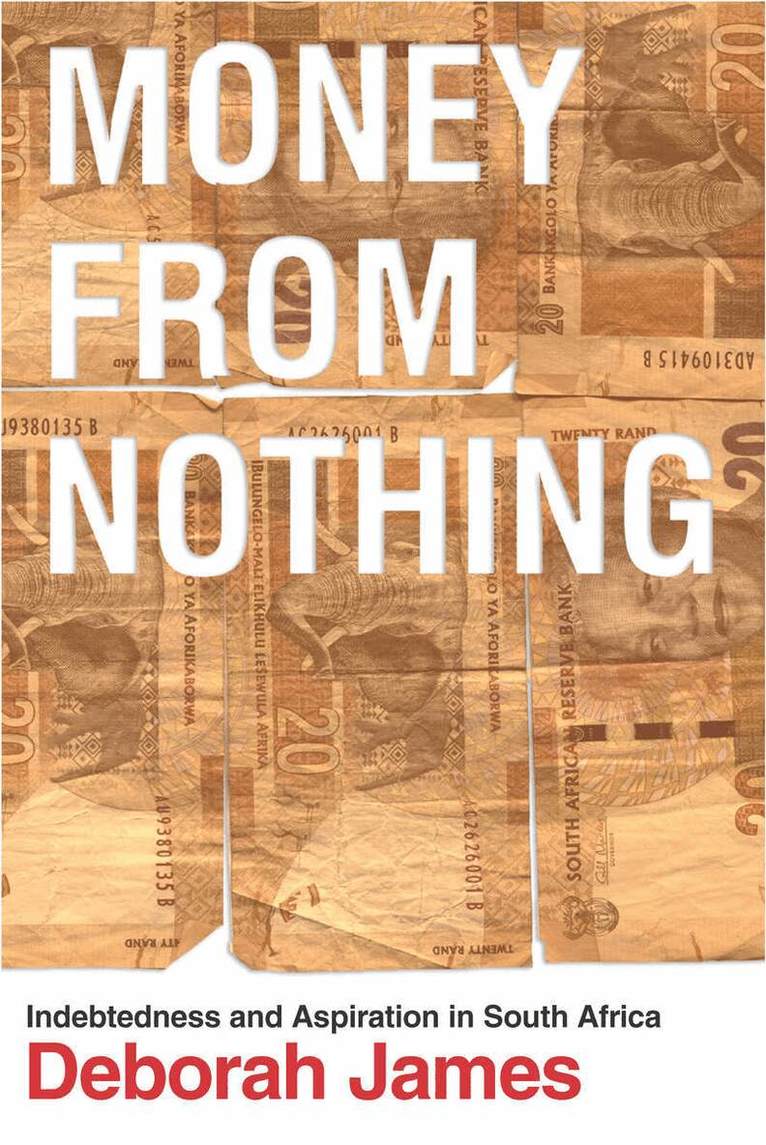
Money from Nothing explores the dynamics surrounding South Africa's national project of financial inclusion—dubbed "banking the unbanked"—which aimed to extend credit to black South Africans as a critical aspect of broad-based economic enfranchisement. Through rich and captivating accounts, Deborah James reveals the varied ways in which middle- and working-class South Africans' access to credit is intimately bound up with identity, status-making, and aspirations of upward mobility. She draws out the deeply precarious nature of both the aspirations and the economic relations of debt which sustain her subjects, revealing the shadowy side of indebtedness and its potential to produce new forms of oppression and disenfranchisement in place of older ones. Money from Nothing uniquely captures the lived experience of indebtedness for those many millions who attempt to improve their positions (or merely sustain existing livelihoods) in emerging economies.
312 kr
Skickas inom 7-10 vardagar
Money from Nothing explores the dynamics surrounding South Africa's national project of financial inclusion—dubbed "banking the unbanked"—which aimed to extend credit to black South Africans as a critical aspect of broad-based economic enfranchisement. Through rich and captivating accounts, Deborah James reveals the varied ways in which middle- and working-class South Africans' access to credit is intimately bound up with identity, status-making, and aspirations of upward mobility. She draws out the deeply precarious nature of both the aspirations and the economic relations of debt which sustain her subjects, revealing the shadowy side of indebtedness and its potential to produce new forms of oppression and disenfranchisement in place of older ones. Money from Nothing uniquely captures the lived experience of indebtedness for those many millions who attempt to improve their positions (or merely sustain existing livelihoods) in emerging economies.
566 kr
Skickas inom 3-6 vardagar
an important and very interesting contribution to, first of all, critical and reflexive anthropology...Every chapter offers fresh insights into a key area of critical anthropology. Undoubtedly, the volume is very well organized, thoroughly substantiated, and interestingly written. I believe that the reviewed collection of articles is a distinguished, very useful, and sometimes provocative reading for all scholars concerned with a critical approach to social science and especially to social anthropology. Anthropos The relationship between anthropologists' ethnographic investigations and the lived social worlds in which these originate is a fundamental issue for anthropology. Where some claim that only native voices may offer authentic accounts of culture and hence that ethnographers are only ever interpreters of it, others point out that anthropologists are, themselves, implanted within specific cultural contexts which generate particular kinds of theoretical discussions. The contributors to this volume reject the premise that ethnographer and informant occupy different and incommensurable "cultural worlds."Instead they investigate the relationship between culture, context, and anthropologists' models and accounts in new ways. In doing so, they offer fresh insights into this key area of anthropological research. Deborah James is Professor of Anthropology at the London School of Economics. Evie Plaice is Associate Professor of Anthropology jointly appointed to the Faculty of Arts and the Faculty of Education at the University of New Brunswick, Canada. Christina Toren is Professor of Social Anthropology at the University of St Andrews.
282 kr
Skickas inom 3-6 vardagar
1 061 kr
Skickas inom 7-10 vardagar
The impulse to redistribute wealth is said to be a tool to counter inequalities, applied by the state or society to curb the worst excesses of capitalist exploitation and free trade. In settings where previous political regimes are reformed, or toppled and replaced by new ones, redistribution can also be a policy specifically oriented at redress, one exercised at the formal level of policy. Drawing on a comparative ethnography in South Africa and the United Kingdom, Clawing Back explores how notions of reallocation and payout are intimately connected with those of compensation for a loss. Where financialization is accompanied by increased informalization, redistribution can equally involve the market as well as kinship and social networks. Drawing on a rich ethnography of the human relationships at the center of redistribution, Deborah James shows how borrowing can provide negotiation opportunities to wage earners and welfare beneficiaries alike: they make use of debt to constitute relations and futures, to engage with the state, to convert between commodified and non-commodified relationships. Rather than suggesting that financialization is serving either a totally negative or wholly beneficial purpose, James posits a different way of visualizing the relationship between the finance industry and the world of everyday needs.
257 kr
Skickas inom 7-10 vardagar
The impulse to redistribute wealth is said to be a tool to counter inequalities, applied by the state or society to curb the worst excesses of capitalist exploitation and free trade. In settings where previous political regimes are reformed, or toppled and replaced by new ones, redistribution can also be a policy specifically oriented at redress, one exercised at the formal level of policy. Drawing on a comparative ethnography in South Africa and the United Kingdom, Clawing Back explores how notions of reallocation and payout are intimately connected with those of compensation for a loss. Where financialization is accompanied by increased informalization, redistribution can equally involve the market as well as kinship and social networks. Drawing on a rich ethnography of the human relationships at the center of redistribution, Deborah James shows how borrowing can provide negotiation opportunities to wage earners and welfare beneficiaries alike: they make use of debt to constitute relations and futures, to engage with the state, to convert between commodified and non-commodified relationships. Rather than suggesting that financialization is serving either a totally negative or wholly beneficial purpose, James posits a different way of visualizing the relationship between the finance industry and the world of everyday needs.
119 kr
Skickas
**As seen on BBC Breakfast**You are stronger than you know, more positive than you ever thought and you can still LIVE with cancer.Drink more green juices, eat turmeric, walk for three hours a day... Arghh, I wanted to scream, run away and tell every well-meaning person to go and do one!Whilst this book doesn’t advocate throwing all advice down the kitchen sink, it will empower you to do things your way as you navigate the big C roller coaster. Deborah James, campaigner and co-presenter of the top-charting podcast You, Me and the Big C, will take you through every twist and turn, reminding you that it’s okay to feel one hundred different things in the space of a minute and showing you how you can still live your life and BE YOURSELF with cancer. Taking you from diagnosis (welcome to the club you never wanted to join), to coping with family and friends (can everyone just fuck off sometimes?!), looking good and feeling better (drink the wine), and celebrating milestones along the way (drink more wine!), this inspiring cancer coach in a book will transform your outlook and encourage you to shout #FUCKYOUCANCER as loudly as you can!
180 kr
Skickas inom 5-8 vardagar
126 kr
Skickas
THE SUNDAY TIMES No 1 BESTSELLER'Deborah James captured the heart of the nation' - The Duke and Duchess of Cambridge @KensingtonRoyal'Brave, bright, beautiful' - Lorraine Kelly'Deborah's ability to find positivity in the darkest of places is an inspiration to us all' - Davina McCall'This book has shaken me awake. I gulped it down in one sitting, then sat and cried... [But] hope is a character on every single page' - Christie Watson-------------------I was alive when I should have been dead. In another movie, I missed the sliding door and departed this wondrous life long ago. Like so many others, I had to learn to live not knowing if I have a tomorrow, because, statistically, I didn't. At the age of 35, I was blindsided by incurable bowel cancer - I was given less than an 8 per cent chance of surviving five years. Five years later, my only option was to live in the now and to value one day at a time.--------------------How do you turn your mind from a negative spiral into realistic and rebellious hope? How do you stop focusing on the why and realise that 'why not me' is just as valid a question?When Deborah James was diagnosed with incurable bowel cancer at just 35, she learned a powerful lesson: the way we respond to any given situation empowers or destroys us. And with the right skills and approach, we can all face huge challenges and find strength and hope in the darkest of places.How to Live When You Could Be Dead will show you how. It will awaken you to question your life as if you didn't have a tomorrow and live it in the way you want to today. By harnessing the power of positivity and valuing each day as though it could be your last, you'll find out, as Deborah did, that it is possible to live with joy and purpose, no matter what.Ebury, a division of Penguin Random House, will pay £2.50 from the sale of each paperback copy of How To Live When You Could Be Dead by Deborah James sold in the UK to Bowelbabe Fund for Cancer Research UK.Cancer Research UK is a charity registered in England and Wales (1089464), Scotland (SC041666), Isle of Man (1103) and Jersey (247).
One Hundred Years of Argonauts
Malinowski, Ethnography and Economic Anthropology
Inbunden, Engelska, 2024
2 164 kr
Skickas inom 3-6 vardagar
Malinowski’s Argonauts of the Western Pacific was a major contribution to anthropological theory and method, while simultaneously establishing the sub-field of economic anthropology. Even a century after its publication, Malinowski’s pioneering work remains critical for anthropology in a postcolonial age. This volume uses ethnographic studies from around the world to contextualize the work politically and intellectually, examining its gestation and influence from multiple perspectives. It critically explores the meaning of “economy” for Malinowski from his formation in the Austro-Hungarian Empire to his path-breaking fieldwork in Melanesia and ensuing career in London.
One Hundred Years of Argonauts
Malinowski, Ethnography and Economic Anthropology
Häftad, Engelska, 2025
358 kr
Skickas inom 3-6 vardagar
Malinowski’s Argonauts of the Western Pacific was a major contribution to anthropological theory and method, while simultaneously establishing the sub-field of economic anthropology. Even a century after its publication, Malinowski’s pioneering work remains critical for anthropology in a postcolonial age. This volume uses ethnographic studies from around the world to contextualize the work politically and intellectually, examining its gestation and influence from multiple perspectives. It critically explores the meaning of “economy” for Malinowski from his formation in the Austro-Hungarian Empire to his path-breaking fieldwork in Melanesia and ensuing career in London.
1 956 kr
Skickas inom 3-6 vardagar
The relationship between anthropologists’ ethnographic investigations and the lived social worlds in which these originate is a fundamental issue for anthropology. Where some claim that only native voices may offer authentic accounts of culture and hence that ethnographers are only ever interpreters of it, others point out that anthropologists are, themselves, implanted within specific cultural contexts which generate particular kinds of theoretical discussions. The contributors to this volume reject the premise that ethnographer and informant occupy different and incommensurable “cultural worlds.” Instead they investigate the relationship between culture, context, and anthropologists’ models and accounts in new ways. In doing so, they offer fresh insights into this key area of anthropological research.
2 432 kr
Skickas inom 10-15 vardagar
Gaining Ground? Rights and Property in South African Land Reform examines how land reform policy and practice in post-apartheid South Africa have been produced and contested. Set in the province of Mpumalanga, the book gives an ethnographic account of local initiatives and conflicts, showing how the poorest sectors of the landless have defied the South African state's attempts to privatize land holdings and create a new class of African farmers. They insist that the 'rights-based' rather than the 'market-driven' version of land reform should prevail and that land restitution was intended to benefit all Africans. However their attempts to gain land access often backfire. Despite state assurances that land reform would benefit all, illegal land selling and 'brokering' are pervasive, representing one of the only feasible routes to land access by the poor.This book shows how human rights lawyers, NGOs and the state, in interaction with local communities, have tried to square these symbolic and economic claims on land.Winner of the inaugural Elliott P. Skinner Book Award of the Association of Africanist Anthropology, 2008