Deirdre Nansen McCloskey - Böcker
Visar alla böcker från författaren Deirdre Nansen McCloskey. Handla med fri frakt och snabb leverans.
13 produkter
13 produkter
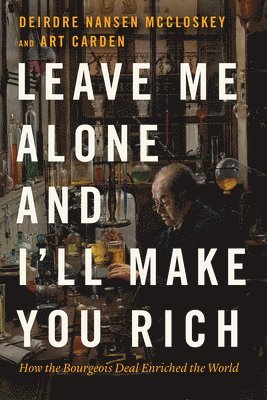
Leave Me Alone and I'll Make You Rich
How the Bourgeois Deal Enriched the World
Inbunden, Engelska, 2020
243 kr
Skickas inom 7-10 vardagar
The economist and historian Deirdre Nansen McCloskey has been best known recently for her Bourgeois Era trilogy, a vigorous defense, unrivaled in scope, of commercially tested betterment. Its massive volumes, The Bourgeois Virtues, Bourgeois Dignity, and Bourgeois Equality, solve Adam Smith's puzzle of the nature and causes of the wealth of nations, and of the moral sentiments of modernity. The world got rich, she argues, not chiefly by material causes but by an idea and a sentiment, a new admiration for the middle class and its egalitarian liberalism. For readers looking for a distillation of McCloskey's magisterial work, Leave Me Alone and I'll Make You Rich is what you've been waiting for. In this lively volume, McCloskey and the economist and journalist Carden bring together the trilogy's key ideas and its most provocative arguments. The rise of the west, and now the rest, is the story of the rise of ordinary people to a dignity and liberty inspiring them to have a go. The outcome was an explosion of innovation after 1800, and a rise of real income by an astounding 3,000 percent. The Great Enrichment, well beyond the conventional Industrial Revolution, did not, McCloskey and Carden show, come from the usual suspects, capital accumulation or class struggle. It came from the idea of economic liberty in Holland and the Anglosphere, then Sweden and Japan, then Italy and Israel and China and India, an idea that bids fair in the next few generations to raise up the wretched of the earth. The original shift to liberalism arose 1517 to 1789 from theological and political revolutions in northwest Europe, upending ancient hierarchies. McCloskey and Carden contend further that liberalism and "innovism" made us better humans as well as richer ones. Not matter but ideas. Not corruption but improvement. Leave Me Alone and I'll Make You Rich draws in entertaining fashion on history, economics, literature, philosophy, and popular culture, from growth theory to the Simpsons. It is the perfect introduction for a broad audience to McCloskey's influential explanation of how we got rich. At a time when confidence in the economic system is under challenge, the book mounts an optimistic and persuasive defense of liberal innovism, and of the modern world it has wrought.
276 kr
Skickas inom 7-10 vardagar
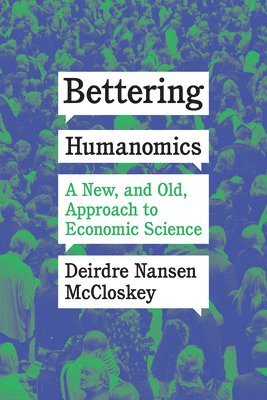
Deirdre Nansen McCloskey's latest meticulous work examines how economics can become a more "human" science.Economic historian Deirdre Nansen McCloskey has distinguished herself through her writing on the Great Enrichment and the betterment of the poor—not just materially but spiritually. In Bettering Humanomics she continues her intellectually playful yet rigorous analysis with a focus on humans rather than the institutions. Going against the grain of contemporary neo-institutional and behavioral economics which privilege observation over understanding, she asserts her vision of “humanomics,” which draws on the work of Bart Wilson, Vernon Smith, and most prominently, Adam Smith. She argues for an economics that uses a comprehensive understanding of human action beyond behaviorism. McCloskey clearly articulates her points of contention with believers in “imperfections,” from Samuelson to Stiglitz, claiming that they have neglected scientific analysis in their haste to diagnose the ills of the system. In an engaging and erudite manner, she reaffirms the global successes of market-tested betterment and calls for empirical investigation that advances from material incentives to an awareness of the human within historical and ethical frameworks. Bettering Humanomics offers a critique of contemporary economics and a proposal for an economics as a better human science.
801 kr
Skickas inom 7-10 vardagar
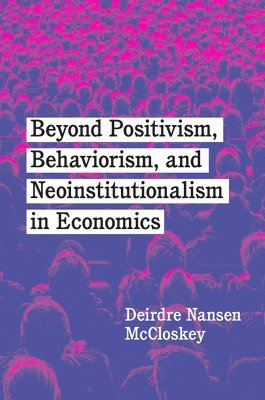
A penetrating analysis from one of the defining voices of contemporary economics.In Beyond Positivism, Behaviorism, and Neoinstitutionalism in Economics, Deirdre Nansen McCloskey zeroes in on the authoritarian cast of recent economics, arguing for a re-focusing on the liberated human. The behaviorist positivism fashionable in the field since the 1930s treats people from the outside. It yielded in Williamson and North a manipulative neo-institutionalism. McCloskey argues that institutions as causes are mainly temporary and intermediate, not ultimate. They are human-made, depending on words, myth, ethics, ideology, history, identity, professionalism, gossip, movies, what your mother taught you. Humans create conversations as they go, in the economy as in the rest of life.In engaging and erudite prose, McCloskey exhibits in detail the scientific failures of neo-institutionalism. She proposes a “humanomics,” an economics with the humans left in. Humanomics keeps theory, quantification, experiment, mathematics, econometrics, though insisting on more true rigor than is usual. It adds what can be learned about the economy from history, philosophy, literature, and all the sciences of humans. McCloskey reaffirms the durability of “market-tested innovation” against the imagined imperfections to be corrected by a perfect government. With her trademark zeal and incisive wit, she rebuilds the foundations of economics.
252 kr
Skickas inom 7-10 vardagar
A penetrating analysis from one of the defining voices of contemporary economics.In Beyond Positivism, Behaviorism, and Neoinstitutionalism in Economics, Deirdre Nansen McCloskey zeroes in on the authoritarian cast of recent economics, arguing for a re-focusing on the liberated human. The behaviorist positivism fashionable in the field since the 1930s treats people from the outside. It yielded in Williamson and North a manipulative neo-institutionalism. McCloskey argues that institutions as causes are mainly temporary and intermediate, not ultimate. They are human-made, depending on words, myth, ethics, ideology, history, identity, professionalism, gossip, movies, what your mother taught you. Humans create conversations as they go, in the economy as in the rest of life.In engaging and erudite prose, McCloskey exhibits in detail the scientific failures of neo-institutionalism. She proposes a “humanomics,” an economics with the humans left in. Humanomics keeps theory, quantification, experiment, mathematics, econometrics, though insisting on more true rigor than is usual. It adds what can be learned about the economy from history, philosophy, literature, and all the sciences of humans. McCloskey reaffirms the durability of “market-tested innovation” against the imagined imperfections to be corrected by a perfect government. With her trademark zeal and incisive wit, she rebuilds the foundations of economics.
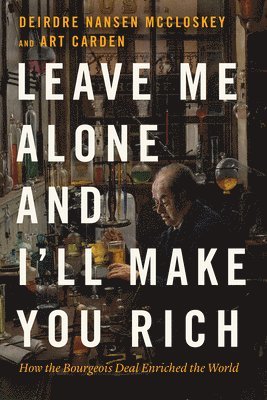
Leave Me Alone and I'll Make You Rich
How the Bourgeois Deal Enriched the World
Häftad, Engelska, 2022
162 kr
Skickas inom 7-10 vardagar
The economist and historian Deirdre Nansen McCloskey has been best known recently for her Bourgeois Era trilogy, a vigorous defense, unrivaled in scope, of commercially tested betterment. Its massive volumes, The Bourgeois Virtues, Bourgeois Dignity, and Bourgeois Equality, solve Adam Smith’s puzzle of the nature and causes of the wealth of nations, and of the moral sentiments of modernity. The world got rich, she argues, not chiefly by material causes but by an idea and a sentiment, a new admiration for the middle class and its egalitarian liberalism. For readers looking for a distillation of McCloskey’s magisterial work, Leave Me Alone and I’ll Make You Rich is what you’ve been waiting for. In this lively volume, McCloskey and the economist and journalist Carden bring together the trilogy’s key ideas and its most provocative arguments. The rise of the west, and now the rest, is the story of the rise of ordinary people to a dignity and liberty inspiring them to have a go. The outcome was an explosion of innovation after 1800, and a rise of real income by an astounding 3,000 percent. The Great Enrichment, well beyond the conventional Industrial Revolution, did not, McCloskey and Carden show, come from the usual suspects, capital accumulation or class struggle. It came from the idea of economic liberty in Holland and the Anglosphere, then Sweden and Japan, then Italy and Israel and China and India, an idea that bids fair in the next few generations to raise up the wretched of the earth. The original shift to liberalism arose from 1517 to 1789 from theological and political revolutions in northwest Europe, upending ancient hierarchies. McCloskey and Carden contend further that liberalism and “innovism” made us better humans as well as richer ones. Not matter but ideas. Not corruption but improvement.Leave Me Alone and I’ll Make You Rich draws in entertaining fashion on history, economics, literature, philosophy, and popular culture, from growth theory to the Simpsons. It is the perfect introduction for a broad audience to McCloskey’s influential explanation of how we got rich. At a time when confidence in the economic system is under challenge, the book mounts an optimistic and persuasive defense of liberal innovism, and of the modern world it has wrought.
170 kr
Skickas inom 7-10 vardagar
Deirdre Nansen McCloskey's latest meticulous work examines how economics can become a more "human" science.Economic historian Deirdre Nansen McCloskey has distinguished herself through her writing on the Great Enrichment and the betterment of the poor—not just materially but spiritually. In Bettering Humanomics she continues her intellectually playful yet rigorous analysis with a focus on humans rather than the institutions. Going against the grain of contemporary neo-institutional and behavioral economics which privilege observation over understanding, she asserts her vision of “humanomics,” which draws on the work of Bart Wilson, Vernon Smith, and most prominently, Adam Smith. She argues for an economics that uses a comprehensive understanding of human action beyond behaviorism. McCloskey clearly articulates her points of contention with believers in “imperfections,” from Samuelson to Stiglitz, claiming that they have neglected scientific analysis in their haste to diagnose the ills of the system. In an engaging and erudite manner, she reaffirms the global successes of market-tested betterment and calls for empirical investigation that advances from material incentives to an awareness of the human within historical and ethical frameworks. Bettering Humanomics offers a critique of contemporary economics and a proposal for an economics as a better human science.
314 kr
Kommande
From a revered public intellectual, an essential argument for the political preconditions of a liberal society. Liberalism has always suffered from messaging challenges. It simultaneously implies a pursuit of individual liberty and social equality, two projects often regarded as at odds. Or: Liberal means the opposite of conservative. Except when it doesn’t. The list goes on. Liberal bard Deirdre Nansen McCloskey understands these rhetorical troubles. Equality of Permission is her stirring and career-defining intervention on this essentially contested yet critical topic—a forceful case for liberalism as our best hope, and an essential vision of the political conditions necessary for its survival. McCloskey prescribes a liberalism built around liberty from the bottom up: “equality before the law and equality of political and economic permissions,” lightly administered.The state, McCloskey argues, is increasingly the source of our discontents—an illiberal institution, hindered by a quixotic fixation on pursuing equality of wealth or opportunity. Equality of Permission evangelizes for a better, and earlier, version of liberalism—that of John Locke, Adam Smith, Mary Wollstonecraft, and Henry David Thoreau—as against a top-down quest for an unattainable utopia. McCloskey shows that statism in pursuit of a chimerical general will, even when well-intentioned, leads to tyranny.Brimming with energy and erudition, drawing on wisdoms from Alexis de Tocqueville to Mae West, Equality of Permission is McCloskey at the peak of her powers—brilliant, lacerating, garrulous, funny, worldly, and warm. Amid intense debate over the use and abuse of government institutions, McCloskey shares her singular vision for a true democracy, one grounded in respect and conducive to universal human flourishing.
Why Liberalism Works
How True Liberal Values Produce a Freer, More Equal, Prosperous World for All
Inbunden, Engelska, 2019
257 kr
Skickas inom 7-10 vardagar
An insightful and passionately written book explaining why a return to Enlightenment ideals is good for the world "Beginning with the simple but fertile idea that people should not push other people around, Deirdre McCloskey presents an elegant defense of 'true liberalism' as opposed to its well-meaning rivals on the left and the right. Erudite, but marvelously accessible and written in a style that is at once colloquial and astringent."—Stanley FishThe greatest challenges facing humankind, according to Deirdre McCloskey, are poverty and tyranny, both of which hold people back. Arguing for a return to true liberal values, this engaging and accessible book develops, defends, and demonstrates how embracing the ideas first espoused by eighteenth-century philosophers like Locke, Smith, Voltaire, and Wollstonecraft is good for everyone. With her trademark wit and deep understanding, McCloskey shows how the adoption of Enlightenment ideals of liberalism has propelled the freedom and prosperity that define the quality of a full life. In her view, liberalism leads to equality, but equality does not necessarily lead to liberalism. Liberalism is an optimistic philosophy that depends on the power of rhetoric rather than coercion, and on ethics, free speech, and facts in order to thrive.
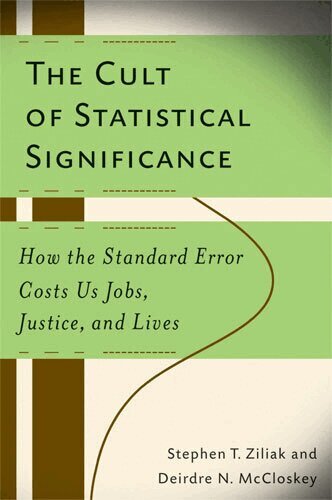
Cult of Statistical Significance
How the Standard Error Costs Us Jobs, Justice, and Lives
Häftad, Engelska, 2008
404 kr
Skickas inom 7-10 vardagar
“McCloskey and Ziliak have been pushing this very elementary, very correct, very important argument through several articles over several years and for reasons I cannot fathom it is still resisted. If it takes a book to get it across, I hope this book will do it. It ought to.”—Thomas Schelling, Distinguished University Professor, School of Public Policy, University of Maryland, and 2005 Nobel Prize Laureate in Economics“With humor, insight, piercing logic and a nod to history, Ziliak and McCloskey show how economists—and other scientists—suffer from a mass delusion about statistical analysis. The quest for statistical significance that pervades science today is a deeply flawed substitute for thoughtful analysis. . . . Yet few participants in the scientific bureaucracy have been willing to admit what Ziliak and McCloskey make clear: the emperor has no clothes.”—Kenneth Rothman, Professor of Epidemiology, Boston University School of HealthThe Cult of Statistical Significance shows, field by field, how “statistical significance,” a technique that dominates many sciences, has been a huge mistake. The authors find that researchers in a broad spectrum of fields, from agronomy to zoology, employ “testing” that doesn’t test and “estimating” that doesn’t estimate. The facts will startle the outside reader: how could a group of brilliant scientists wander so far from scientific magnitudes? This study will encourage scientists who want to know how to get the statistical sciences back on track and fulfill their quantitative promise. The book shows for the first time how wide the disaster is, and how bad for science, and it traces the problem to its historical, sociological, and philosophical roots.Stephen T. Ziliak is the author or editor of many articles and two books. He currently lives in Chicago, where he is Professor of Economics at Roosevelt University. Deirdre N. McCloskey, Distinguished Professor of Economics, History, English, and Communication at the University of Illinois at Chicago, is the author of twenty books and three hundred scholarly articles. She has held Guggenheim and National Humanities Fellowships. She is best known for How to Be Human* Though an Economist (University of Michigan Press, 2000) and her most recent book, The Bourgeois Virtues: Ethics for an Age of Commerce (2006).
328 kr
Skickas inom 7-10 vardagar
In this thoroughly engaging book Deirdre McCloskey puts the "dismal science" under the microscope. She offers advice to young economists, offering models from the old; and she lambastes the middle-aged who have allowed economics to become, as she puts it with characteristic verve, "a boys' game in a sandbox." McCloskey deploys her wit and style to serious purpose: to bring economics back to science.Anyone can learn about the field of economics from How to Be Human. She can learn how economics works as a discipline and as a piece of sociology, who the heroes are and the villains, how a career in economics relates to matters of ethics and epistemology. She can learn what it is like to be a new woman in a boys' subject, a subject that avoids at all costs the word "love."During the 1990s Deirdre McCloskey established herself as the main internal critic of the economic mainstream. Her quarterly columns in the Eastern Economic Journal, many of which are collected here, have become a handbook for reform. Trained in economics herself, she knows the normal science of the field from the inside: she has done it as a distinguished economic historian; and has watched it work from the faculties of Chicago (for twelve years) and Iowa (for nineteen), and now at the University of Illinois at Chicago.Her criticism from the inside is that the two methods on which economics has depended since the 1940s--existence-theorem mathematics and significance-testing statistics--are nonsense. They have, she claims, nothing to do with economic science, and have massively diverted economists from finding out how the economy works.McCloskey's book is written for anyone interested in economics, whether trained in it or not--anyone who cares about the economy but is not taken in by the boys' game.Deirdre McCloskey is University Professor of the Human Sciences, University of Illinois at Chicago.
Cult of Statistical Significance
How the Standard Error Costs Us Jobs, Justice, and Lives
Inbunden, Engelska, 2008
1 190 kr
Skickas inom 7-10 vardagar
“McCloskey and Ziliak have been pushing this very elementary, very correct, very important argument through several articles over several years and for reasons I cannot fathom it is still resisted. If it takes a book to get it across, I hope this book will do it. It ought to.”—Thomas Schelling, Distinguished University Professor, School of Public Policy, University of Maryland, and 2005 Nobel Prize Laureate in Economics“With humor, insight, piercing logic and a nod to history, Ziliak and McCloskey show how economists—and other scientists—suffer from a mass delusion about statistical analysis. The quest for statistical significance that pervades science today is a deeply flawed substitute for thoughtful analysis. . . . Yet few participants in the scientific bureaucracy have been willing to admit what Ziliak and McCloskey make clear: the emperor has no clothes.”—Kenneth Rothman, Professor of Epidemiology, Boston University School of HealthThe Cult of Statistical Significance shows, field by field, how “statistical significance,” a technique that dominates many sciences, has been a huge mistake. The authors find that researchers in a broad spectrum of fields, from agronomy to zoology, employ “testing” that doesn’t test and “estimating” that doesn’t estimate. The facts will startle the outside reader: how could a group of brilliant scientists wander so far from scientific magnitudes? This study will encourage scientists who want to know how to get the statistical sciences back on track and fulfill their quantitative promise. The book shows for the first time how wide the disaster is, and how bad for science, and it traces the problem to its historical, sociological, and philosophical roots.Stephen T. Ziliak is the author or editor of many articles and two books. He currently lives in Chicago, where he is Professor of Economics at Roosevelt University. Deirdre N. McCloskey, Distinguished Professor of Economics, History, English, and Communication at the University of Illinois at Chicago, is the author of twenty books and three hundred scholarly articles. She has held Guggenheim and National Humanities Fellowships. She is best known for How to Be Human* Though an Economist (University of Michigan Press, 2000) and her most recent book, The Bourgeois Virtues: Ethics for an Age of Commerce (2006).
301 kr
Kommande
89 kr
Skickas inom 5-8 vardagar
Året som försvann innehåller texter av de tjugo mest lästa författarna i Svensk Tidskrift 2020, ett tidsdokument över det år som gått. Svensk Tidskrift är partipolitiskt och organisatoriskt obunden och den enda tidskrift i sitt slag som utkommer en gång i veckan. På svensktidskrift.se hittar du ett nytt nummer varje fredag, och kan dessutom bläddra fritt i hela vårt hundranioåriga arkiv. 1911 grundade nationalekonomerna Eli Hekscher och Gösta Bagge Svensk Tidskrift. Över hundra år senare utgör tidningen fortfarande ett levande, liberalkonservativt forum för en borgerlig debatt om politik, ekonomi och kultur.