
Dennis J. Snower - Böcker
Visar alla böcker från författaren Dennis J. Snower. Handla med fri frakt och snabb leverans.
5 produkter
5 produkter
1 542 kr
Skickas inom 7-10 vardagar
Technological change, unemployment and industrial restructuring have highlighted training and the acquisition of skills as a policy issue. There is widespread concern that employees are insufficiently skilled, and it is recognised that this deficiency can have serious economic consequences. The situation is likely to become particularly urgent, as the dramatic increase in the share of temporary and part-time employment in the OECD leads to a decline in the incentives to train. This 1996 book, from the Centre for Economic Policy Research, provides a systematic account of the causes, consequences, and policy implications of failure in training provision and skills acquisition in the industrial world. It explains why the market mechanism leads people to under-invest in skills and examines the empirical outcome of these problems using a portfolio of examples for European countries.

583 kr
Skickas inom 7-10 vardagar
Technological change, unemployment and industrial restructuring have highlighted training and the acquisition of skills as a policy issue. There is widespread concern that employees are insufficiently skilled, and it is recognised that this deficiency can have serious economic consequences. The situation is likely to become particularly urgent, as the dramatic increase in the share of temporary and part-time employment in the OECD leads to a decline in the incentives to train. This 1996 book, from the Centre for Economic Policy Research, provides a systematic account of the causes, consequences, and policy implications of failure in training provision and skills acquisition in the industrial world. It explains why the market mechanism leads people to under-invest in skills and examines the empirical outcome of these problems using a portfolio of examples for European countries.
658 kr
Skickas inom 7-10 vardagar
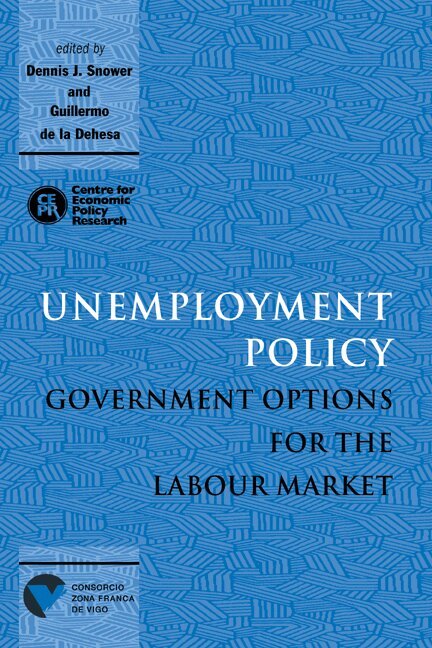
There is substantial disagreement among policy-makers about how governments should respond to the problem of high unemployment. Thus far there has been little, if any, systematic attempt to evaluate the strengths and weaknesses of the main unemployment policies available to governments in market economies. Individual policy recommendations are usually made in isolation from one another. This book attempts to provide a balanced assessment of the various policy options, including the following: demand management versus supply-side policy, subsidizing employment and training, restructuring labour market regulations, and reforming the welfare state. The book also examines the political economy of unemployment policy and the effect of this policy on productivity growth.
Employment Policy in Transition
The Lessons of German Integration for the Labor Market
Inbunden, Engelska, 2000
1 064 kr
Skickas inom 10-15 vardagar
A historically unique experiment is about to enter its second decade - German unification. Early hopes for a rapid and smooth economic transformation soon turned out to be overly optimistic. Despite massive financial transfers, the political promise of a "blooming landscape" remains a vision. Actual developments have left deep scars on the labor market, and the effects will be felt for decades to come. Was this outcome to be expected, perhaps even inevitable? What went wrong, and what were the available options? Or is the current state of Eastern German labor market in fact better than is commonly assumed?
Employment Policy in Transition
The Lessons of German Integration for the Labor Market
Häftad, Engelska, 2013
1 064 kr
Skickas inom 10-15 vardagar
A historically unique experiment is about to enter its second decade - German unification. Early hopes for a rapid and smooth economic transformation soon turned out to be overly optimistic. Despite massive financial transfers, the political promise of a "blooming landscape" remains a vision. Actual developments have left deep scars on the labor market, and the effects will be felt for decades to come. Was this outcome to be expected, perhaps even inevitable? What went wrong, and what were the available options? Or is the current state of Eastern German labor market in fact better than is commonly assumed?