Derek Bickerton - Böcker
Visar alla böcker från författaren Derek Bickerton. Handla med fri frakt och snabb leverans.
12 produkter
12 produkter
465 kr
Tillfälligt slut
753 kr
Skickas inom 5-8 vardagar
483 kr
Skickas inom 3-6 vardagar
"What this book proposes to do," writes Derek Bickerton, "is to stand the conventional wisdom of the behavioral sciences on its head: instead of the human species growing clever enough to invent language, it will view that species as blundering into language and, as a direct result of that, becoming clever." According to Bickerton, the behavioral sciences have failed to give an adequate account of human nature at least partly because of the conjunction and mutual reinforcement of two widespread beliefs: that language is simply a means of communication and that human intelligence is the result of the rapid growth and unusual size of human brains.Bickerton argues that each of the properties distinguishing human intelligence and consciousness from that of other animals can be shown to derive straightforwardly from properties of language. In essence, language arose as a representational system, not a means of communication or a skill, and not a product of culture but an evolutionary adaptation.The author stresses the necessity of viewing intelligence in evolutionary terms, seeing it not as problem solving but as a way of maintaining homeostasis—the preservation of those conditions most favorable to an organism, the optimal achievable conditions for survival and well-being. Nonhumans practice what he calls "on-line thinking" to maintain homeostasis, but only humans can employ off-line thinking: "only humans can assemble fragments of information to form a pattern that they can later act upon without having to wait on that great but unpunctual teacher, experience."The term protolanguage is used to describe the stringing together of symbols that prehuman hominids employed. "It did not allow them to turn today's imagination into tomorrow's fact. But it is just this power to transform imagination into fact that distinguishes human behavior from that of our ancestral species, and indeed from that of all other species. It is exactly what enables us to change our behavior, or invent vast ranges of new behavior, practically overnight, with no concomitant genetic changes."Language and Human Behavior should be of interest to anyone in the behavioral and evolutionary sciences and to all those concerned with the role of language in human behavior.
441 kr
Skickas inom 7-10 vardagar
In this volume the author describes and systematically accounts for language variation in a Creole-speaking community and assesses the implications the study has on generally accepted notions of the nature of language. Based on an extensive study of Guyana, South America, the volume analyses the bewildering diversity found in the syntax and underlying semantics of tense and aspect of the language of that country and shows that data which at first sight appear merely chaotic in fact represent different developmental stages of the language existing side by side in the contemporary community. The volume also offers strong support for theories of Creole origins of 'Black English' in the United States. It should be of interest not only to those linguists involved in Creole and pidgin studies but also to anyone concerned with general linguistic theory.
386 kr
Skickas inom 10-15 vardagar
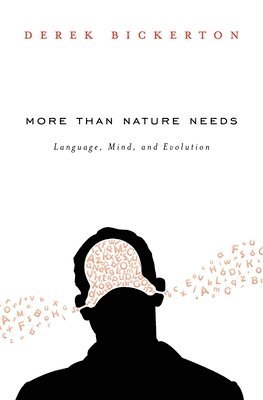
The human mind is an unlikely evolutionary adaptation. How did humans acquire cognitive capacities far more powerful than anything a hunting-and-gathering primate needed to survive? Alfred Russel Wallace, co-founder with Darwin of evolutionary theory, saw humans as "divine exceptions" to natural selection. Darwin thought use of language might have shaped our sophisticated brains, but his hypothesis remained an intriguing guess--until now. Combining state-of-the-art research with forty years of writing and thinking about language evolution, Derek Bickerton convincingly resolves a crucial problem that both biology and the cognitive sciences have hitherto ignored or evaded.What evolved first was neither language nor intelligence--merely normal animal communication plus displacement. That was enough to break restrictions on both thought and communication that bound all other animals. The brain self-organized to store and automatically process its new input, words. But words, which are inextricably linked to the concepts they represent, had to be accessible to consciousness. The inevitable consequence was a cognitive engine able to voluntarily merge both thoughts and words into meaningful combinations. Only in a third phase could language emerge, as humans began to tinker with a medium that, when used for communication, was adequate for speakers but suboptimal for hearers.Starting from humankind's remotest past, More than Nature Needs transcends nativist thesis and empiricist antithesis by presenting a revolutionary synthesis--one that instead of merely repeating "nature and nurture" clichés shows specifically and in a principled manner how and why the synthesis came about.
254 kr
Skickas inom 5-8 vardagar
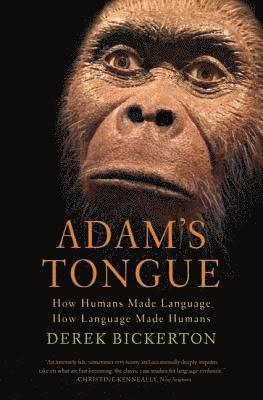
How language evolved has been called 'the hardest problem in science'. In "ADAM'S TONGUE", Derek Bickerton - long a leading authority in this field - shows how and why previous attempts to solve that problem have fallen short. Taking cues from topics as diverse as the foraging strategies of ants, the distribution of large prehistoric herbivores, and the construction of ecological niches, Bickerton produces a dazzling new alternative to the conventional wisdom. Language is unique to humans, but it isn't the only thing that sets us apart from other species - our cognitive powers are qualitatively different. So could there be two separate discontinuities between humans and the rest of nature? No, says Bickerton; he shows how the mere possession of symbolic units - words - automatically opened a new and different cognitive universe, one that yielded novel innovations ranging from barbed arrowheads to the Apollo spacecraft. Written in Bickerton's lucid and irreverent style, this book is the first to thoroughly integrate the story of how language evolved with the story of how humans evolved.Sure to be controversial, it will make indispensable reading both for experts in the field and for every reader who has ever wondered how a species as remarkable as ours could have come into existence.
Bastard Tongues: A Trailblazing Linguist Finds Clues to Our Common Humanity in the World's Lowliest Languages
Häftad, Engelska, 2009
254 kr
Skickas inom 5-8 vardagar
306 kr
Skickas inom 3-6 vardagar
306 kr
Skickas inom 3-6 vardagar
170 kr
Tillfälligt slut
422 kr
Skickas inom 3-6 vardagar
294 kr
Skickas inom 5-8 vardagar