D.L. Borchers - Böcker
Visar alla böcker från författaren D.L. Borchers. Handla med fri frakt och snabb leverans.
4 produkter
4 produkter
1 430 kr
Skickas inom 7-10 vardagar
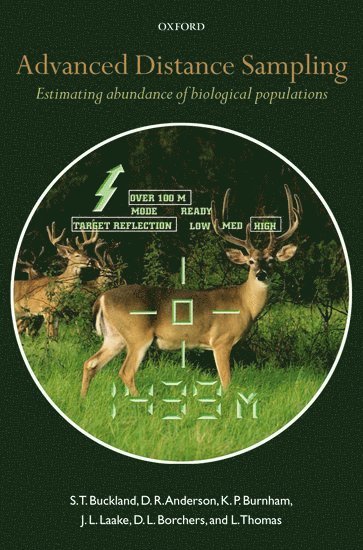
This advanced text focuses on the uses of distance sampling to estimate the density and abundance of biological populations. It addresses new methodologies, new technologies and recent developments in statistical theory and is the follow up companion to Introduction to Distance Sampling (OUP, 2001). In this text, a general theoretical basis is established for methods of estimating animal abundance from sightings surveys, and a wide range of approaches to analysis of sightings data is explored. These approaches include: modelling animal detectability as a function of covariates, where the effects of habitat, observer, weather, etc. on detectability can be assessed; estimating animal density as a function of location, allowing for example animal density to be related to habitat and other locational covariates; estimating change over time in populations, a necessary aspect of any monitoring programme; estimation when detection of animals on the line or at the point is uncertain, as often occurs for marine populations, or when the survey region has dense cover; survey design and automated design algorithms, allowing rapid generation of sound survey designs using geographic information systems; adaptive distance sampling methods, which concentrate survey effort in areas of high animal density; passive distance sampling methods, which extend the application of distance sampling to species that cannot be readily detected in sightings surveys, but can be trapped; and testing of methods by simulation, so that performance of the approach in varying circumstances can be assessed. Authored by a leading team this text is aimed at professionals in government and environment agencies,statisticians, biologists, wildlife managers, conservation biologists and ecologists, as well as graduate students, studying the density and abundance of biological populations.
817 kr
Skickas inom 7-10 vardagar
This advanced text focuses on the uses of distance sampling to estimate the density and abundance of biological populations. It addresses new methodologies, new technologies and recent developments in statistical theory and is the follow up companion to Introduction to Distance Sampling (OUP, 2001). In this text, a general theoretical basis is established for methods of estimating animal abundance from sightings surveys, and a wide range of approaches to analysis of sightings data is explored. These approaches include: modelling animal detectability as a function of covariates, where the effects of habitat, observer, weather, etc. on detectability can be assessed; estimating animal density as a function of location, allowing for example animal density to be related to habitat and other locational covariates; estimating change over time in populations, a necessary aspect of any monitoring programme; estimation when detection of animals on the line or at the point is uncertain, as often occurs for marine populations, or when the survey region has dense cover; survey design and automated design algorithms, allowing rapid generation of sound survey designs using geographic information systems; adaptive distance sampling methods, which concentrate survey effort in areas of high animal density; passive distance sampling methods, which extend the application of distance sampling to species that cannot be readily detected in sightings surveys, but can be trapped; and testing of methods by simulation, so that performance of the approach in varying circumstances can be assessed.
538 kr
Skickas inom 10-15 vardagar
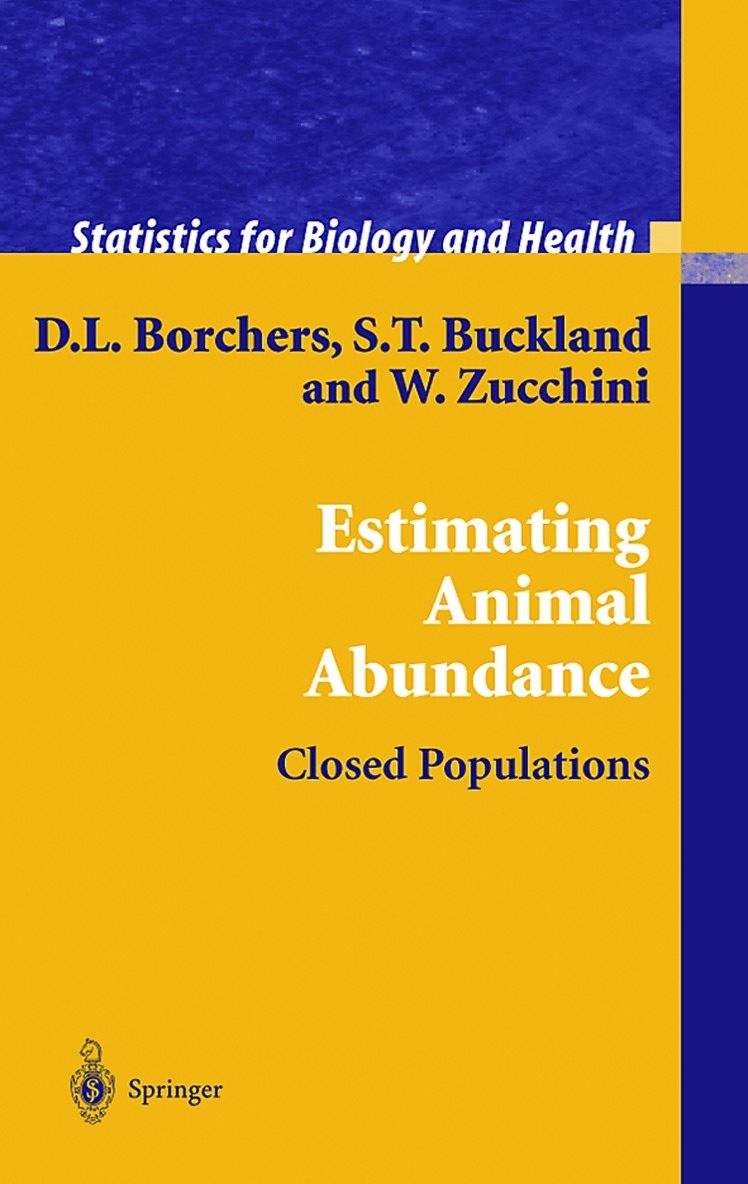
Open population methods are in many ways simply extensions of closed population methods, and we have tried to pro vide the reader with a foundation on which understanding of both closed and open population methods can develop.
538 kr
Skickas inom 10-15 vardagar
This is the first book to provide an accessible comprehensive introduction to wildlife population assessment methods. It uses a new approach that makes the full range of methods accessible in a way that has not previously been possible. Traditionally, newcomers to the field have had to face the daunting prospect of grasping new concepts for almost every one of the many methods. In contrast, this book uses a single conceptual (and statistical) framework for all the methods. This makes understanding the apparently different methods easier because each can be seen to be a special case of the general framework. The approach provides a natural bridge between simple methods and recently developed methods. It also links closed population methods quite naturally with open population methods. The book is accompanied by free software on the web, in the form of an R library, allowing readers to get some "hands-on" experience with the methods and how they perform in different contexts - without the considerable effort and expense required to do this in the real world.It also provides a tool for teaching the methods, including a means for teachers to generate examples and exercises customised to the needs of their students. As the first truly up-to-date and introductory text in the field, this book should become a standard reference for students and professionals in the fields of statistics, biology and ecology.