• Fri frakt över 249 kr
  • •
  • Snabba leveranser
  • •
  • Billiga böcker
Kundservice

Du är på sajten för privatpersoner.

Företag, bibliotek eller offentlig verksamhet?

Du handlar på classic.bokus.com, där alla dina funktioner finns intakta.
Till classic.bokus.com
Bokus logotyp. Gå till startsidan.
  • Erbjudanden
  • Nyheter
  • Student
  • Topplistor
  • Barn & ungdom
  • Bokus Play
  • E-böcker
  • Pocketböcker
  • Spel & pussel

10% rabatt på allt med kod NYSTART10 →

Sidfot

Mina sidor

    Hjälp

    • Kundservice
    • Vanliga frågor och svar
    • Frakt och leverans
    • Retur vid ångerrätt
    • Reklamera vara
    • Betalning
    • Köpvillkor
    • Allmänna villkor
    • Information om webbplatsens tillgänglighet

    Om Bokus

    • Om oss
    • Pressrum
    • För studenter
    • För företag
    • För bibliotek och offentlig verksamhet
    • För leverantörer
    • Hållbarhet

    Populärt

    • Aktuella erbjudanden
    • Presentkort
    • Studentlitteratur
    • Nya böcker
    • Topplistor
    • Signerade böcker
    • Engelska böcker

    Inspiration

    • Boktips
    • BookTok
    • Populära bokserier
    • Barnbokskaraktärer
    • Populära författare
    Logotyp för Bokus
    Följ oss på Facebook (extern länk)Följ oss på Instagram (extern länk)Följ oss på YouTube (extern länk)Följ oss på TikTok (extern länk)
    bokus @ CookiesAnpassa cookiesIntegritetspolicyKöpvillkor
    Till Citymail hemsida (extern länk)Till Budbee hemsida (extern länk)Till Postnord hemsida (extern länk)Till Schenker hemsida (extern länk)Till Early Bird hemsida (extern länk)Till Walleys hemsida (extern länk)
    1. Naturvetenskap och teknik
    2. Matematik och naturvetenskap
    3. Biologi
    4. Zoologi

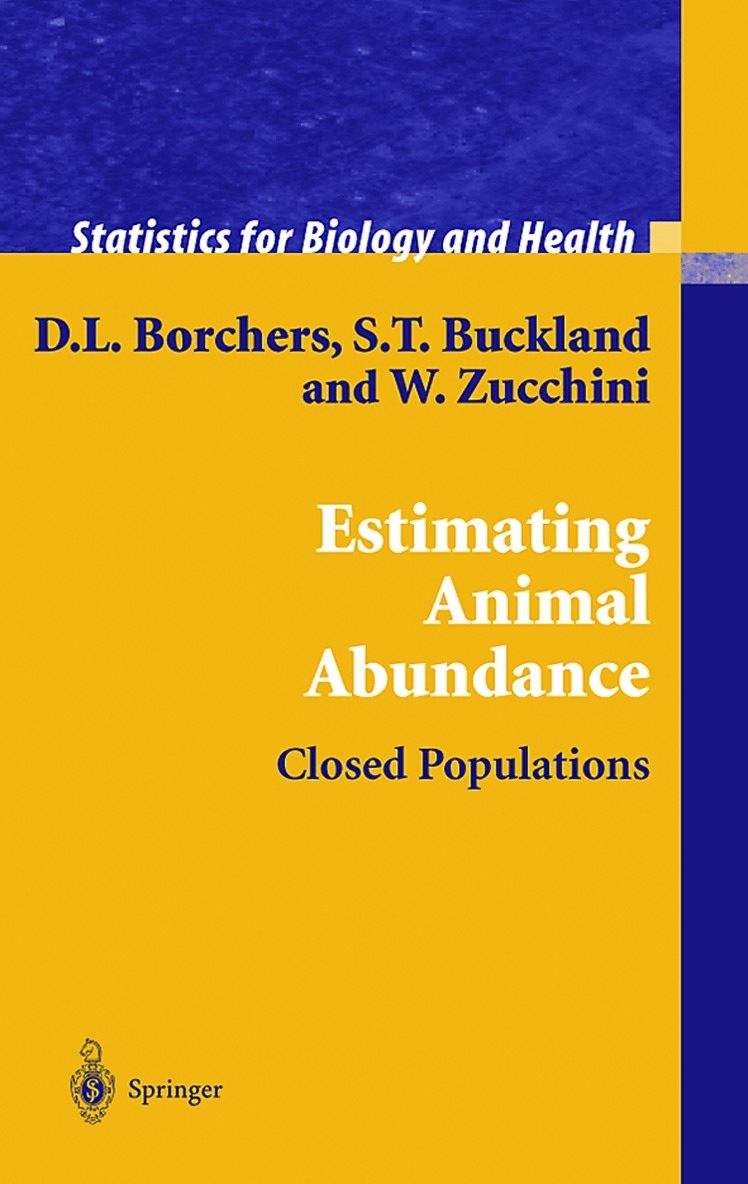
    Estimating Animal Abundance

    Closed Populations

    AvD.L. Borchers,Stephen T. Buckland

    Inbunden, Engelska, 2002

    Del i serien Statistics for Biology and Health

    546 kr

    Beställningsvara. Skickas inom 10-15 vardagar. Fri frakt över 249 kr.

    Fler format och utgåvor

    Häftad

    546 kr

    Beskrivning

    We hope this book will make the bewildering variety of methods for estimat­ ing the abundance of animal populations more accessible to the uninitiated and more coherent to the cogniscenti. We have tried to emphasize the fun­ damental similarity of many methods and to draw out the common threads that underlie them. With the exception of Chapter 13, we restrict ourselves to closed populations (those that do not change in composition over the period(s) being considered). Open population methods are in many ways simply extensions of closed population methods, and we have tried to pro­ vide the reader with a foundation on which understanding of both closed and open population methods can develop. We would like to thank Miguel Bernal for providing the St Andrews example dataset used frequently in the book; Miguel Bernal and Jeff Laake for commenting on drafts of the book; Jeff Laake for providing Figure 10.1; NRC Research Press for allowing us to use Figures 10.2, 10.3, 10.4, 10.5, 10.6 and10.7; the International Whaling Commission for allowing us to use Figure 12.1; Sharon Hedley for providing Figures 12.1 and 12.2. D.L.B. is eternally indebted to Carol, Alice and Aidan for their support through writing the book, and for the many evenings and weekends that it has taken from them.

    Produktinformation

    • Utgivningsdatum:2002-07-01
    • Mått:155 x 235 x 24 mm
    • Vikt:664 g
    • Format:Inbunden
    • Språk:Engelska
    • Serie:Statistics for Biology and Health
    • Antal sidor:314
    • Upplaga:2002
    • Förlag:Springer London Ltd
    • ISBN:9781852335601

    Utforska kategorier

    • Zoologi inom Naturvetenskap och teknik
    • Naturvetenskap:allmänt inom Naturvetenskap och teknik
    • Djurböcker inom Djur och Natur

    Recensioner i media

    From the reviews: "In a unified likelihood-based framework, this book provides an excellent updated introduction to closed population models. The authors also briefly address how the framework can be extended to deal with open populations...In addition to intended readers in biology, ecology and statistics, this book will reach a wider audience in other disciplines as some closed models have been widely applied to other areas including epidemiology, health sciences, software reliability and census undercount estimation. I compliment the authors for this significant book and hope they will write another on open populations." Biometrics "This is a useful book. It provides a comprehensive, readable survey which should be of value to anyone who wants an introduction to the currently available methodology for estimating animal numbers." International Statistical Institute, Short Book Reviews "The great strength of this text is that all methods are described not just in the same book, but in the same statistical framework... The authors have gone to great lengths to explain the principles underlying every method, in easily accessible, nonspecialist language. This includes a single-sentence "key idea" at the beginning of every chapter, which is generally a succinct and pertinent introduction. Practitioners with little background in statistics will find these explanations particularly worthwhile, being all too-familiar with the "recipe"approach to statistical analyses..."Coherence for the cognoscenti" is possibly the book's greatest contribution. It unfolds like a well-written sonata, with every section echoing the underlying themes before letting rip with the detailed development. Its potential as a nursery for new research ideas should not be overlooked." Journal of the American Statistical Association "This would be a good reference book for bio-statisticians interested in problems of estimation of animal abundance." (T.J. Rao, Sankhya, Vol. 65 (2), 2003) "This book introduces and surveys the various methods used to assess wildlife populations. ... This is a useful book. It provides a comprehensive, readable survey which should be of value to anyone who wants an introduction to the currently available methodology for estimating animal numbers. The book is well-written. ... Relevant free software is also available on the web in the form of an R Library of simulation and estimation functions for many of the advanced methods ... ." (C.D. Kemp, Short Book Reviews, Vol. 23 (1), 2003) "This is the first book to provide an accessible, comprehensive introduction to wildlife population assessment methods. It uses a new approach that makes the full range of methods accessible ... . This book uses a single conceptual and statistical framework for all the methods. This makes understanding the apparently different methods easier ... . As the first truly up-to-date and introductory text in the field, this book should become a standard reference for students and professionals in the fields of statistics, biology and ecology." (T. Postelnicu, Zentralblatt MATH, Vol. 1002 (2), 2003)

    Innehållsförteckning

    • 1 Introduction.- 2 Using likelihood for estimation.- 3 Building blocks.- 4 Plot sampling.- 5 Removal, catch-effort and change-in-ratio.- 6 Simple mark-recapture.- 7 Distance sampling.- 8 Nearest neighbour and point-to-nearest-object.- 9 Further building blocks.- 10 Spatial/temporal models with certain detection.- 11 Dealing with heterogeneity.- 12 Integrated models.- 13 Dynamic and open population models.- 14 Which method?.- A Notation and Glossary.- A.1 Notation.- A.2 Glossary.- B Statistical formulation for observation models.- B.1 Detection function.- B.2 Multiple surveys.- C The asymptotic variance of MLEs.- C.1 Estimating the variance of an MLE.- C.2 Estimating the variance of a function of an MLE.- C.3 A one-parameter example.- C.3.1 Fisher information version 1.- C.3.2 Fisher information version 2.- C.3.3 Observed information.- D State models for mark-recapture and removal methods.- D.1 Static population.- D.2 Independent dynamics.- D.3 Markov dynamics.- References.