Donald K. Swearer - Böcker
Visar alla böcker från författaren Donald K. Swearer. Handla med fri frakt och snabb leverans.
9 produkter
9 produkter
739 kr
Skickas inom 7-10 vardagar
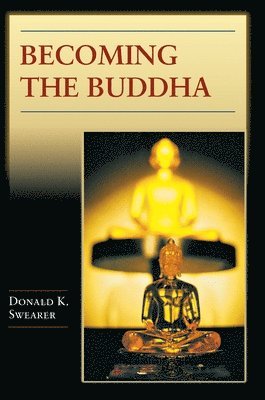
Becoming the Buddha is the first book-length study of a key ritual of Buddhist practice in Asia: the consecration of a Buddha image or "new Buddha," a ceremony by which the Buddha becomes present or alive. Through a richly detailed, accessible exploration of this ritual in northern Thailand, an exploration that stands apart from standard text-based or anthropological approaches, Donald Swearer makes a major contribution to our understanding of the Buddha image, its role in Buddhist devotional life, and its relationship to the veneration of Buddha relics. Blending ethnography, analysis, and Buddhist texts related to this mimetic reenactment of the night of the Buddha's enlightenment, he demonstrates that the image becomes the Buddha's surrogate by being invested with the Buddha's story and charged with the extraordinary power of Buddhahood. The process by which this transformation occurs through chant, sermon, meditation, and the presence of charismatic monks is at the heart of this book. Known as "opening the eyes of the Buddha," image consecration traditions throughout Buddhist Asia share much in common.Within the cultural context of northern Thailand, Becoming the Buddha illuminates scriptural accounts of the making of the first Buddha image; looks at debates over the ritual's historical origin, at Buddhological insights achieved, and at the hermeneutics of absence and presence; and provides a thematic comparison of several Buddhist traditions.
382 kr
Tillfälligt slut
This work brings together in a single volume the translated essays of Buddhadasā Bhikkhu, the major interpreter of Theravada Buddhism in Southeast Asia.
432 kr
Tillfälligt slut
An English translation and a commentary on the chronicle of Queen Cama, an important but neglected female monarch who founded a dynasty in Northern Thailand.The Legend of Queen Cāma ( Cāmadevīvaṃsa), an early fifteenth-century Pali chronicle written by Mahathera Bodhiraṃsi, recounts the story of the founding of the kingdom of Haripuñjaya in the Chiang Mai valley of Northern Thailand in the seventh century C.E. Similar to other Theravāda Pali chronicles, the legend integrates religious and political stories, namely, Queen Cāma's founding of a dynastic lineage and the fortunes of Buddhism within it. The Legend of Queen Cāma offers revealing insights into the nature of Buddhism as a living tradition during one of the greatest periods in the history of Thai Buddhism. These insights include the symbolic structure of Buddhist cosmology, the close association of Buddhism and the founding of city states, the interrelationship of popular Buddhist ethical teachings and devotional religion, and the inherently syncretic nature of Buddhism as presented in a text indebted to the folkloric traditions of Northern Thailand.One of the most striking features of the book is the parallelism between the text's dominant narratives—the Buddha's journey to Northern Thailand and his prediction of the discovery of a Buddha relic by King Adittaraja (eleventh century C.E.), and the founding by Queen Cāma of a lineage destined to govern Haripunjaya for five hundred years. The Buddha and Queen Cāma are equal partners in this creative, cosmically significant act. Both plant the seeds that mature into a Mon Buddhist politico-cultural center that predates the advent of Thai suzerainty in Northern Thailand by five hundred years.
Del 10 - Religions of the World and Ecology
Ecology and the Environment
Perspectives from the Humanities
Häftad, Engelska, 2009
172 kr
Skickas inom 11-20 vardagar
The scientific, political, and economic policy debates about the global environmental crisis have tended to ignore its historical, ethical, religious, and aesthetic dimensions. This book redresses that omission by highlighting these humanistic components that are integral to the fabric of our ecological understanding and, consequentially, essential to a broad, multidisciplinary approach to environmental studies and public policy initiatives. In this slim volume, seven world-class scholars discuss the wide range of perspectives that the fields of literature, history, religion, philosophy, environmental ethics, and anthropology bring to the natural environment and our place in it. The preface summarizes the development of the religion and ecology movement; the editor’s critical introduction highlights the essays’ major themes. Bringing insights from the humanities to bear on ecological concerns, this volume will appeal to a wide audience in the humanities and environmental studies, policy makers, and the general public. The book represents a continuation of the Center for the Study of World Religions’ highly regarded Religions of the World and Ecology series.
133 kr
Skickas inom 7-10 vardagar
In our globalized world, differing conceptions of human nature and human values raise questions as to whether universal and partisan claims and perspectives can be reconciled, whether interreligious and intercultural conversations can help build human community, and whether a pluralistic ethos can transcend uncompromising notions as to what is true, good, and just.In this volume, world-class scholars from religious studies, the humanities, and the social sciences explore what it means to be human through a multiplicity of lives in time and place as different as fourth-century BCE China and the world of an Alzheimer’s patient today. Refusing the binary, these essays go beyond description to theories of aging and acceptance, ethics in caregiving, and the role of ritual in healing the inevitable divide between the human and the ideal.
196 kr
Skickas inom 7-10 vardagar
In this volume, prominent Buddhist scholar Donald Swearer posits that the future requires a radical shift toward living in recognition of the interdependence of all life forms and the consequent ethic of communality and a life style of moderation or “enoughness” that flows from that recognition, which he calls “an ecology of human flourishing.” Swearer has assembled world-class thinkers to explore and imagine several dimensions of an ecology of human flourishing: economic, sociological, religious, ethical, environmental, historical, literary; how notions of human flourishing, quality of life, and common good have been constructed; and, in the contemporary world, how they are illuminated or are challenged by issues of distributive justice, poverty and economic inequality, global health, and environmental sustainability.With contributors ranging from ecoactivist Bill McKibben and medical anthropologist Arthur Kleinman, to transformative theologian Sallie McFague and Malaysian critic of global injustice Chandra Muzzafar, this book expresses ethical and religious aspirations to remake the world in the midst of the contradictions, injustices, and problems of our daily lives and today's global economic and climate crises.
372 kr
Skickas inom 7-10 vardagar
A wide-ranging, readable account of the Theravada Buddhist thought and practice in the Southeast Asian societies of Thailand, Myanmar (Burma), Laos, Cambodia, and Sri Lanka.An unparalleled portrait, Donald K. Swearer's Buddhist World of Southeast Asia has been a key source for all those interested in the Theravada homelands since the work's publication in 1995. Expanded and updated, the second edition offers this wide ranging account for readers at the beginning of the twenty-first century.Swearer shows Theravada Buddhism in Southeast Asia to be a dynamic, complex system of thought and practice embedded in the cultures, societies, and histories of Thailand, Myanmar (Burma), Laos, Cambodia, and Sri Lanka. The work focuses on three distinct yet interrelated aspects of this milieu. The first is the popular tradition of life models personified in myths and legends, rites of passage, festival celebrations, and ritual occasions. The second deals with Buddhism and the state, illustrating how King Asoka serves as the paradigmatic Buddhist monarch, discussing the relationship of cosmology and kingship, and detailing the rise of charismatic Buddhist political leaders in the postcolonial period. The third is the modern transformation of Buddhism: the changing roles of monks and laity, modern reform movements, the role of women, and Buddhism in the West.
989 kr
Skickas inom 7-10 vardagar
A wide-ranging, readable account of the Theravada Buddhist thought and practice in the Southeast Asian societies of Thailand, Myanmar (Burma), Laos, Cambodia, and Sri Lanka.An unparalleled portrait, Donald K. Swearer's Buddhist World of Southeast Asia has been a key source for all those interested in the Theravada homelands since the work's publication in 1995. Expanded and updated, the second edition offers this wide ranging account for readers at the beginning of the twenty-first century.Swearer shows Theravada Buddhism in Southeast Asia to be a dynamic, complex system of thought and practice embedded in the cultures, societies, and histories of Thailand, Myanmar (Burma), Laos, Cambodia, and Sri Lanka. The work focuses on three distinct yet interrelated aspects of this milieu. The first is the popular tradition of life models personified in myths and legends, rites of passage, festival celebrations, and ritual occasions. The second deals with Buddhism and the state, illustrating how King Asoka serves as the paradigmatic Buddhist monarch, discussing the relationship of cosmology and kingship, and detailing the rise of charismatic Buddhist political leaders in the postcolonial period. The third is the modern transformation of Buddhism: the changing roles of monks and laity, modern reform movements, the role of women, and Buddhism in the West.
358 kr
Skickas inom 3-6 vardagar
The mountains of northern Thailand constitute part of northern Thai identity. They inspire fear and awe, respect and love, curiosity and creative imagination. They define both the physical and mental landscape of northern Thailand.Drawing on the legendary histories of three mountains in the region—Doi Ang Salung Chiang Dao, Doi Suthep, and Doi Kham—coauthor Donald Swearer explores the various ways that mountains in northern Thailand are seen as sacred space, and therefore as an environment to be respected rather than exploited.The volume presents, in English translation, the stories associated with these sacred sites as recorded in the legendary chronicles, or tamnan, of the story of the Chiang Dao mountain and cave, the account of the enshrining of the Buddha relic on Doi Suthep, and the interwoven legends of the hermit Wasuthep, the demons Pu Sae and Ya Sae, the chief Wilangkha, and the queen Chamathewi.In preserving the fascinating folklore of these sacred mountains, the authors contribute to the preservation of the mountains themselves.