Doris Marie Provine - Böcker
Visar alla böcker från författaren Doris Marie Provine. Handla med fri frakt och snabb leverans.
4 produkter
4 produkter
235 kr
Skickas inom 7-10 vardagar
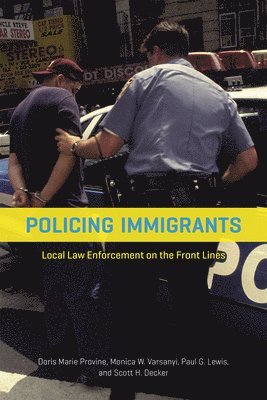
The United States deported nearly two million illegal immigrants during the first five years of the Obama presidency—more than during any previous administration. President Obama stands accused by activists of being “deporter in chief.” Yet despite efforts to rebuild what many see as a broken system, the president has not yet been able to convince Congress to pass new immigration legislation, and his record remains rooted in a political landscape that was created long before his election. Deportation numbers have actually been on the rise since 1996, when two federal statutes sought to delegate a portion of the responsibilities for immigration enforcement to local authorities.Policing Immigrants traces the transition of immigration enforcement from a traditionally federal power exercised primarily near the US borders to a patchwork system of local policing that extends throughout the country’s interior. Since federal authorities set local law enforcement to the task of bringing suspected illegal immigrants to the federal government’s attention, local responses have varied. While some localities have resisted the work, others have aggressively sought out unauthorized immigrants, often seeking to further their own objectives by putting their own stamp on immigration policing. Tellingly, how a community responds can best be predicted not by conditions like crime rates or the state of the local economy but rather by the level of conservatism among local voters. What has resulted, the authors argue, is a system that is neither just nor effective—one that threatens the core crime-fighting mission of policing by promoting racial profiling, creating fear in immigrant communities, and undermining the critical community-based function of local policing.
224 kr
Skickas inom 7-10 vardagar
Race is clearly a factor in government efforts to control dangerous drugs, but the precise ways that race affects drug laws remain difficult to pinpoint. Illuminating this elusive relationship, "Unequal under Law" lays out how decades of both manifest and latent racism helped shape a punitive U.S. drug policy whose onerous impact on racial minorities has been willfully ignored by Congress and the courts. Doris Marie Provine's engaging analysis traces the history of race in anti-drug efforts from the temperance movement of the early 1900s to the crack scare of the late twentieth century, showing how campaigns to criminalize drug use have always conjured images of feared minorities. Explaining how alarm over a threatening black drug trade fueled support in the 1980s for a mandatory minimum sentencing scheme of unprecedented severity, Provine contends that while our drug laws may no longer be racist by design, they remain racist in design. Moreover, their racial origins have long been ignored by every branch of government.This dangerous denial threatens our constitutional guarantee of equal protection of law and mutes a much-needed national discussion about institutionalized racism - a discussion that Unequal under Law promises to initiate.
559 kr
Skickas inom 5-8 vardagar
This comprehensive book compares the intersection of political forces and legal practices in five industrial nations—the United States, England, France, Germany, and Japan. The authors, eminent political scientists and legal scholars, investigate how constitutional courts function in each country, how the adjudication of criminal justice and the processing of civil disputes connect legal systems to politics, and how both ordinary citizens and large corporations use the courts.For each of the five countries, the authors discuss the structure of courts and access to them, the manner in which politics and law are differentiated or amalgamated, whether judicial posts are political prizes or bureaucratic positions, the ways in which courts are perceived as legitimate forms for addressing political conflicts, the degree of legal consciousness among citizens, the kinds of work lawyers do, and the manner in which law and courts are used as social control mechanisms. The authors find that although the extent to which courts participate in policymaking varies dramatically from country to country, judicial responsiveness to perceived public problems is not a uniquely American phenomenon.
369 kr
Skickas inom 3-6 vardagar