E. Jennifer Ashworth - Böcker
Visar alla böcker från författaren E. Jennifer Ashworth. Handla med fri frakt och snabb leverans.
2 produkter
2 produkter
Del 25 - Auctores Britannici Medii Aevi
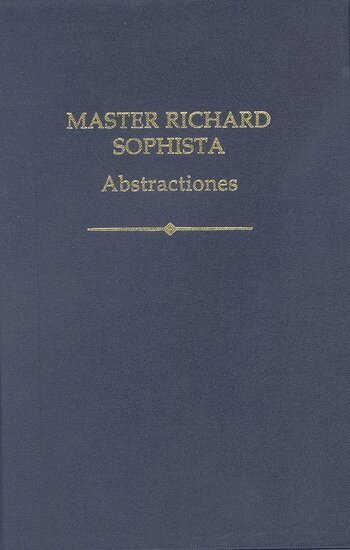
Master Richard Sophista: Abstractiones
Abstractiones
Inbunden, Engelska, 2016
1 305 kr
Skickas inom 7-10 vardagar
The Abstractiones is a work in medieval logic from the second half of the 13th century. Clearly a product of the British university culture and much cited, quoted and imitated, it is attributed in two manuscripts to 'Master Richard the Sophist'. This Richard is referred to by other philosophers and logicians as 'The Master of Abstractions' - an honorific title which indicates that his work was a standard textbook. The Abstractiones is a collection of sophismata, or logical puzzles of increasing complexity and difficulty which have been gathered under logical operators like 'all'. Each sophisma is introduced by a proposition that appears to be both provably true and provably false, like 'God knows whatever he knew'. The Master determines the truth or falsity of the proposition and analyses the defects of the arguments that have been offered by detecting logical fallacies, equivocal expressions and the like. The work as we have it is clearly the result of a process of development, modification, and interpolation, probably extending over at least a generation. Although there came to be works that imitated the Abstractions and followed some of its plan and style, these are 'descendants,' rather than variations.The Abstractions gives us a better sense than does an independent and original work of medieval logic like William of Ockham's Summa Totius Logicae of how instruction in techniques of argumentation and reasoning, often of a fairly sophisticated sort, was carried on in British universities in the latter part of the 13th century and well into the 14th century.
2 197 kr
Skickas inom 7-10 vardagar
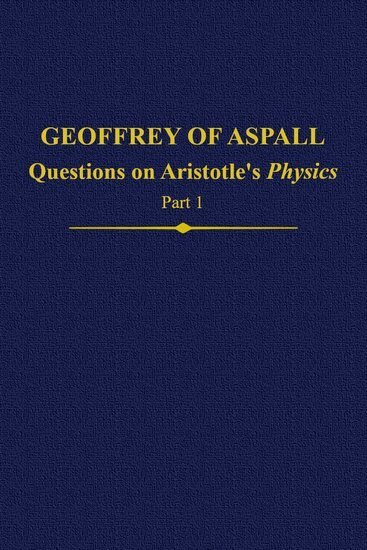
Geoffrey of Aspall, who died in 1287 and was master of Arts by 1262, was active at Oxford in the years 1255 to1265. He wrote commentaries on several Aristotelian works, and was certainly a major protagonist of the introduction of Aristotelian learning to Oxford. In particular, he produced a very extensive question-style commentary on Aristotle's Physics, which contains important discussions of the fundamental topics of Aristotle's natural philosophy, like matter, form, natural agency, causes, change, the infinite and the continuum, time, the eternity of the world, self-movers. Aspall's Physics commentary shows the influence of Grosseteste's metaphysics of light and of Roger Bacon's view on the physical role of intentional species, as well as a strong inclination to ontological realism.Aspall's commentary on Aristotle's Physics is edited here in two volumes, which together form the first critical edition of this work. The Latin text is accompanied by a facing English translation, and the text is extensively cross-referenced and provided with scholarly apparatus. The detailed introduction guides the reader through the intricacies of the textual transmission of Aspall's commentary, and also presents the main topics discussed in this commentary. The appendix to the edition makes available alternative versions of some sections of Aspall's commentary.