Eckart Schütrumpf - Böcker
Visar alla böcker från författaren Eckart Schütrumpf. Handla med fri frakt och snabb leverans.
9 produkter
9 produkter
2 091 kr
Skickas inom 10-15 vardagar
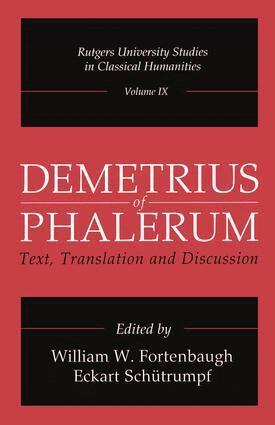
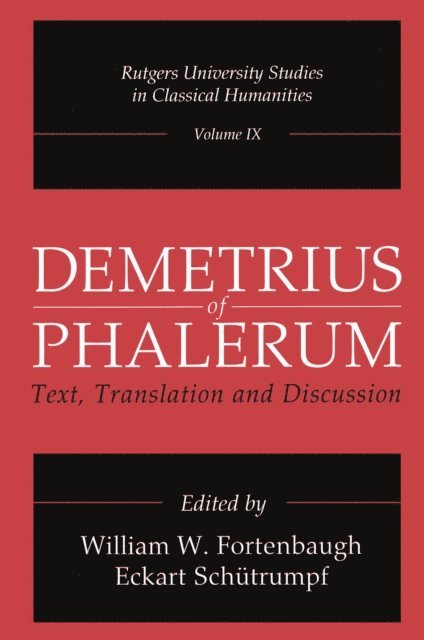
Demetrius of Phalerum (c. 355-280BCE) of Phalerum was a philosopher-statesman. He studied in the Peripatos under Theophrastus and subsequently used his political influence to help his teacher acquire property for the Peripatetic school. As overseer of Athens, his governance was characterized by a decade of domestic peace. Exiled to Alexandria in Egypt, he became the adviser of Ptolemy. He is said to have been in charge of legislation, and it is likely that he influenced the founding of the Museum and the Library.This edition of the fragments of Demetrius of Phalerum reflects the growing interest in the Hellenistic period and the philosophical schools of that age. As a philosopher-statesman, Demetrius appears to have combined theory and practice. For example, in the work On Behalf of the Politeia, he almost certainly explained his own legislation and governance by appealing to the Aristotelian notion of politeia, that is, a constitution in which democratic and oligarchic elements are combined. In On Peace, he may have defended his subservience to Macedon by appealing to Aristotle, who repeatedly recognized the importance of peace over war; and in On Fortune, he will have followed Theophrastus, emphasizing the way fortune can determine the success or failure of sound policy. Whatever the case concerning any one title, we can well understand why Cicero regarded Demetrius as a unique individual: the educated statesman who was able to bring learning out of the shadows of erudition into the light of political conflict, and that despite an oratorical style more suited to the shadows of the Peripatos then to political combat.The new edition of secondary reports by Stork, van Ophuijsen, and Dorandi brings together the evidence for these and other judgments. The facing translation which accompanies the Greek and Latin texts opens up the material to readers who lack the ancient languages, and the accompanying essays introduce us to important issues. The volume will be of interest to those interested in Greek literature, Hellenistic philosophy, Hellenistic history, and generally to persons captivated by the notion of philosopher-statesman.
2 091 kr
Skickas inom 10-15 vardagar
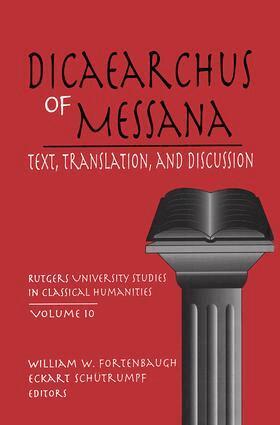
Dicaearchus of Messana (fl. c. 320 b.c.) was a peripatetic philosopher. Like Theophrastus of Eresus, he was a pupil of Aristotle. Dicaearchus's life is not well documented. There is no biography by Diogenes Laertius, and what the Suda offers is meager. However, it can be ascertained that a close friendship existed between Aristoxenus and Dicaearchus as both are mentioned as personal students of Aristotle.Dicaearchus lived for a time in the Peleponnesus, and in his pursuit of geographical studies and measuring mountains, he is said to have enjoyed the patronage of kings. Dicaearchus's interests were in certain respects narrower than Aristotle's. There is no evidence that Dicaearchus worked in logic, physics, or metaphysics. To the contrary, his work On the Soul recalls the Aristotelian treatise of the same title, but Dicaearchus's work was not an esoteric treatise. Instead, it was a dialogue in two parts. His interest in good and bad lifestyles also found expression in works such as On the Sacrifice at Ilium, and On the Destruction of Human Beings, in which he presented man himself as the greatest threat to mankind. In On Lives, a work of at least two books, he considered philosophers and others noted for their wisdom, with his main thesis being the superiority of the active life over that of quiet contemplation. Cicero speaks of controversy between Dicaearchus and Theophrastus the former championing the active life and the latter that of contemplation. Circuit of the Earth was a work of descriptive geography in which Dicaearchus said that the earth has the shape of a globe. This interest in earth's sphericity led him to make maps and discuss other phenomena like the cause of ebb- and flood-tides and the source of the Nile River. The largest number of texts in the collection deal with cultural history, most of which stem or appear to stem from his Life of Greece, while the smallest section deals with politics.This tenth volume in the series Rutgers Studies in Classical Humanities includes a facing translation of the Greek and Latin texts, making the material accessible to readers who lack the ancient languages, and the accompanying essays introduce important issues beyond the scope of the text.
686 kr
Skickas inom 10-15 vardagar
Demetrius of Phalerum (c. 355-280BCE) of Phalerum was a philosopher-statesman. He studied in the Peripatos under Theophrastus and subsequently used his political influence to help his teacher acquire property for the Peripatetic school. As overseer of Athens, his governance was characterized by a decade of domestic peace. Exiled to Alexandria in Egypt, he became the adviser of Ptolemy. He is said to have been in charge of legislation, and it is likely that he influenced the founding of the Museum and the Library.This edition of the fragments of Demetrius of Phalerum reflects the growing interest in the Hellenistic period and the philosophical schools of that age. As a philosopher-statesman, Demetrius appears to have combined theory and practice. For example, in the work On Behalf of the Politeia, he almost certainly explained his own legislation and governance by appealing to the Aristotelian notion of politeia, that is, a constitution in which democratic and oligarchic elements are combined. In On Peace, he may have defended his subservience to Macedon by appealing to Aristotle, who repeatedly recognized the importance of peace over war; and in On Fortune, he will have followed Theophrastus, emphasizing the way fortune can determine the success or failure of sound policy. Whatever the case concerning any one title, we can well understand why Cicero regarded Demetrius as a unique individual: the educated statesman who was able to bring learning out of the shadows of erudition into the light of political conflict, and that despite an oratorical style more suited to the shadows of the Peripatos then to political combat.The new edition of secondary reports by Stork, van Ophuijsen, and Dorandi brings together the evidence for these and other judgments. The facing translation which accompanies the Greek and Latin texts opens up the material to readers who lack the ancient languages, and the accompanying essays introduce us to important issues. The volume will be of interest to those interested in Greek literature, Hellenistic philosophy, Hellenistic history, and generally to persons captivated by the notion of philosopher-statesman.
826 kr
Skickas inom 10-15 vardagar
Dicaearchus of Messana (fl. c. 320 b.c.) was a peripatetic philosopher. Like Theophrastus of Eresus, he was a pupil of Aristotle. Dicaearchus's life is not well documented. There is no biography by Diogenes Laertius, and what the Suda offers is meager. However, it can be ascertained that a close friendship existed between Aristoxenus and Dicaearchus as both are mentioned as personal students of Aristotle.Dicaearchus lived for a time in the Peleponnesus, and in his pursuit of geographical studies and measuring mountains, he is said to have enjoyed the patronage of kings. Dicaearchus's interests were in certain respects narrower than Aristotle's. There is no evidence that Dicaearchus worked in logic, physics, or metaphysics. To the contrary, his work On the Soul recalls the Aristotelian treatise of the same title, but Dicaearchus's work was not an esoteric treatise. Instead, it was a dialogue in two parts. His interest in good and bad lifestyles also found expression in works such as On the Sacrifice at Ilium, and On the Destruction of Human Beings, in which he presented man himself as the greatest threat to mankind. In On Lives, a work of at least two books, he considered philosophers and others noted for their wisdom, with his main thesis being the superiority of the active life over that of quiet contemplation. Cicero speaks of controversy between Dicaearchus and Theophrastus the former championing the active life and the latter that of contemplation. Circuit of the Earth was a work of descriptive geography in which Dicaearchus said that the earth has the shape of a globe. This interest in earth's sphericity led him to make maps and discuss other phenomena like the cause of ebb- and flood-tides and the source of the Nile River. The largest number of texts in the collection deal with cultural history, most of which stem or appear to stem from his Life of Greece, while the smallest section deals with politics.This tenth volume in the series Rutgers Studies in Classical Humanities includes a facing translation of the Greek and Latin texts, making the material accessible to readers who lack the ancient languages, and the accompanying essays introduce important issues beyond the scope of the text.
821 kr
Skickas inom 10-15 vardagar
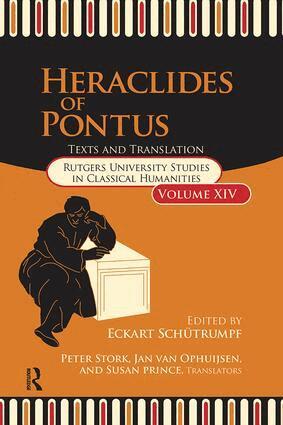
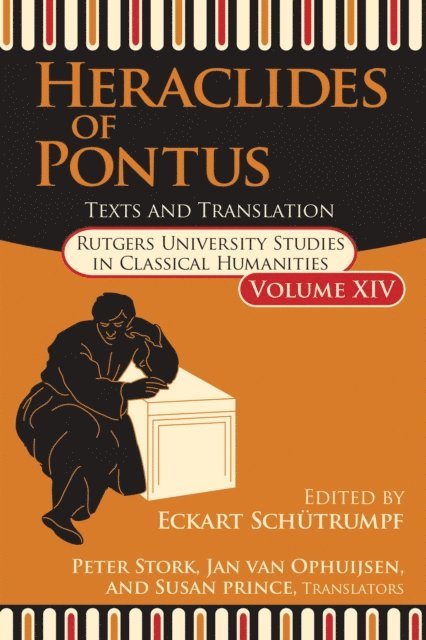
Heraclides of Pontus hailed from the shores of the Black Sea. He studied with Aristotle in Plato's Academy, and became a respected member of that school. During Plato's third trip to Sicily, Heraclides served as head of the Academy and was almost elected its head on the death of Speusippus. His interests were diverse. He wrote on the movements of the planets and the basic matter of the universe. He adopted a materialistic theory of soul, which he considered immortal and subject to reincarnation. He discussed pleasure, and like Aristotle, he commented on the Homeric poems. In addition, he concerned himself with religion, music, and medical issues. None of Heraclides' works have survived intact, but in antiquity his dialogues were much admired and often pillaged for sententiae and the like.The volume contains a new edition of the sources for Heraclides' life and thought. The text is by Eckart Schutrumpf and the translation by Peter Stork, Jan van Ophuijsen, and Susan Prince. The discussion of the sources includes contributions by twelve scholars: "La Tradizione Papirologica di Eraclide Pontico" by Tiziano Dorandi; "Heraclides' Intellectual Context" by Jorgen Mejer; "Heraclides of Pontus and the Philosophical Dialogue" by Matthew Fox; "Heraclides on Pleasure" by Eckart Schutrumpf; "Heraclides on the Soul and Its Ancient Readers" by Inna Kupreeva; "Unjointed Masses: A Note on Heraclides Physical Theory" by Robert W. Sharples; "Heliocentrism in or out of Heraclides" by Paul T. Keyser; "The Reception of Heraclides' Theory of the Rotation of the Earth from Posidonius to Simplicius: Texts, Contexts and Continuities" by Robert B. Todd and Alan C. Bowen; "Heraclides of Pontus on the Motions of Venus and Mercury by Alan C. Bowen and Robert B. Todd; "The Woman Not Breathing" by Philip van der Eijk; "Heraclides of Pontus on Homer" by Malcolm Heath; and "Heraclides and Musical History" by Andrew Barker.
2 103 kr
Skickas inom 10-15 vardagar
Heraclides of Pontus hailed from the shores of the Black Sea. He studied with Aristotle in Plato's Academy, and became a respected member of that school. During Plato's third trip to Sicily, Heraclides served as head of the Academy and was almost elected its head on the death of Speusippus. His interests were diverse. He wrote on the movements of the planets and the basic matter of the universe. He adopted a materialistic theory of soul, which he considered immortal and subject to reincarnation. He discussed pleasure, and like Aristotle, he commented on the Homeric poems. In addition, he concerned himself with religion, music, and medical issues. None of Heraclides' works have survived intact, but in antiquity his dialogues were much admired and often pillaged for sententiae and the like.The volume contains a new edition of the sources for Heraclides' life and thought. The text is by Eckart Schutrumpf and the translation by Peter Stork, Jan van Ophuijsen, and Susan Prince. The discussion of the sources includes contributions by twelve scholars: "La Tradizione Papirologica di Eraclide Pontico" by Tiziano Dorandi; "Heraclides' Intellectual Context" by Jorgen Mejer; "Heraclides of Pontus and the Philosophical Dialogue" by Matthew Fox; "Heraclides on Pleasure" by Eckart Schutrumpf; "Heraclides on the Soul and Its Ancient Readers" by Inna Kupreeva; "Unjointed Masses: A Note on Heraclides Physical Theory" by Robert W. Sharples; "Heliocentrism in or out of Heraclides" by Paul T. Keyser; "The Reception of Heraclides' Theory of the Rotation of the Earth from Posidonius to Simplicius: Texts, Contexts and Continuities" by Robert B. Todd and Alan C. Bowen; "Heraclides of Pontus on the Motions of Venus and Mercury by Alan C. Bowen and Robert B. Todd; "The Woman Not Breathing" by Philip van der Eijk; "Heraclides of Pontus on Homer" by Malcolm Heath; and "Heraclides and Musical History" by Andrew Barker.
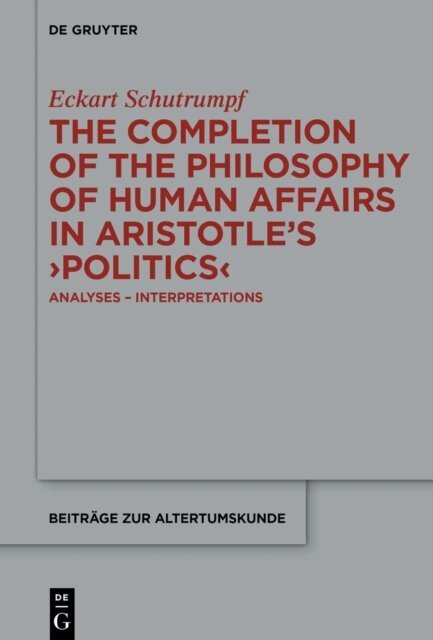
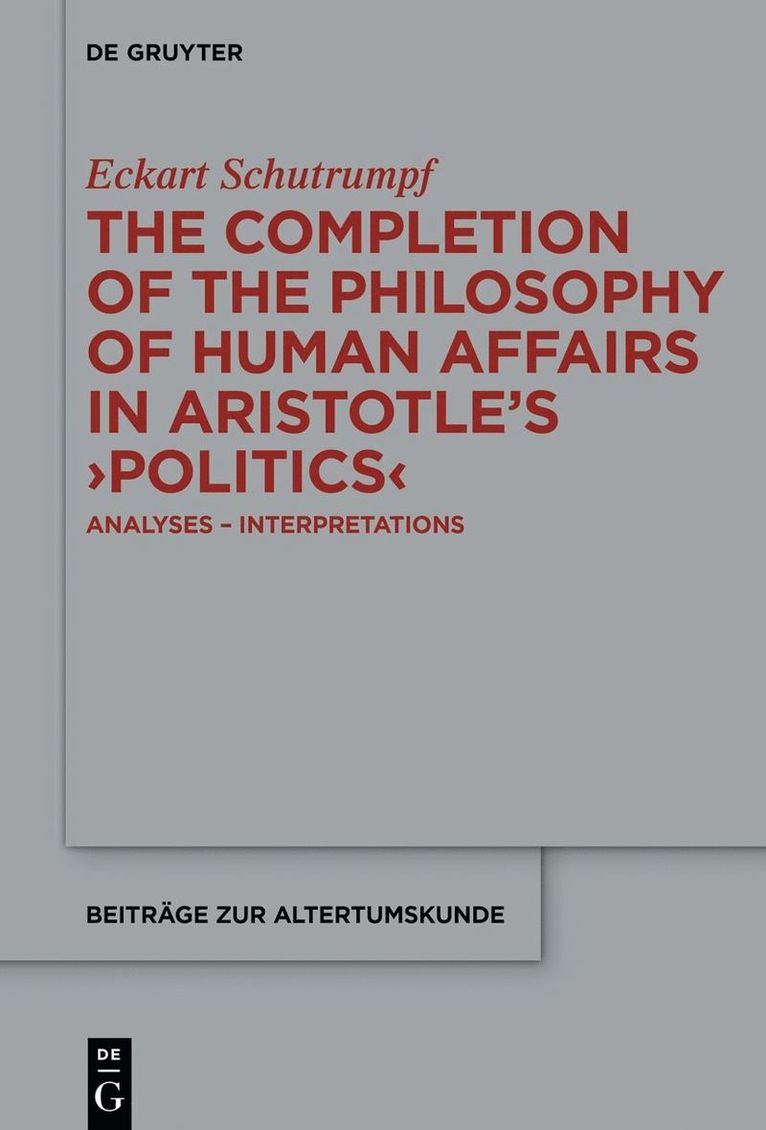
Completion of the Philosophy of Human Affairs in Aristotle's ›Politics‹
Analyses – Interpretations
Inbunden, Engelska, 2025
1 512 kr
Skickas inom 7-10 vardagar
This study addresses the often-discussed relationship between the two works that comprise Aristotle’s philosophy of human affairs, the Nicomachean Ethics and the Politics. Their relationship has been described often by determining “politics” as the subject of both.By this view, for the Nicomachean Ethics a political dimension is claimed which it does not have. While in Nicomachean Ethics 1.1 a political knowledge which possesses absolute powers is introduced, it has no counterpart in the Politics and is an abomination by the general views of the Politics about the powers, that is people, that govern the polis. On the other hand, by the view that Aristotle´s practical philosophy was unified, the Politics is not recognized as a theoretical study in its own right, which is independent of anything discussed in the Nicomachean Ethics, and pursues its own objectives.This study will focus on the central subjects of the Politics, its theoretical concepts and their relationship to one another. It will emphasize the dominant theoretical approach of this work, which develops in a systematic manner the crucial political concepts of polis, community, constitution, and addresses the political aspirations of free citizens which must be met.
291 kr
Skickas inom 3-6 vardagar
984 kr
Skickas inom 3-6 vardagar