Eduardo Gill-Pedro - Böcker
Visar alla böcker från författaren Eduardo Gill-Pedro. Handla med fri frakt och snabb leverans.
5 produkter
5 produkter
570 kr
Skickas inom 10-15 vardagar
The orthodox view is that rights complement democracy. This book critically examines this view in the context of EU fundamental rights, specifically in situations where EU law requires member states to respect EU fundamental rights. It first sets out a legal theoretical account of how human rights can complement democracy. It argues that they can do so only if they are understood as both the conditions for the democratic process, and the outcome of such a democratic process. In light of this legal theoretical account of human rights, this book examines the demands which the Court of Justice of the EU (CJEU) imposes on the national orders in respect of EU fundamental rights. The conclusion reached is that the demands which EU fundamental rights impose on national legal orders entail a cost for the democratic legitimacy of those legal orders. Ultimately, accepting the demands of the CJEU in respect of EU fundamental rights may require the national legal order to abandon its commitment to protecting the human rights which are the foundation of the national legal order’s very legitimacy.
1 930 kr
Skickas inom 10-15 vardagar
The orthodox view is that rights complement democracy. This book critically examines this view in the context of EU fundamental rights, specifically in situations where EU law requires member states to respect EU fundamental rights. It first sets out a legal theoretical account of how human rights can complement democracy. It argues that they can do so only if they are understood as both the conditions for the democratic process, and the outcome of such a democratic process. In light of this legal theoretical account of human rights, this book examines the demands which the Court of Justice of the EU (CJEU) imposes on the national orders in respect of EU fundamental rights. The conclusion reached is that the demands which EU fundamental rights impose on national legal orders entail a cost for the democratic legitimacy of those legal orders. Ultimately, accepting the demands of the CJEU in respect of EU fundamental rights may require the national legal order to abandon its commitment to protecting the human rights which are the foundation of the national legal order’s very legitimacy.
2 077 kr
Kommande
In this book, legal scholars from a range of disciplines examine the private commercial corporation as a bearer of rights and as the central actor in the global transformations that constitute the Technocene: a geological epoch brought about not by the actions of humans, individually or collectively, but by technological agency.Central to this agency is the modern company: a form of legal technology that has made possible the emergence of entities with their own interests and objectives and which are able to operate with a considerable degree of autonomy from the human beings that create them and that work within them. A key element in the construction of this legal technology has been the ascription of rights – by claiming rights companies get not only legal standing but also political and moral legitimacy. It is in this role, as a bearer of rights, that the company most closely mirrors the human legal subject.This volume is the first sustained, dedicated intervention to examine the private commercial corporation as a bearer of rights, and as a central actor in the global transformations that constitute the Technocene. It will be an indispensable resource for students and scholars of corporate law, human rights law and transnational law. The chapters were first published as a special issue of Transnational Legal Theory.
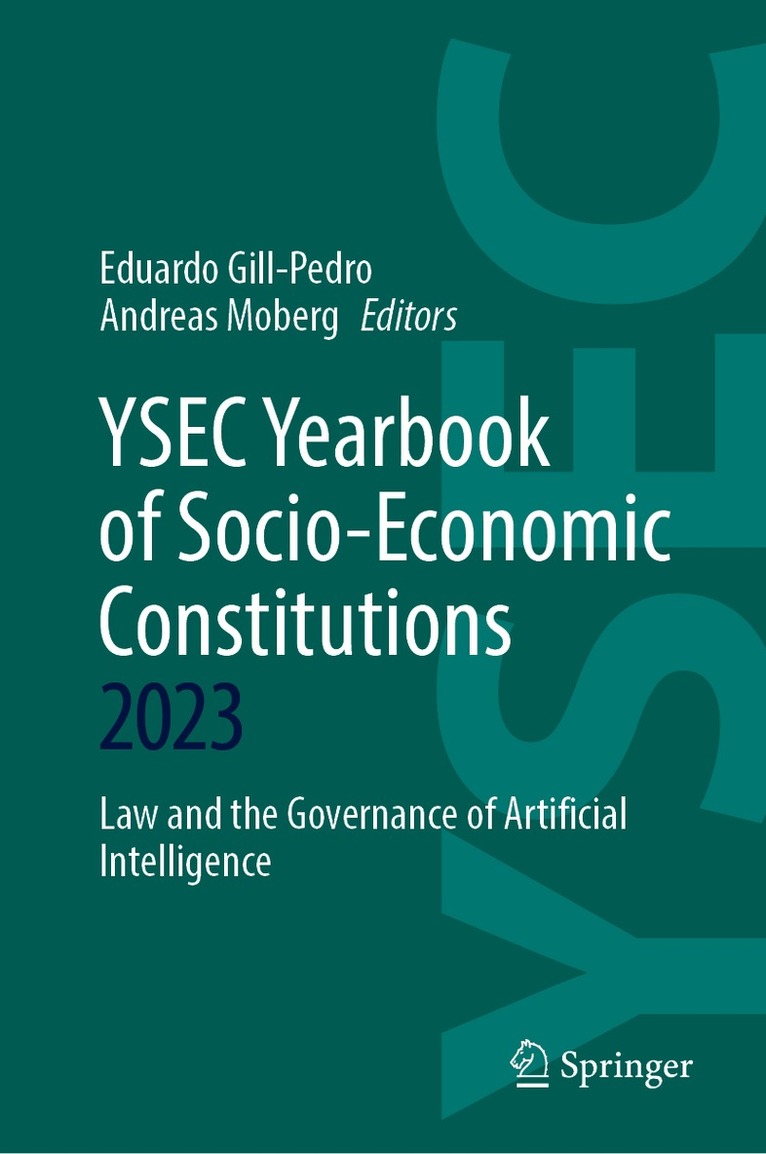
YSEC Yearbook of Socio-Economic Constitutions 2023
Law and the Governance of Artificial Intelligence
Inbunden, Engelska, 2024
1 554 kr
Skickas inom 10-15 vardagar
Artificial intelligence (AI) has the potential to radically transform our society. It may lead to a massive increase in the capabilities of humankind and allow us to address some of our most intractable challenges. It may also entail profound disruption to structures and processes that have sustained our society over centuries. These developments present a unique challenge to the socio-economic constitutional arrangements which govern our world at national, regional and international level. The deployment of increasingly powerful AI systems, able to function with increasing degree of autonomy, has led to concerns over loss of human control of important societal processes, over the disruption of existing economic, social and legal relationships, and over the empowerment of some societal actors at the expense of others, together with the entrenchment of situations of domination or discrimination. It has also made increasingly clear how tremendous the potential benefits, that these technologies may bring, are to those who successfully develop and deploy them. There is therefore great pressure on governments, international institutions, public authorities, civil society organisations, industry bodies and individual firms to introduce or adapt mechanisms and structures that will avoid the potentially negative outcomes of AI and achieve the positive ones. These mechanisms and structures, which have been given the umbrella term ‘AI governance’, cover a wide range of approaches, from individual firms introducing ethical principles which they volunteer to abide by, to the European Union legislating an AI Act, which will prohibit certain types of AI applications and impose binding obligations on AI developers and deployers. The fast pace of innovation in the development of AI technologies is mirrored by the fast pace of development of the emerging field of AI governance, where traditional legislation by public bodies is complemented with more innovative approaches, such ashybrid and adaptive governance, ethical alignment, governance by design and the creation of regulatory sandboxes. The chapter “AI and Sensitive Personal Data Under the Law Enforcement Directive: Between Operational Efficiency and Legal Necessity” is available open access under a Creative Commons Attribution 4.0 International License via link.springer.com.
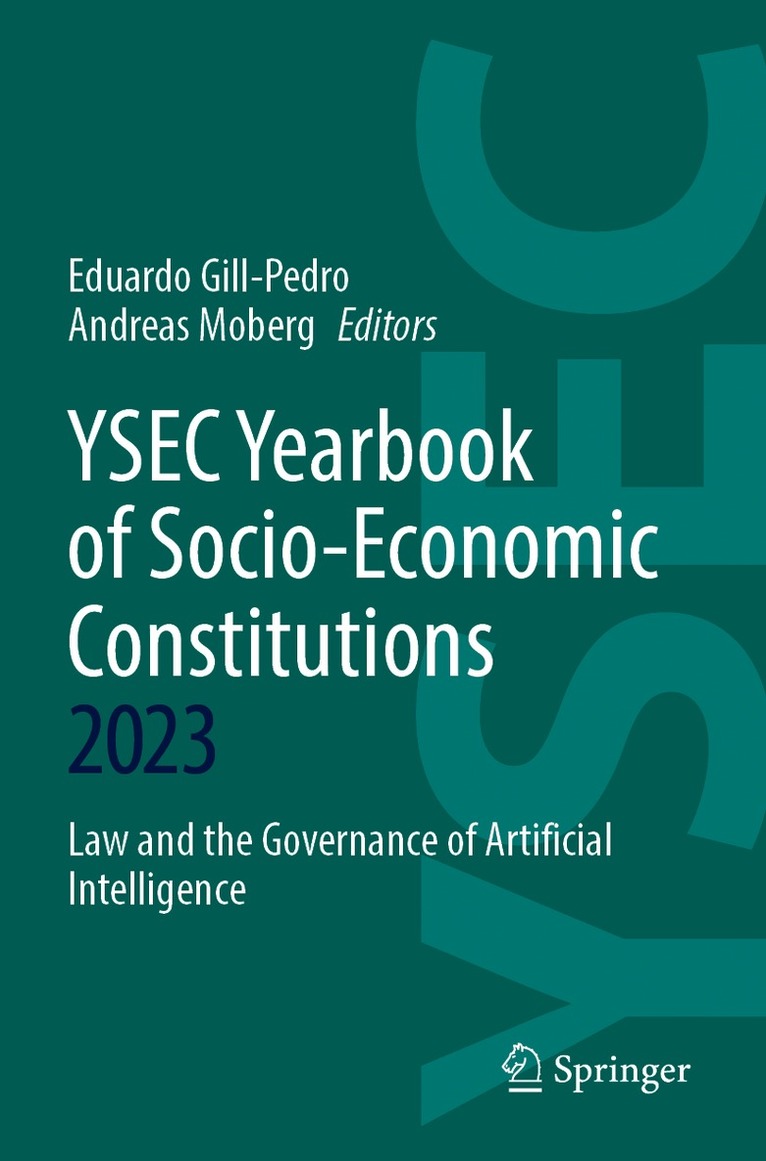
YSEC Yearbook of Socio-Economic Constitutions 2023
Law and the Governance of Artificial Intelligence
Häftad, Engelska, 2025
1 554 kr
Skickas inom 10-15 vardagar
Artificial intelligence (AI) has the potential to radically transform our society. It may lead to a massive increase in the capabilities of humankind and allow us to address some of our most intractable challenges. It may also entail profound disruption to structures and processes that have sustained our society over centuries. These developments present a unique challenge to the socio-economic constitutional arrangements which govern our world at national, regional and international level. The deployment of increasingly powerful AI systems, able to function with increasing degree of autonomy, has led to concerns over loss of human control of important societal processes, over the disruption of existing economic, social and legal relationships, and over the empowerment of some societal actors at the expense of others, together with the entrenchment of situations of domination or discrimination. It has also made increasingly clear how tremendous the potential benefits, that these technologies may bring, are to those who successfully develop and deploy them. There is therefore great pressure on governments, international institutions, public authorities, civil society organisations, industry bodies and individual firms to introduce or adapt mechanisms and structures that will avoid the potentially negative outcomes of AI and achieve the positive ones. These mechanisms and structures, which have been given the umbrella term ‘AI governance’, cover a wide range of approaches, from individual firms introducing ethical principles which they volunteer to abide by, to the European Union legislating an AI Act, which will prohibit certain types of AI applications and impose binding obligations on AI developers and deployers. The fast pace of innovation in the development of AI technologies is mirrored by the fast pace of development of the emerging field of AI governance, where traditional legislation by public bodies is complemented with more innovative approaches, such ashybrid and adaptive governance, ethical alignment, governance by design and the creation of regulatory sandboxes. The chapter “AI and Sensitive Personal Data Under the Law Enforcement Directive: Between Operational Efficiency and Legal Necessity” is available open access under a Creative Commons Attribution 4.0 International License via link.springer.com.