Edward Berenson - Böcker
Visar alla böcker från författaren Edward Berenson. Handla med fri frakt och snabb leverans.
9 produkter
9 produkter
1 619 kr
Skickas inom 3-6 vardagar
313 kr
Skickas inom 7-10 vardagar
The rise and fall of William J. Levitt, the man who made the suburban house a mass commodity Two material artifacts defined the middle-class American lifestyle in the mid-twentieth century: the automobile, which brought gas stations, highways, commercial strips, and sprawl; and the single-family suburban home, the repository of many families’ long-term wealth. While the man who did the most to make the automobile a mass commodity—Henry Ford—is well known, few know the story of the man who did the same for the suburban house. Edward Berenson describes the remarkable career of William Levitt, who did more than anyone else to create the modern suburb. In response to an unprecedented housing shortage as veterans returned home from World War II, his Levittown developments provided inexpensive mass-produced housing that was wildly popular—prospective buyers would camp out in line for two days for the chance to put down a deposit on a Levitt house. He was a celebrity, a life-changing hero to tens of thousands, and the pitchman of a renewed American Dream. But Levitt also shared Ford’s dark side. He refused to allow Black people to buy or rent in his developments and doggedly defended this practice against legal challenges. Leading the way for other developers who emulated his actions, he helped ensure that suburbs nationwide remained white enclaves. These legacies are still with us. Levitt made a major contribution to the stubborn wealth disparity between white families and Black families, and his solution to the housing crisis of the 1940s—the detached house and surrounding yard—is a primary cause of the housing crisis today. As a person, Levitt was a strangely guileless and tragic figure. He accumulated vast wealth but, after losing control of his building company, surrendered it all through foolish investments and a lavish lifestyle that included a Long Island mansion and a two-hundred-foot yacht. Just weeks before his death, as a charity patient in a hospital to which he had once given millions, he was still imagining his great comeback.
250 kr
Skickas inom 7-10 vardagar
On 22 September 1928, four-year-old Barbara Griffith strayed into the woods surrounding Massena in New York. Hundreds of people looked for the child but could not find her; then someone suggested that Barbara had been kidnapped and killed by Jews. The mayor and local police believed the rumour and the allegation of ritual murder, known to Jews as “blood libel”, took hold. Rational people in government and Jewish leaders had to intervene to restore calm once Barbara was safely found.At first glance it seems bizarre that so many embraced the accusation but many of Massena’s inhabitants had emigrated recently from Central and Eastern Europe where "blood libel" was common. The Accusation is a shocking and perceptive cross-cultural exploration of American and European responses to anti-Semitism.
251 kr
Skickas inom 7-10 vardagar
Edward Berenson recounts the trial of Henriette Caillaux, the wife of a powerful French cabinet minister, who murdered her husband's enemy Le Figaro editor Gaston Calmette, in March 1914, on the eve of World War I. In analyzing this momentous event, Berenson draws a fascinating portrait of Belle Epoque politics and culture.
534 kr
Skickas inom 3-6 vardagar
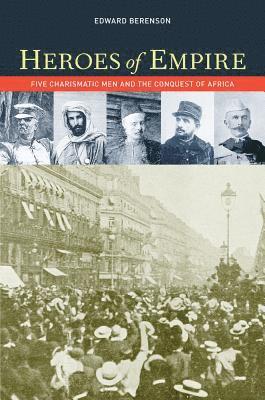
During the decades of empire (1870-1914), legendary heroes and their astonishing deeds of conquest gave imperialism a recognizable human face. Henry Morton Stanley, Pierre Savorgnan de Brazza, Charles Gordon, Jean-Baptiste Marchand, and Hubert Lyautey all braved almost unimaginable dangers among "savage" people for their nation's greater good. This vastly readable book, the first comparative history of colonial heroes in Britain and France, shows via unforgettable portraits the shift from public veneration of the peaceful conqueror to unbridled passion for the vanquishing hero. Edward Berenson argues that these five men transformed the imperial steeplechase of those years into a powerful 'heroic moment'. He breaks new ground by linking the era's 'new imperialism' to its 'new journalism' - the penny press - which furnished the public with larger-than-life figures who then embodied each nation's imperial hopes and anxieties.
479 kr
Skickas inom 7-10 vardagar
Examining the democratic-socialist politics of the Second Republic, Edward Berenson delves into the largely unexplored content of the Montagnards' ideology and traces its diffusion and reception in the populist religious culture of rural France. This book shows how the urbanbased Montagnards were able to appeal to rural Frenchmen by advocating doctrines grounded in the ideals and morality of early Christianity. Originally published in 1984. The Princeton Legacy Library uses the latest print-on-demand technology to again make available previously out-of-print books from the distinguished backlist of Princeton University Press. These editions preserve the original texts of these important books while presenting them in durable paperback and hardcover editions. The goal of the Princeton Legacy Library is to vastly increase access to the rich scholarly heritage found in the thousands of books published by Princeton University Press since its founding in 1905.
2 271 kr
Skickas inom 3-6 vardagar
Examining the democratic-socialist politics of the Second Republic, Edward Berenson delves into the largely unexplored content of the Montagnards' ideology and traces its diffusion and reception in the populist religious culture of rural France. This book shows how the urbanbased Montagnards were able to appeal to rural Frenchmen by advocating doctrines grounded in the ideals and morality of early Christianity. Originally published in 1984. The Princeton Legacy Library uses the latest print-on-demand technology to again make available previously out-of-print books from the distinguished backlist of Princeton University Press. These editions preserve the original texts of these important books while presenting them in durable paperback and hardcover editions. The goal of the Princeton Legacy Library is to vastly increase access to the rich scholarly heritage found in the thousands of books published by Princeton University Press since its founding in 1905.
583 kr
Skickas inom 3-6 vardagar
Railroads, telegraphs, lithographs, photographs, and mass periodicals-the major technological advances of the 19th century seemed to diminish the space separating people from one another, creating new and apparently closer, albeit highly mediated, social relationships. Nowhere was this phenomenon more evident than in the relationship between celebrity and fan, leader and follower, the famous and the unknown. By mid-century, heroes and celebrities constituted a new and powerful social force, as innovations in print and visual media made it possible for ordinary people to identify with the famous; to feel they knew the hero, leader, or "star"; to imagine that public figures belonged to their private lives. This volume examines the origins and nature of modern mass media and the culture of celebrity and fame they helped to create. Crossing disciplines and national boundaries, the book focuses on arts celebrities (Sarah Bernhardt, Byron and Liszt); charismatic political figures (Napoleon and Wilhelm II); famous explorers (Stanley and Brazza); and celebrated fictional characters (Cyrano de Bergerac).
Constructing Charisma
Celebrity, Fame, and Power in Nineteenth-Century Europe
Inbunden, Engelska, 2010
2 014 kr
Skickas inom 3-6 vardagar
Railroads, telegraphs, lithographs, photographs, and mass periodicals—the major technological advances of the 19th century seemed to diminish the space separating people from one another, creating new and apparently closer, albeit highly mediated, social relationships. Nowhere was this phenomenon more evident than in the relationship between celebrity and fan, leader and follower, the famous and the unknown. By mid-century, heroes and celebrities constituted a new and powerful social force, as innovations in print and visual media made it possible for ordinary people to identify with the famous; to feel they knew the hero, leader, or "star"; to imagine that public figures belonged to their private lives. This volume examines the origins and nature of modern mass media and the culture of celebrity and fame they helped to create. Crossing disciplines and national boundaries, the book focuses on arts celebrities (Sarah Bernhardt, Byron and Liszt); charismatic political figures (Napoleon and Wilhelm II); famous explorers (Stanley and Brazza); and celebrated fictional characters (Cyrano de Bergerac).