Edwin Willmore - Böcker
Visar alla böcker från författaren Edwin Willmore. Handla med fri frakt och snabb leverans.
4 produkter
4 produkter
452 kr
Skickas inom 7-10 vardagar
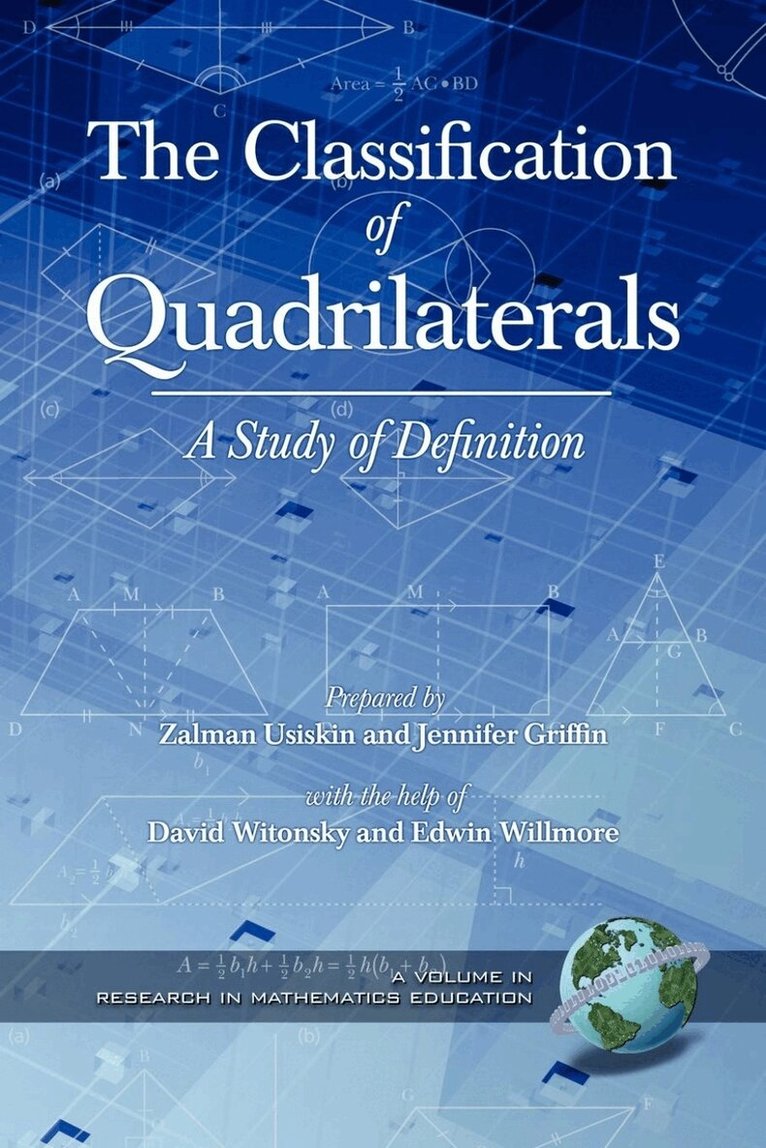
This monograph reports on an analysis of a small part of the mathematics curriculum, the definitions given to quadrilaterals. This kind of research, which we call micro-curricular analysis, is often undertaken by those who create curriculum, but it is not usually done systematically and it is rarely published.Many terms in mathematics education can be found to have different definitions in mathematics books. Among these are “natural number,” “parallel lines” and “congruent triangles,” “trapezoid” and “isosceles trapezoid,” the formal definitions of the trigonometric functions and absolute value, and implicit definitions of the arithmetic operations addition, subtraction, multiplication, and division.Yet many teachers and students do not realize there is a choice of definitions for mathematical terms. And even those who realize there is a choice may not know who decides which definition of any mathematical term is better, and under what criteria. Finally, rarely are the mathematical implications of various choices discussed. As a result, many students misuse and otherwise do not understand the role of definition in mathematics.We have chosen in this monograph to examine a bit of mathematics for its definitions: the quadrilaterals. We do so because there is some disagreement in the definitions and, consequently, in the ways in which quadrilaterals are classified and relate to each other. The issues underlying these differences have engaged students, teachers, mathematics educators, and mathematicians. There have been several articles and a number of essays on the definitions and classification of quadrilaterals. But primarily we chose this specific area of definition in mathematics because it demonstrates how broad mathematical issues revolving around definitions become reflected in curricular materials. While we were undertaking this research, we found that the area of quadrilaterals supplied grist for broader and richer discussions than we had first anticipated.The intended audience includes curriculum developers, researchers, teachers, teacher trainers, and anyone interested in language and its use.
834 kr
Skickas inom 7-10 vardagar
This monograph reports on an analysis of a small part of the mathematics curriculum, the definitions given to quadrilaterals. This kind of research, which we call micro-curricular analysis, is often undertaken by those who create curriculum, but it is not usually done systematically and it is rarely published.Many terms in mathematics education can be found to have different definitions in mathematics books. Among these are “natural number,” “parallel lines” and “congruent triangles,” “trapezoid” and “isosceles trapezoid,” the formal definitions of the trigonometric functions and absolute value, and implicit definitions of the arithmetic operations addition, subtraction, multiplication, and division.Yet many teachers and students do not realize there is a choice of definitions for mathematical terms. And even those who realize there is a choice may not know who decides which definition of any mathematical term is better, and under what criteria. Finally, rarely are the mathematical implications of various choices discussed. As a result, many students misuse and otherwise do not understand the role of definition in mathematics.We have chosen in this monograph to examine a bit of mathematics for its definitions: the quadrilaterals. We do so because there is some disagreement in the definitions and, consequently, in the ways in which quadrilaterals are classified and relate to each other. The issues underlying these differences have engaged students, teachers, mathematics educators, and mathematicians. There have been several articles and a number of essays on the definitions and classification of quadrilaterals. But primarily we chose this specific area of definition in mathematics because it demonstrates how broad mathematical issues revolving around definitions become reflected in curricular materials. While we were undertaking this research, we found that the area of quadrilaterals supplied grist for broader and richer discussions than we had first anticipated.The intended audience includes curriculum developers, researchers, teachers, teacher trainers, and anyone interested in language and its use.
Mathematics Curriculum in Pacific Rim Countries- China, Japan, Korea, and Singapore Proceedings of a Conference
Häftad, Engelska, 2008
643 kr
Skickas inom 7-10 vardagar
This volume contains the proceedings of the First International Curriculum Conference sponsored by the Center for the Study of Mathematics Curriculum (CSMC). The CSMC is one of the National Science Foundation Centers for Learning and Teaching (Award No. ESI-0333879). The countries—China, Japan, Korea, and Singapore (in alphabetical order, which also happens to be the order of their populations)—have each been in the news because of their performance on international testsand/or their economic performance and potential. They also have centralized education ministries that create a single mathematics curriculum framework followed in the entire country. In all these countries, curricula are differentiated for students with different interests, usually around Grade 10 or 11. We think the reader will agree that the papers are of very high quality, befitting the standing of the individuals who were invited, but particularly notable for our international speakers because in three of these countries, English is not the speaker’s first language. Following each paper, we have included a short biography of the author(s), so that the reader can understand the perspective of the paper’s author.
Mathematics Curriculum in Pacific Rim Countries- China, Japan, Korea, and Singapore Proceedings of a Conference
Inbunden, Engelska, 2008
1 089 kr
Skickas inom 7-10 vardagar
This volume contains the proceedings of the First International Curriculum Conference sponsored by the Center for the Study of Mathematics Curriculum (CSMC). The CSMC is one of the National Science Foundation Centers for Learning and Teaching (Award No. ESI-0333879). The countries—China, Japan, Korea, and Singapore (in alphabetical order, which also happens to be the order of their populations)—have each been in the news because of their performance on international testsand/or their economic performance and potential. They also have centralized education ministries that create a single mathematics curriculum framework followed in the entire country. In all these countries, curricula are differentiated for students with different interests, usually around Grade 10 or 11. We think the reader will agree that the papers are of very high quality, befitting the standing of the individuals who were invited, but particularly notable for our international speakers because in three of these countries, English is not the speaker’s first language. Following each paper, we have included a short biography of the author(s), so that the reader can understand the perspective of the paper’s author.