Zalman Usiskin – författare
469 kr
Skickas inom 5-8 vardagar
866 kr
Skickas inom 5-8 vardagar
667 kr
Skickas inom 5-8 vardagar
1 130 kr
Skickas inom 5-8 vardagar
337 kr
Läs direkt efter köp
481 kr
Läs direkt efter köp
This volume contains the proceedings of the First International Curriculum Conference sponsored by the Center for the Study of Mathematics Curriculum (CSMC). The CSMC is one of the National Science Foundation Centers for Learning and Teaching (Award No. ESI-0333879). The countries—China, Japan, Korea, and Singapore (in alphabetical order, which also happens to be the order of their populations)—have each been in the news because of their performance on international testsand/or their economic performance and potential. They also have centralized education ministries that create a single mathematics curriculum framework followed in the entire country. In all these countries, curricula are differentiated for students with different interests, usually around Grade 10 or 11. We think the reader will agree that the papers are of very high quality, befitting the standing of the individuals who were invited, but particularly notable for our international speakers because in three of these countries, English is not the speaker’s first language. Following each paper, we have included a short biography of the author(s), so that the reader can understand the perspective of the paper’s author.
433 kr
Läs direkt efter köp
551 kr
Skickas inom 5-8 vardagar
1 027 kr
Skickas inom 5-8 vardagar
396 kr
Läs direkt efter köp
601 kr
Skickas inom 5-8 vardagar
1 064 kr
Skickas inom 5-8 vardagar
433 kr
Läs direkt efter köp
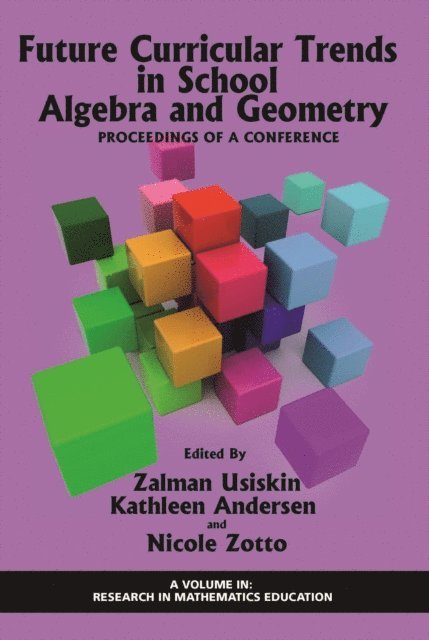
The mathematics curriculum – what mathematics is taught, to whom it is taught, and when it is taught – is the bedrock to understanding what mathematics students can, could, and should learn. Today’s digital technology influences the mathematics curriculum in two quite different ways.
One influence is on the delivery of mathematics through hardware such as desktops, laptops, and tablets. Another influence is on the doing of mathematics using software available on this hardware, but also available on the internet, calculators, or smart phones.
These developments, rapidly increasing in their availability and decreasing in their cost, raise fundamental questions regarding a mathematics curriculum that has traditionally been focused on paper-and-pencil work and taught in many places as a set of rules to be practiced and learned.
This volume presents the talks given at a conference held in 2014 at the University of Chicago, sponsored by the Center for the Study of Mathematics Curriculum. The speakers – experts from around the world and inside the USA – were asked to discuss one or more of the following topics:
changes in the nature and creation of curricular materials available to students transformations in how students learn and how they demonstrate their learning rethinking the role of the teacher and how students and teachers interact within a classroom and across distances from each otherThe result is a set of articles that are interesting and captivating, and challenge us to examine how the learning of mathematics can and should be affected by today’s technology.
649 kr
Läs direkt efter köp
The mathematics curriculum – what mathematics is taught, to whom it is taught, and when it is taught – is the bedrock to understanding what mathematics students can, could, and should learn. Today’s digital technology influences the mathematics curriculum in two quite different ways.
One influence is on the delivery of mathematics through hardware such as desktops, laptops, and tablets. Another influence is on the doing of mathematics using software available on this hardware, but also available on the internet, calculators, or smart phones.
These developments, rapidly increasing in their availability and decreasing in their cost, raise fundamental questions regarding a mathematics curriculum that has traditionally been focused on paper-and-pencil work and taught in many places as a set of rules to be practiced and learned.
This volume presents the talks given at a conference held in 2014 at the University of Chicago, sponsored by the Center for the Study of Mathematics Curriculum. The speakers – experts from around the world and inside the USA – were asked to discuss one or more of the following topics:
changes in the nature and creation of curricular materials available to students transformations in how students learn and how they demonstrate their learning rethinking the role of the teacher and how students and teachers interact within a classroom and across distances from each otherThe result is a set of articles that are interesting and captivating, and challenge us to examine how the learning of mathematics can and should be affected by today’s technology.
594 kr
Läs direkt efter köp
649 kr
Läs direkt efter köp
721 kr
Läs direkt efter köp
505 kr
Läs direkt efter köp