Elin Bjarnegård - Böcker
Visar alla böcker från författaren Elin Bjarnegård. Handla med fri frakt och snabb leverans.
7 produkter
7 produkter
1 914 kr
Skickas inom 3-6 vardagar
What can gender tell us about political parties? Historically, and often still, political parties have been dominated by men from majority groups, and shaped by traditional gender relations and norms that generally disadvantage women. Gender is crucial in understanding the persistence of men's political overrepresentation and the corresponding marginalization of women in politics, as well as in exploring questions of why and how parties adapt and change, and what their role is in representative democracy. Gendering Party Politics explores the relationship between gender, institutions, and political parties through a feminist institutionalist lens, advancing new theoretical, methodological, and empirical directions for party politics scholarship. The contributors synthesize two decades of research, introduce foundational concepts and frameworks, and present innovative methods and empirical cases from around the world. They also make the case as to why this research matters, evaluating the practical opportunities for and obstacles to transforming parties in more gender equitable ways. Each chapter demonstrates the wide-ranging applications of feminist institutionalism for understanding the complexities of gender dynamics within parties. Together, these contributions constitute a significant intervention into wider debates over the relationship between political parties, power, democracy, and representation. Featuring insights from an international cast of leading scholars, Gendering Party Politics is essential for anyone interested in the evolving landscape of gender and politics, political parties and institutions, and political representation.Chapter 8 of this work is available under the terms of a CC BY-NC-ND 4.0 International open access license. This part of the work is free to read on the Oxford Academic platform and offered as a free PDF download from OUP and selected open access locations.
278 kr
Skickas inom 5-8 vardagar
What can gender tell us about political parties? Historically, and often still, political parties have been dominated by men from majority groups, and shaped by traditional gender relations and norms that generally disadvantage women. Gender is crucial in understanding the persistence of men's political overrepresentation and the corresponding marginalization of women in politics, as well as in exploring questions of why and how parties adapt and change, and what their role is in representative democracy. Gendering Party Politics explores the relationship between gender, institutions, and political parties through a feminist institutionalist lens, advancing new theoretical, methodological, and empirical directions for party politics scholarship. The contributors synthesize two decades of research, introduce foundational concepts and frameworks, and present innovative methods and empirical cases from around the world. They also make the case as to why this research matters, evaluating the practical opportunities for and obstacles to transforming parties in more gender equitable ways. Each chapter demonstrates the wide-ranging applications of feminist institutionalism for understanding the complexities of gender dynamics within parties. Together, these contributions constitute a significant intervention into wider debates over the relationship between political parties, power, democracy, and representation. Featuring insights from an international cast of leading scholars, Gendering Party Politics is essential for anyone interested in the evolving landscape of gender and politics, political parties and institutions, and political representation.Chapter 8 of this work is available under the terms of a CC BY-NC-ND 4.0 International open access license. This part of the work is free to read on the Oxford Academic platform and offered as a free PDF download from OUP and selected open access locations.
455 kr
Kommande
Why autocratic leaders have adopted gender-equality reforms as a way to legitimize their ruleAuthoritarian governments are often seen as attacking gender equality. Vladimir Putin, Viktor Orbán, and Recep Tayyip Erdoğan have made well-publicized critiques of feminism. But, as Elin Bjarnegård and Pär Zetterberg show in this book, autocratic regimes are also actively adopting gender-equality reforms, surpassing some democracies in their embrace of such policies. Why have leaders of countries known for violating human rights become unlikely champions of gender equality? Bjarnegård and Zetterberg argue that gender serves as a versatile tool for autocrats seeking to legitimize their rule, deflecting attention from authoritarian practices by promoting policies that seem liberal and even democratic. They call this strategy of political misdirection autocratic genderwashing.Drawing on data from authoritarian governments in countries including Rwanda, Nicaragua, Singapore, and Uganda, Bjarnegård and Zetterberg show how gender equality policies interact with noncoercive authoritarian strategies to claim legitimacy for autocratic rule. They describe autocratic genderwashing as political theater, shining a spotlight on specific reforms and accomplishments—domestic violence legislation, increased numbers of women in parliament, the creation of women’s policy agencies—while leaving authoritarian practices in the dark. Considering the question of whether autocratic genderwashing is successful as a legitimation strategy, Bjarnegård and Zetterberg find that it is more convincing to international audiences than to domestic ones.
1 542 kr
Kommande
Why autocratic leaders have adopted gender-equality reforms as a way to legitimize their ruleAuthoritarian governments are often seen as attacking gender equality. Vladimir Putin, Viktor Orbán, and Recep Tayyip Erdoğan have made well-publicized critiques of feminism. But, as Elin Bjarnegård and Pär Zetterberg show in this book, autocratic regimes are also actively adopting gender-equality reforms, surpassing some democracies in their embrace of such policies. Why have leaders of countries known for violating human rights become unlikely champions of gender equality? Bjarnegård and Zetterberg argue that gender serves as a versatile tool for autocrats seeking to legitimize their rule, deflecting attention from authoritarian practices by promoting policies that seem liberal and even democratic. They call this strategy of political misdirection autocratic genderwashing.Drawing on data from authoritarian governments in countries including Rwanda, Nicaragua, Singapore, and Uganda, Bjarnegård and Zetterberg show how gender equality policies interact with noncoercive authoritarian strategies to claim legitimacy for autocratic rule. They describe autocratic genderwashing as political theater, shining a spotlight on specific reforms and accomplishments—domestic violence legislation, increased numbers of women in parliament, the creation of women’s policy agencies—while leaving authoritarian practices in the dark. Considering the question of whether autocratic genderwashing is successful as a legitimation strategy, Bjarnegård and Zetterberg find that it is more convincing to international audiences than to domestic ones.
1 212 kr
Skickas inom 7-10 vardagar
There has been an increase in testimonies from women politicians who have been targets of violence and from survivors of conflict-related sexual violence. The editors and contributors to of Gender and Violence against Political Actors seek to understand how gender influences both physical and psychological forms of violence and how sexual violence affects both men and women.Chapters focus on theoretical approaches demonstrating how different disciplinary starting points-e.g., politics, violence and gender-give rise to different lenses. Essays examine violence carried out during conflict and peacetime, and relate to the continuum of violence-physical, sexual, psychological, and online. In addition, six country case studies reveal how different types of political actors have been targets of violence. Gender and Violence against Political Actors ends by providing various approaches to responding to the problem of gendered violence in politics while also evaluating policy responses. Contributors: Kerryn Baker, Julie Ballington, Gabrielle Bardall, Gabriella Borovsky, Cheryl N. Collier, Sofia Collignon, Maria Eriksson Baaz, Eleonora Esposito, Nicole Haley, Rebekah Herrick, Sandra HÅkansson, Roudabeh Kishi, Anne-Kathrin Kreft, Mona Lena Krook, Rebecca Kuperberg, Robert U. Nagel, Louise Olsson, Jennifer M. Piscopo, Tracey Raney, Juliana Restrepo SanÍn, Paige Schneider, Maria Stern, Sue Thomas, and the editors
413 kr
Skickas inom 7-10 vardagar
There has been an increase in testimonies from women politicians who have been targets of violence and from survivors of conflict-related sexual violence. The editors and contributors to of Gender and Violence against Political Actors seek to understand how gender influences both physical and psychological forms of violence and how sexual violence affects both men and women.Chapters focus on theoretical approaches demonstrating how different disciplinary starting points-e.g., politics, violence and gender-give rise to different lenses. Essays examine violence carried out during conflict and peacetime, and relate to the continuum of violence-physical, sexual, psychological, and online. In addition, six country case studies reveal how different types of political actors have been targets of violence. Gender and Violence against Political Actors ends by providing various approaches to responding to the problem of gendered violence in politics while also evaluating policy responses. Contributors: Kerryn Baker, Julie Ballington, Gabrielle Bardall, Gabriella Borovsky, Cheryl N. Collier, Sofia Collignon, Maria Eriksson Baaz, Eleonora Esposito, Nicole Haley, Rebekah Herrick, Sandra HÅkansson, Roudabeh Kishi, Anne-Kathrin Kreft, Mona Lena Krook, Rebecca Kuperberg, Robert U. Nagel, Louise Olsson, Jennifer M. Piscopo, Tracey Raney, Juliana Restrepo SanÍn, Paige Schneider, Maria Stern, Sue Thomas, and the editors
439 kr
Skickas
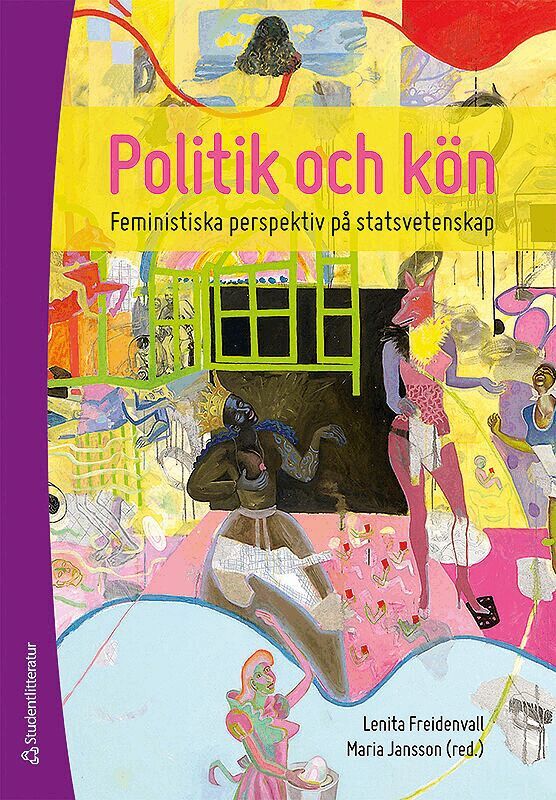
Denna bok är en ovärderlig introduktion till feministisk statsvetenskaplig forskning. Här presenteras feministiska teorier och empiriska analyser som tillsammans tecknar en bild av ett kreativt forskningsfält som samlas kring vikten av att använda kön som analytiskt verktyg, och som rymmer både konstruktiva teoretiska debatter och intressanta empiriska resultat.Boken innehåller introduktioner till feministisk forskning inom de statsvetenskapliga subdisciplinerna politisk teori, svensk politik, jämförande politik och internationella relationer samt fördjupningar i de för fälten centrala begreppen kön, representation, medborgarskap och säkerhet. Dessutom presenteras exempel på empirisk forskning. Läsaren får här veta mer om hur närbyråkrater för omsorgsetiska resonemang, hur svensk familjepolitik drabbar ensamstående mödrar, vad som karaktäriserar olika typer av könskvotering och hur ritualerna kring begravningar av kvinnliga soldater som har dött i striderna i Afghanistan återskapar den manliga soldaten som norm. Politik och kön vänder sig i första hand till studenter i statsvetenskap och genusvetenskap.