Emanuela Bianchi - Böcker
Visar alla böcker från författaren Emanuela Bianchi. Handla med fri frakt och snabb leverans.
4 produkter
4 produkter
524 kr
Skickas inom 3-6 vardagar
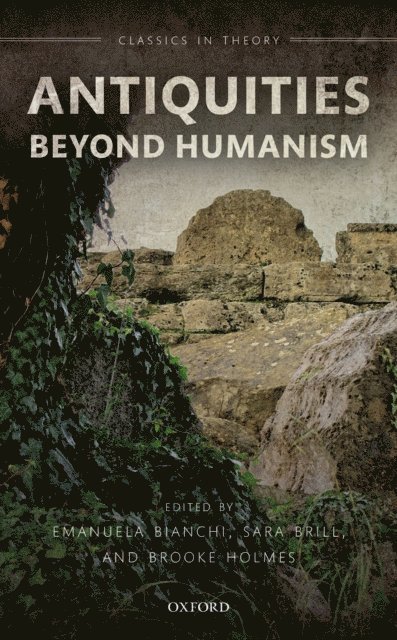
Greco-Roman antiquity is often presumed to provide the very paradigm of humanism from the Renaissance to the present. This paradigm has been increasingly challenged by new theoretical currents such as posthumanism and the "new materialisms", which point toward entities, forces, and systems that pass through and beyond the human and dislodge it from its primacy as the measure of things. Antiquities beyond Humanism seeks to explode the presumed dichotomy between the ancient tradition and the twenty-first century "turn" by exploring the myriad ways in which Greek and Roman philosophy and literature can be understood as foregrounding the non-human. Greek philosophy in particular is filled with metaphysical explanations of the cosmos grounded in observations of the natural world, while other areas of ancient humanistic inquiry - poetry, political theory, medicine - extend into the realms of plant, animal, and even stone life, continually throwing into question the ontological status of living and non-living beings. By casting the ancient non-human or more-than-human in a new light in relation to contemporary questions of gender, ecological networks and non-human communities, voice, eros, and the ethics and the politics of posthumanism, the volume demonstrates that encounters with ancient texts, experienced as both familiar and strange, can help forge new understandings of life, whether understood as physical, psychical, divine, or cosmic.
1 723 kr
Skickas inom 7-10 vardagar
Greco-Roman antiquity is often presumed to provide the very paradigm of humanism from the Renaissance to the present. This paradigm has been increasingly challenged by new theoretical currents such as posthumanism and the "new materialisms", which point toward entities, forces, and systems that pass through and beyond the human and dislodge it from its primacy as the measure of things. Antiquities beyond Humanismseeks to explode the presumed dichotomy between the ancient tradition and the twenty-first century "turn" by exploring the myriad ways in which Greek and Roman philosophy and literature can be understood as foregrounding the non-human. Greek philosophy in particular is filled with metaphysical explanations of the cosmos grounded in observations of the natural world, while other areas of ancient humanistic inquiry - poetry, political theory, medicine - extend into the realms of plant, animal, and even stone life, continually throwing into question the ontological status of living and non-living beings. By casting the ancient non-human or more-than-human in a new light in relation to contemporary questions of gender, ecological networks and non-human communities, voice, eros, and the ethics and the politics of posthumanism, the volume demonstrates that encounters with ancient texts, experienced as both familiar and strange, can help forge new understandings of life, whether understood as physical, psychical, divine, or cosmic.
918 kr
Skickas inom 10-15 vardagar
The first English-language study of Aristotle's natural philosophy from a continental perspective, the Feminine Symptom takes as its starting point the problem of female offspring. If form is transmitted by the male and the female provides only matter, how is a female child produced? Aristotle answers that there must be some fault or misstep in the process.This inexplicable but necessary coincidence—sumptoma in Greek—defines the feminine symptom. Departing from the standard associations of male-activity-form and female-passivity-matter, Bianchi traces the operation of chance and spontaneity throughout Aristotle's biology, physics, cosmology, and metaphysics and argues that it is not passive but aleatory matter— unpredictable, ungovernable, and acting against nature and teleology—that he continually allies with the feminine.Aristotle's pervasive disparagement of the female as a mild form of monstrosity thus works to shore up his polemic against the aleatory and to consolidate patriarchal teleology in the face of atomism and Empedocleanism.Bianchi concludes by connecting her analysis to recent biological and materialist political thinking, and makes the case for a new, antiessentialist politics of aleatory feminism.
315 kr
Skickas inom 10-15 vardagar
The first English-language study of Aristotle's natural philosophy from a continental perspective, the Feminine Symptom takes as its starting point the problem of female offspring. If form is transmitted by the male and the female provides only matter, how is a female child produced? Aristotle answers that there must be some fault or misstep in the process.This inexplicable but necessary coincidence—sumptoma in Greek—defines the feminine symptom. Departing from the standard associations of male-activity-form and female-passivity-matter, Bianchi traces the operation of chance and spontaneity throughout Aristotle's biology, physics, cosmology, and metaphysics and argues that it is not passive but aleatory matter— unpredictable, ungovernable, and acting against nature and teleology—that he continually allies with the feminine.Aristotle's pervasive disparagement of the female as a mild form of monstrosity thus works to shore up his polemic against the aleatory and to consolidate patriarchal teleology in the face of atomism and Empedocleanism.Bianchi concludes by connecting her analysis to recent biological and materialist political thinking, and makes the case for a new, antiessentialist politics of aleatory feminism.