E.P. van den Heuvel - Böcker
Visar alla böcker från författaren E.P. van den Heuvel. Handla med fri frakt och snabb leverans.
7 produkter
7 produkter
3 149 kr
Skickas inom 10-15 vardagar
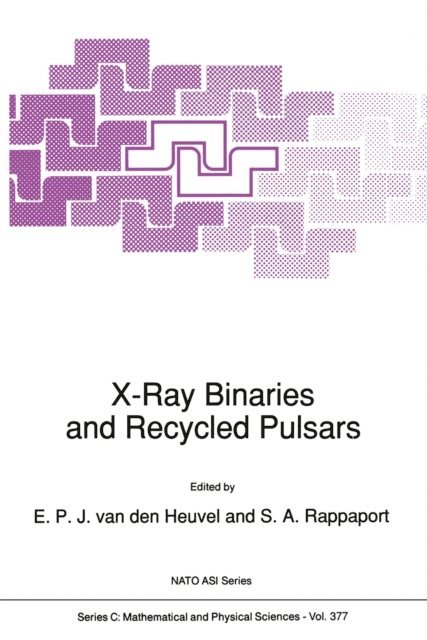
The idea for organizing an Advanced Study Institute devoted largely to neutron star timing arose independently in three places, at Istanbul, Garching and Amster dam; when we became aware of each other's ideas we decided to join forces. The choice of a place for the Institute, in Turkey, appealed much to us all, and it was then quickly decided that Qe§me would be an excellent spot. When the preparations for the Institute started, early in 1987, we could not have guessed how timely the subject actually was. Of course, the recently dis covered QPO phenomena in accreting neutron stars and half a dozen binary and millisecond radio pulsars known at the time formed one of the basic motivations for organizing this Institute. But none of us could have guessed that later in 1987 we were to witness the wonderful discovery of the binary and millisecond radio pulsars in globular clusters and, -as if Nature wished to give us a special present for this the discovery in March 1988 of a millisecond pulsar in an eclipsing binary Institu- system, the first eclipsing radio pulsar ever found, and the second fastest in the sky! The discussion of this pulsar, its formation and fate was one of the highlights of this meeting, especially since its discoverers were among the participants of the Institute and could provide us with first-hand information.
Compact Stars in Binaries
Proceedings of the 165th Symposium of the International Astronomical Union, Held in the Hague, The Netherlands, August 15–19, 1994
Inbunden, Engelska, 1996
2 101 kr
Skickas inom 10-15 vardagar
Research on the formation, structure and evolution of binary stars with at least one compact component (that is, a white dwarf, neutron star, or black hole), has in recent years been one of the most active areas in astrophysics. This volume gives an overview of recent progress in this area, with particular emphasis on the evolutionary connection that may exist between these binaries as observed in a variety of wavelength bands, in particular in the radio and X-ray bands. Among the subjects covered are: Type Ib/c supernovae and supernovae in binaries; common-envelope evolution, coalescence of binaries and Thorne-Zytkow objects; gravitational waves from compact bodies; binary and millisecond radio pulsars; planets around pulsars; the pulsar velocity distribution; transient X-ray sources and black-hole binaries; quasi-periodic oscillations in X-ray sources; supersoft X-ray sources and their possible connection with Type I supernovae; soft gamma-ray repeaters; and gamma-ray bursts and binary neutron star mergers.
Compact Stars in Binaries
Proceedings of the 165th Symposium of the International Astronomical Union, Held in the Hague, The Netherlands, August 15–19, 1994
Häftad, Engelska, 1996
2 101 kr
Skickas inom 10-15 vardagar
Research on the formation, structure and evolution of binary stars with at least one compact component (that is, a white dwarf, neutron star, or black hole), has in recent years been one of the most active areas in astrophysics. This volume gives an overview of recent progress in this area, with particular emphasis on the evolutionary connection that may exist between these binaries as observed in a variety of wavelength bands, in particular in the radio and X-ray bands. Among the subjects covered are: Type Ib/c supernovae and supernovae in binaries; common-envelope evolution, coalescence of binaries and Thorne-Zytkow objects; gravitational waves from compact bodies; binary and millisecond radio pulsars; planets around pulsars; the pulsar velocity distribution; transient X-ray sources and black-hole binaries; quasi-periodic oscillations in X-ray sources; supersoft X-ray sources and their possible connection with Type I supernovae; soft gamma-ray repeaters; and gamma-ray bursts and binary neutron star mergers.
2 101 kr
Skickas inom 10-15 vardagar
Observers and theorists discuss the latest developments in the astrophysics of neutron stars, black holes and their interaction in the universe. Often found in compact, interacting binaries, these objects exhibit broadly similar behaviour. The determination of observational signatures that distinguish between these two types is explored. Supernovae and evolutionary scenarios leading to neutron stars and black holes, single or in binaries, are discussed in detail. There is also a discussion of the mystery of cosmic gamma ray bursts, currently thought to represent enormous stellar explosions at cosmological distances. These could be the result of mergers of a neutron star and its compact binary companion: a literal neutron star-black hole connection. This text provides a series of lectures for the advanced graduate student and presents material that should prove useful to the research astrophysicist and space physicist.
2 101 kr
Skickas inom 10-15 vardagar
Observers and theorists discuss the latest developments in the astrophysics of neutron stars, black holes and their interaction in the universe. Often found in compact, interacting binaries, these objects exhibit broadly similar behaviour. The determination of observational signatures that distinguish between these two types is explored. Supernovae and evolutionary scenarios leading to neutron stars and black holes, single or in binaries, are discussed in detail. There is also a discussion of the mystery of cosmic gamma ray bursts, currently thought to represent enormous stellar explosions at cosmological distances. These could be the result of mergers of a neutron star and its compact binary companion: a literal neutron star-black hole connection. This text provides a series of lectures for the advanced graduate student and presents material that should prove useful to the research astrophysicist and space physicist.
536 kr
Skickas inom 10-15 vardagar
V. Trimble-Concluding remarks 541 Authors Index 549 Object Index 551 Subject Index 555 List of participants and observers Ali Alpar, M. , Physics Department, Middle East Technical University, Ankara, Turkey Anderson, S. , USA California Institute of Technology, Pasadena CA, Araya, R. A. , The Johns Hopkins University, Deptartment of Physics and Astronomy, Baltimore MD, USA Arons, J. , Department of Astronomy, UC Berkeley, Berkeley CA, USA Backer, D. , Department of Astronomy, UC Berkeley, Berkeley CA, USA Bailyn, C. D. , Center for Astrophysics, Cambridge MA, USA Bandiera, R. , Osservatorio Astrofisico di Arcetri, Firenze, Italy Banit, M. , Astrophysics Department, Columbia University, New York NY, USA Bhattacharya, D. , Astronomical Institute, University of Amsterdam, The Netherlands Blandford, R. , Theoretical Astrophysics, CalTech, Pasadena CA, USA Blondin, J. M. , University of Virginia, Department of Astronomy, Charlottesville VA, USA Cernohorsky, J. , Center for High Energy Astrophysics, Amsterdam, The Netherlands Chanmugam, G. , Louisiana State University, Department of Physics and Astronomy, Ba- ton Rouge LA, USA Cordes, J., Cornell University Centre for Radiophysics & Space Research, Ithaca NY, USA Dewey, R. , Jet Propulsion Laboratory, CalTech, Pasadena CA, USA Eardley, D. , University of California, Institute for Theoretical Physics, Santa Barbara CA,USA Edberg, T. , University of California, Center for Particle Astrophysics, Berkeley CA, USA Eggleton, P. P. , Institute of Astronomy, Cambridge, United Kingdom Eichler, D.
3 149 kr
Skickas inom 10-15 vardagar
The idea for organizing an Advanced Study Institute devoted largely to neutron star timing arose independently in three places, at Istanbul, Garching and Amster dam; when we became aware of each other's ideas we decided to join forces. The choice of a place for the Institute, in Turkey, appealed much to us all, and it was then quickly decided that Qe§me would be an excellent spot. When the preparations for the Institute started, early in 1987, we could not have guessed how timely the subject actually was. Of course, the recently dis covered QPO phenomena in accreting neutron stars and half a dozen binary and millisecond radio pulsars known at the time formed one of the basic motivations for organizing this Institute. But none of us could have guessed that later in 1987 we were to witness the wonderful discovery of the binary and millisecond radio pulsars in globular clusters and, -as if Nature wished to give us a special present for this the discovery in March 1988 of a millisecond pulsar in an eclipsing binary Institu- system, the first eclipsing radio pulsar ever found, and the second fastest in the sky! The discussion of this pulsar, its formation and fate was one of the highlights of this meeting, especially since its discoverers were among the participants of the Institute and could provide us with first-hand information.