J.E Ventura - Böcker
Visar alla böcker från författaren J.E Ventura. Handla med fri frakt och snabb leverans.
4 produkter
4 produkter
3 147 kr
Skickas inom 10-15 vardagar
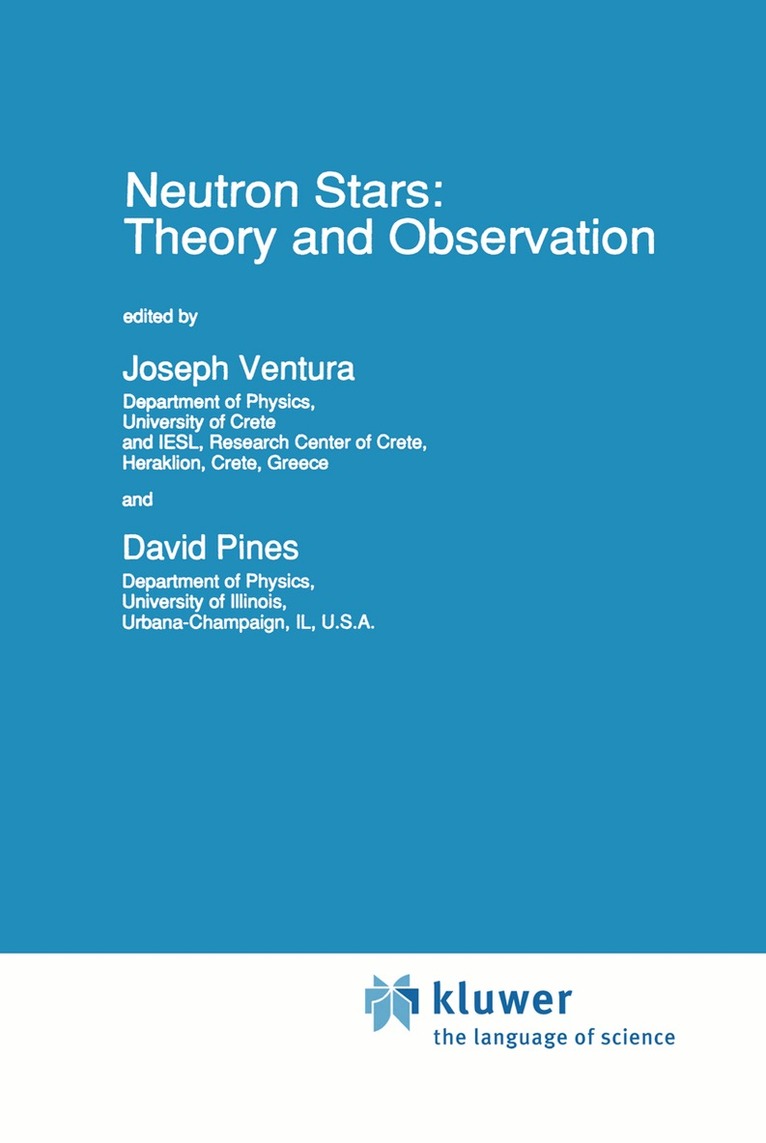
Some twenty-three years after the discovery of pulsars and their identification as rotating neutron stars, neutron star physics may be regarded as comingofage. Pul sars and accreting neutron stars have now been studied at every wavelength, from the initial radio observations, through optical, X-, and "{-ray, up to the very recent observations in the TeV region, while theorists have studied in some detail relevant physical processes both outside and inside neutron stars. As a result, comparisonof theory with observation provides a test ofour theoretical ideas in fields as diverse as neutron and nuclear matter, superfluidity and superconductivity, the acceleration of high energy particles, and the generation and maintenance of intense magnetic fields. For example, through observations of glitches and post glitch behavior of pulsars, it has become possible to establish the presence ofsuperfluid neutron mat ter in the inner crust of neutron stars, and to determine some of its properties, while neutron stars in compact binary systems offer one ofthe most efficient energy generation mechanisms known. It is in fact the interactive interpretation of these ,diverse pieces of information that can lead to major advances in our understanding of the physics of these exotic objects, and justifies the characterization of neutron stars as hadron physics laboratories.
2 100 kr
Skickas inom 10-15 vardagar
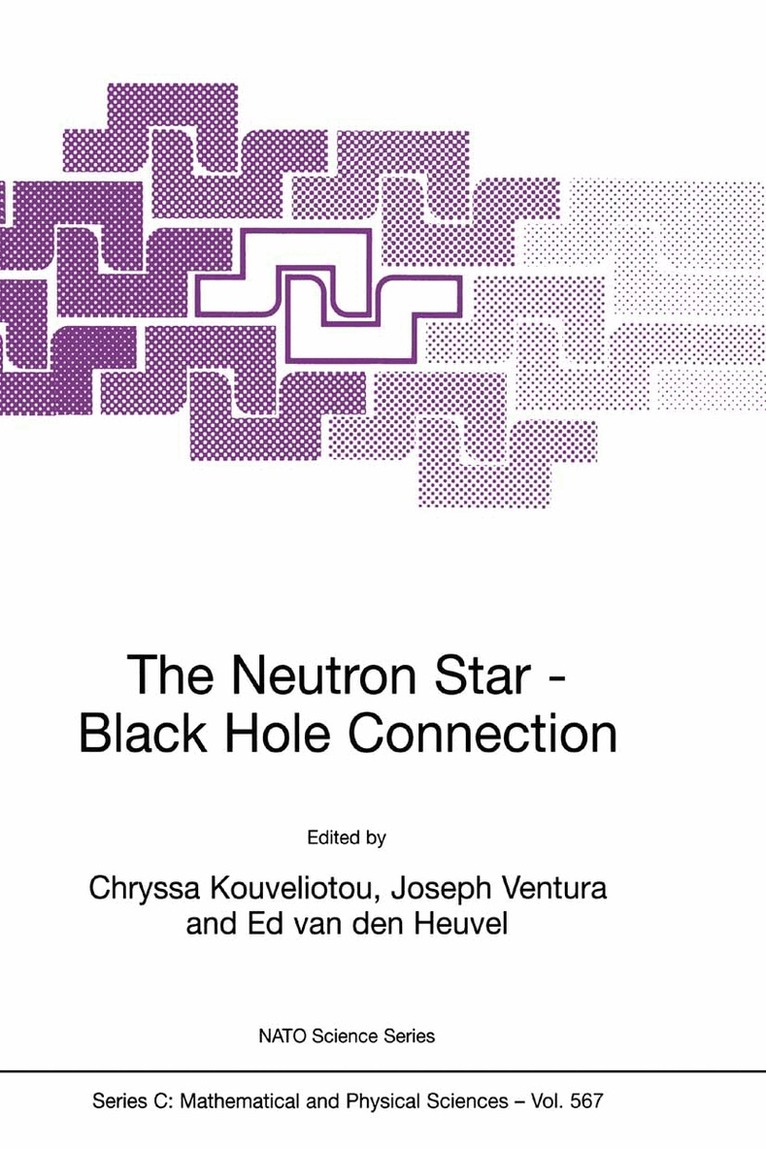
Observers and theorists discuss the latest developments in the astrophysics of neutron stars, black holes and their interaction in the universe. Often found in compact, interacting binaries, these objects exhibit broadly similar behaviour. The determination of observational signatures that distinguish between these two types is explored. Supernovae and evolutionary scenarios leading to neutron stars and black holes, single or in binaries, are discussed in detail. There is also a discussion of the mystery of cosmic gamma ray bursts, currently thought to represent enormous stellar explosions at cosmological distances. These could be the result of mergers of a neutron star and its compact binary companion: a literal neutron star-black hole connection. This text provides a series of lectures for the advanced graduate student and presents material that should prove useful to the research astrophysicist and space physicist.
2 100 kr
Skickas inom 10-15 vardagar
Observers and theorists discuss the latest developments in the astrophysics of neutron stars, black holes and their interaction in the universe. Often found in compact, interacting binaries, these objects exhibit broadly similar behaviour. The determination of observational signatures that distinguish between these two types is explored. Supernovae and evolutionary scenarios leading to neutron stars and black holes, single or in binaries, are discussed in detail. There is also a discussion of the mystery of cosmic gamma ray bursts, currently thought to represent enormous stellar explosions at cosmological distances. These could be the result of mergers of a neutron star and its compact binary companion: a literal neutron star-black hole connection. This text provides a series of lectures for the advanced graduate student and presents material that should prove useful to the research astrophysicist and space physicist.
3 147 kr
Skickas inom 10-15 vardagar
Some twenty-three years after the discovery of pulsars and their identification as rotating neutron stars, neutron star physics may be regarded as comingofage. Pul sars and accreting neutron stars have now been studied at every wavelength, from the initial radio observations, through optical, X-, and "{-ray, up to the very recent observations in the TeV region, while theorists have studied in some detail relevant physical processes both outside and inside neutron stars. As a result, comparisonof theory with observation provides a test ofour theoretical ideas in fields as diverse as neutron and nuclear matter, superfluidity and superconductivity, the acceleration of high energy particles, and the generation and maintenance of intense magnetic fields. For example, through observations of glitches and post glitch behavior of pulsars, it has become possible to establish the presence ofsuperfluid neutron mat ter in the inner crust of neutron stars, and to determine some of its properties, while neutron stars in compact binary systems offer one ofthe most efficient energy generation mechanisms known. It is in fact the interactive interpretation of these ,diverse pieces of information that can lead to major advances in our understanding of the physics of these exotic objects, and justifies the characterization of neutron stars as hadron physics laboratories.