
Eric M. Gander – författare
Visar alla böcker från författaren Eric M. Gander. Handla med fri frakt och snabb leverans.
2 produkter
2 produkter
380 kr
Tillfälligt slut
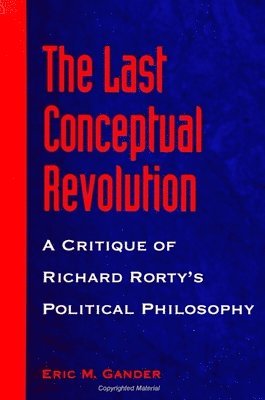
A critique of Rorty's own provocative political philosophy, as well as an in-depth look at both the issues concerning the relationship between the public and the private, and arguments on the role of reason in liberal political discourse generally.In 1989, with the publication of Contingency, Irony, and Solidarity, and in articles throughout the 1990s, Richard Rorty developed a detailed social and political philosophy that brings together core elements in liberalism, pragmatism, and postmodern, anti-foundationalist philosophy. The Last Conceptual Revolution provides a critique both of Rorty's own provocative political philosophy, as well as an in-depth look at the issues concerning the relationship between the public and the private; between persuasion and force; and arguments about the role of reason in liberal political discourse generally.
On Our Minds
How Evolutionary Psychology Is Reshaping the Nature versus Nurture Debate
Inbunden, Engelska, 2004
507 kr
Tillfälligt slut
There is no question more fundamental to human existence than that posed by the nature-versus-nurture debate. For much of the past century, it was widely believed that there was no essential human nature and that people could be educated or socialized to thrive in almost any imaginable culture. Today, that orthodoxy is being directly and forcefully challenged by a new science of the mind: evolutionary psychology. Like the theory of evolution itself, the implications of evolutionary psychology are provocative and unsettling. Rather than viewing the human mind as a mysterious black box or a blank slate, evolutionary psychologists see it as a physical organ that has evolved to process certain types of information in certain ways that enables us to thrive only in certain types of cultures. In On Our Minds, Eric M. Gander examines all sides of the public debate between evolutionary psychologists and their critics. Paying particularly close attention to the popular science writings of Steven Pinker, Edward O.Wilson, Richard Dawkins, and Stephen Jay Gould, Gander traces the history of the controversy, succinctly summarizes the claims and theories of the evolutionary psychologists, dissects the various arguments deployed by each side, and considers in detail the far-reaching ramifications-social, cultural, and political-of this debate. Gander's lucid and highly readable account concludes that evolutionary psychology now holds the potential to answer our oldest and most profound moral and philosophical questions, fundamentally changing our self-perception as a species.