Eugene Bardach - Böcker
Visar alla böcker från författaren Eugene Bardach. Handla med fri frakt och snabb leverans.
7 produkter
7 produkter
746 kr
Skickas inom 3-6 vardagar
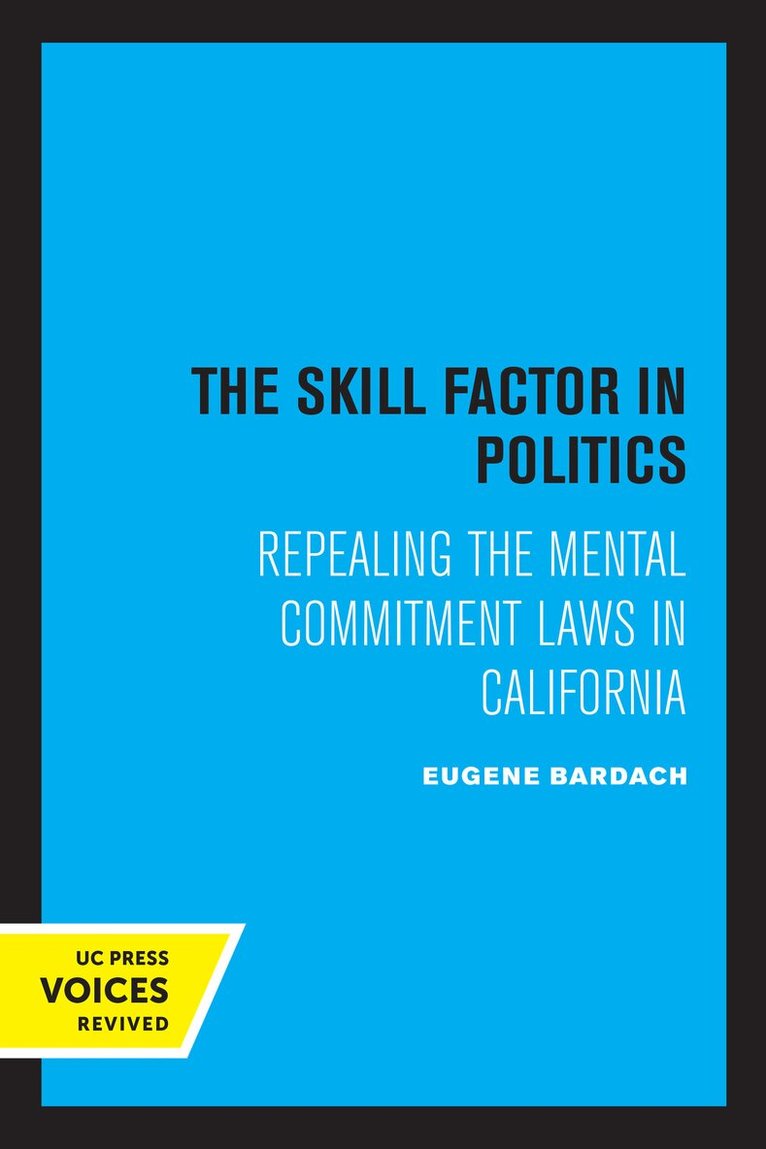
Eugene Bardach’s The Skill Factor in Politics: Repealing the Mental Commitment Laws in California uses the 1965–67 overhaul of California’s involuntary commitment system to explore what political skill actually is—and how it determines outcomes. Tracking a reform coalition that most observers initially rated as long-shots (and briefly wrote off for dead) before it ultimately prevailed, Bardach argues that standard political science couldn’t explain the win because it lacked a workable theory of “skill.” Rather than treating skill as a personality trait, he defines it as a quality of action in problem-solving—timely, efficient, inventive maneuvers tailored to the structure of a policy contest. His evidence comes from close observation of the commitment reform and four comparative cases in California mental health politics (an interdepartmental turf struggle, an internal DMH controversy, a licensing fight over psychotherapy, and a state-hospital budget battle), supplemented by interviews, documents, and a survey of the “attentive public.”From these cases Bardach sketches a pragmatic model of policy entrepreneurship. Success equals authorization by relevant authorities, which depends on assembling “enough” support from strategically weighted interests. The entrepreneur’s four core problems are: (1) designing proposals and plausible alternatives that can attract the right mix of interests; (2) recruiting and activating a coalition with resources (persuasion, information, venues, procedural leverage) to build that support; (3) defending and countering opposition through timing, sabotage, and agenda control; and (4) sustaining organizational capacity—managing attention, sequencing moves, and adapting doctrine as events unfold. Bardach’s aim isn’t to rank skill above other forces, but to make it visible and teachable as craft. He closes by urging broader diffusion of these skills—among analysts, citizen-advocates, and officials—arguing that representative institutions work best when more participants can map the field, diagnose leverage points, and execute creative, well-timed political action.This title is part of UC Press's Voices Revived program, which commemorates University of California Press’s mission to seek out and cultivate the brightest minds and give them voice, reach, and impact. Drawing on a backlist dating to 1893, Voices Revived makes high-quality, peer-reviewed scholarship accessible once again using print-on-demand technology. This title was originally published in 1972.
1 352 kr
Skickas inom 3-6 vardagar
Eugene Bardach’s The Skill Factor in Politics: Repealing the Mental Commitment Laws in California uses the 1965–67 overhaul of California’s involuntary commitment system to explore what political skill actually is—and how it determines outcomes. Tracking a reform coalition that most observers initially rated as long-shots (and briefly wrote off for dead) before it ultimately prevailed, Bardach argues that standard political science couldn’t explain the win because it lacked a workable theory of “skill.” Rather than treating skill as a personality trait, he defines it as a quality of action in problem-solving—timely, efficient, inventive maneuvers tailored to the structure of a policy contest. His evidence comes from close observation of the commitment reform and four comparative cases in California mental health politics (an interdepartmental turf struggle, an internal DMH controversy, a licensing fight over psychotherapy, and a state-hospital budget battle), supplemented by interviews, documents, and a survey of the “attentive public.”From these cases Bardach sketches a pragmatic model of policy entrepreneurship. Success equals authorization by relevant authorities, which depends on assembling “enough” support from strategically weighted interests. The entrepreneur’s four core problems are: (1) designing proposals and plausible alternatives that can attract the right mix of interests; (2) recruiting and activating a coalition with resources (persuasion, information, venues, procedural leverage) to build that support; (3) defending and countering opposition through timing, sabotage, and agenda control; and (4) sustaining organizational capacity—managing attention, sequencing moves, and adapting doctrine as events unfold. Bardach’s aim isn’t to rank skill above other forces, but to make it visible and teachable as craft. He closes by urging broader diffusion of these skills—among analysts, citizen-advocates, and officials—arguing that representative institutions work best when more participants can map the field, diagnose leverage points, and execute creative, well-timed political action.This title is part of UC Press's Voices Revived program, which commemorates University of California Press’s mission to seek out and cultivate the brightest minds and give them voice, reach, and impact. Drawing on a backlist dating to 1893, Voices Revived makes high-quality, peer-reviewed scholarship accessible once again using print-on-demand technology. This title was originally published in 1972.
Social Security at the Dawn of the 21st Century
Topical Issues and New Approaches
Häftad, Engelska, 2001
659 kr
Skickas inom 10-15 vardagar
Presenting a periodic overview of the most significant developments and trends in the field of social security has become, for the International Social Security Association, a tradition and a firm commitment. Benefiting from the vast quantity of information uniquely available to the ISSA, its triennial review takes stock of the current state of social security world wide and focuses, through expert analyses, on some of the most pressing social security issues. Social Security at the Dawn of the 21st Century, the outcome of the most recent review, is intended to significantly extend the access of an international readership to accurate and up-to-date information and analyses on social security, which has without question developed during the twentieth century into one of the most important publicly financed and administered institutions in modern society. The chapters are grouped into two parts. Part one treats subjects related to policy trends and regional developments, with special emphasis on such important issues as redesigning social security programs, new management practices, and the informal care dilemma. It features major aspects of developments in Asia-Pacific and Latin America. Part two focuses on specific program areas, with special emphasis on problems and reforms in employment policy, pension systems, and public disability schemes. Information is also provided on new approaches to ensuring adequate access to health care and on policies in response to changes in family structures as well as an recent experience with social assistance programs.
672 kr
Skickas inom 10-15 vardagar
What is regulation? Under what circumstances is it needed? What forms should it take? Such questions are especially relevant at a time in United States history when governmental involvement in decisions formerly left to individuals and business firms evokes concern on all sides of the political spectrum. In Going by the Book, Eugene Bardach and Robert A. Kagan address these questions and provide richly detailed descriptions of the dilemmas of enforcement in a broad variety of regulatory programs.The authors argue that the most successful forms of regulation emerge from a flexible rather than a legalistic method of implementation. Relying on extensive interviews with government agency officials and regulated businesses, they find that American techniques of regulation, by their very nature, frequently generate "regulatory unreasonableness," that is, governmental requirements that seem sensible in principle but that make little sense in particular situations. By exploring the roots and dynamics of regulatory unreasonableness and the ways in which some regulatory officials and programs avoid it, Going by the Book simultaneously illustrates the virtues of flexible regulatory enforcement and illuminates the political and practical obstacles to achieving that goal. In their new introduction, the authors discuss their findings in light of the twenty years that have passed since Going by the Book was first published. They explore the growth of regulation in recent years as well as many reforms, noting that while much has changed, much has not. They argue the United States remains torn between two competing visions of regulation: enforcing laws versus solving social problems. Thus, the deep insights into the regulatory process that Going by the Book provides continue to make it a mandatory work for public policymakers, experts in economics, government, and regulatory law, and students and teachers of political science, public policy, and sociolegal studies.
Getting Agencies to Work Together
The Practice and Theory of Managerial Craftsmanship
Häftad, Engelska, 1998
287 kr
Skickas inom 10-15 vardagar
Collaboration between government agencies, an old joke goes, is an unnatural act committed by nonconsenting adults. Eugene Bardach argues that today's opinion climate favoring more results-oriented government makes collaboration a lot more natural--though it is still far from easy. In this book, Bardach diagnoses the difficulties, explains how they are sometimes overcome, and offers practical ideas for public managers, advocates, and others interested in developing interagency collaborative networks.Bardach provides examples from diverse policy areas, including children, youth, and family services; welfare-to-work; antipollution enforcement; fire prevention; and ecosystem management.
2 306 kr
Skickas inom 10-15 vardagar
What is regulation? Under what circumstances is it needed? What forms should it take? Such questions are especially relevant at a time in United States history when governmental involvement in decisions formerly left to individuals and business firms evokes concern on all sides of the political spectrum. In Going by the Book, Eugene Bardach and Robert A. Kagan address these questions and provide richly detailed descriptions of the dilemmas of enforcement in a broad variety of regulatory programs.The authors argue that the most successful forms of regulation emerge from a flexible rather than a legalistic method of implementation. Relying on extensive interviews with government agency officials and regulated businesses, they find that American techniques of regulation, by their very nature, frequently generate "regulatory unreasonableness," that is, governmental requirements that seem sensible in principle but that make little sense in particular situations. By exploring the roots and dynamics of regulatory unreasonableness and the ways in which some regulatory officials and programs avoid it, Going by the Book simultaneously illustrates the virtues of flexible regulatory enforcement and illuminates the political and practical obstacles to achieving that goal. In their new introduction, the authors discuss their findings in light of the twenty years that have passed since Going by the Book was first published. They explore the growth of regulation in recent years as well as many reforms, noting that while much has changed, much has not. They argue the United States remains torn between two competing visions of regulation: enforcing laws versus solving social problems. Thus, the deep insights into the regulatory process that Going by the Book provides continue to make it a mandatory work for public policymakers, experts in economics, government, and regulatory law, and students and teachers of political science, public policy, and sociolegal studies.
Social Security at the Dawn of the 21st Century
Topical Issues and New Approaches
Inbunden, Engelska, 2017
2 103 kr
Skickas inom 10-15 vardagar
Presenting a periodic overview of the most significant developments and trends in the field of social security has become, for the International Social Security Association, a tradition and a firm commitment. Benefiting from the vast quantity of information uniquely available to the ISSA, its triennial review takes stock of the current state of social security world wide and focuses, through expert analyses, on some of the most pressing social security issues. Social Security at the Dawn of the 21st Century, the outcome of the most recent review, is intended to significantly extend the access of an international readership to accurate and up-to-date information and analyses on social security, which has without question developed during the twentieth century into one of the most important publicly financed and administered institutions in modern society. The chapters are grouped into two parts. Part one treats subjects related to policy trends and regional developments, with special emphasis on such important issues as redesigning social security programs, new management practices, and the informal care dilemma. It features major aspects of developments in Asia-Pacific and Latin America. Part two focuses on specific program areas, with special emphasis on problems and reforms in employment policy, pension systems, and public disability schemes. Information is also provided on new approaches to ensuring adequate access to health care and on policies in response to changes in family structures as well as an recent experience with social assistance programs.