Felicity A. Nussbaum - Böcker
Visar alla böcker från författaren Felicity A. Nussbaum. Handla med fri frakt och snabb leverans.
7 produkter
7 produkter
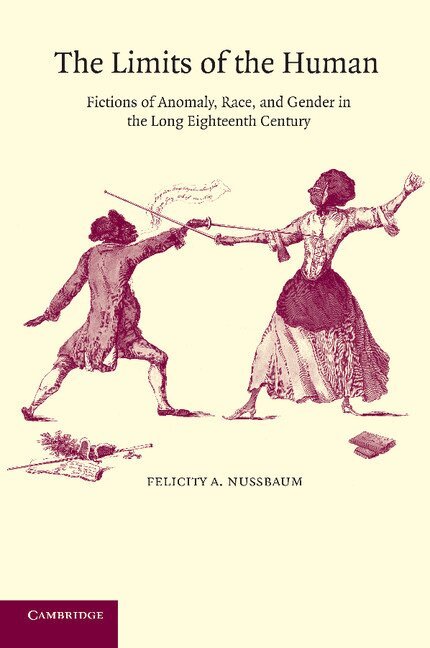
The Limits of the Human
Fictions of Anomaly, Race and Gender in the Long Eighteenth Century
Häftad, Engelska, 2003
644 kr
Skickas inom 7-10 vardagar
In this book, Felicity Nussbaum examines literary and cultural representations of human difference in England and its empire during the long eighteenth century. With a special focus on women's writing, Nussbaum analyzes canonical and lesser-known novels and plays from the Restoration to abolition. She considers a range of anomalies (defects, disease, and disability) as they intermingle with ideas of femininity, masculinity, and race to define 'normalcy' as national identity. Incorporating writings by Behn, Burney, and the Bluestockings, as well as Southerne, Shaftesbury, Johnson, Sterne, and Equiano, Nussbaum treats a range of disabilities - being mute, blind, lame - and physical oddities such as eunuchism and giantism as they are inflected by emerging notions of a racial femininity and masculinity. She shows that these corporeal features, perceived as aberrant and extraordinary, combine in the popular imagination to reveal a repertory of differences located between the extremes of splendid and horrid novelty.
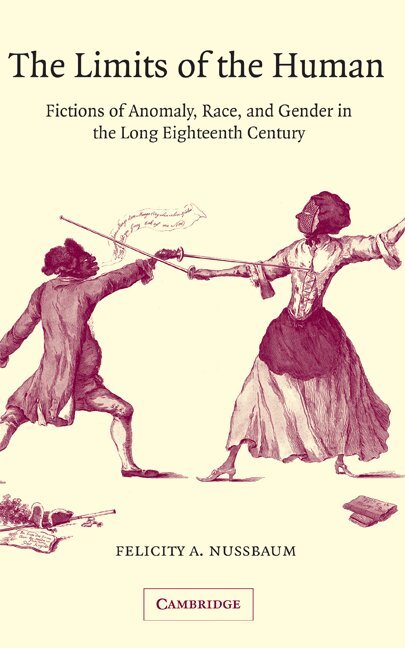
The Limits of the Human
Fictions of Anomaly, Race and Gender in the Long Eighteenth Century
Inbunden, Engelska, 2003
1 613 kr
Skickas inom 7-10 vardagar
In this book, Felicity Nussbaum examines literary and cultural representations of human difference in England and its empire during the long eighteenth century. With a special focus on women's writing, Nussbaum analyzes canonical and lesser-known novels and plays from the Restoration to abolition. She considers a range of anomalies (defects, disease, and disability) as they intermingle with ideas of femininity, masculinity, and race to define 'normalcy' as national identity. Incorporating writings by Behn, Burney, and the Bluestockings, as well as Southerne, Shaftesbury, Johnson, Sterne, and Equiano, Nussbaum treats a range of disabilities - being mute, blind, lame - and physical oddities such as eunuchism and giantism as they are inflected by emerging notions of a racial femininity and masculinity. She shows that these corporeal features, perceived as aberrant and extraordinary, combine in the popular imagination to reveal a repertory of differences located between the extremes of splendid and horrid novelty.
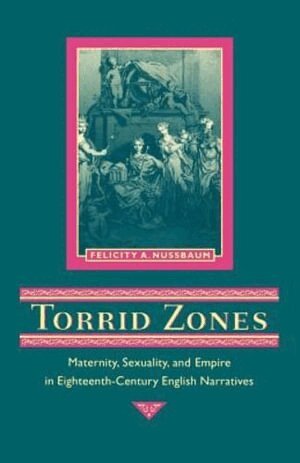
Torrid Zones
Maternity, Sexuality, and Empire in Eighteenth-Century English Narratives
Häftad, Engelska, 1996
358 kr
Skickas inom 7-10 vardagar
How did the creation of the "Other" woman in English narratives contribute to the displacement of sexuality onto the exotic or savage woman? How did this cultural invention reinforce the cult of domesticity at home? What were the social and economic forces driving the process? Among the first books to consider issues of empire in relation to literary texts of the eighteenth century, Torrid Zones offers a compelling revision of the history of feminism in a postcolonial context. Felicity Nussbaum argues that the need to control women's sexuality in eighteenth-century England intensified as the demands of trade and colonization required an ever-larger, able-bodied population. Describing how women's reproductive labor was harnessed to that task, Nussbaum explores issues such as the production of life, of goods, and of desire. She also considers a variety of cultural practices (usually construed as exotic) in England and the empire, including polygamy, infanticide, prostitution, homoeroticism, and arranged marriages.Torrid Zones includes new readings of significant texts by and about female subjects, including novels by Defoe, Richardson, Johnson, Cleland, Lennox, Sarah Scott, Frances Sheridan, and Phebe Gibbes. It also considers the more broadly defined texts of culture such as travel narratives, medical documents, legal records, and engravings. "I take as a central metaphor for the consideration of maternity and sexuality the concept of torrid zones, both the geographical torrid zones of the territory between the Tropic of Cancer and the Tropic of Capricorn, and the torrid zone mapped onto the human body, especially the female body. A premise of my study is that the contrasts among the torrid, temperate, and frigid zones of the globe are formative in imagining that a sexualized woman of empire is distinct from domestic English womanhood. The general category of 'woman' muddles the binaries between mother and whore, self and Other, center and periphery."-from the Introduction
394 kr
Skickas inom 7-10 vardagar
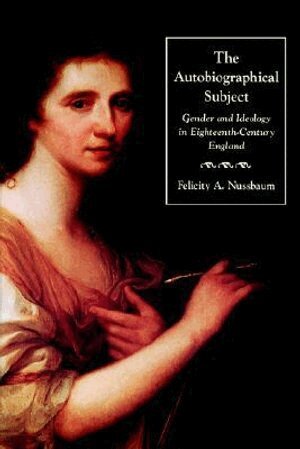
'Co-recipient of the American Association for Eighteenth-Century Studies' Louis Gottschalk Prize' "Acutely analyzes the construction of gendered character in canonical British autobiographical texts and provides provocative explorations outside the canon, particularly among first-person narratives by women."--'Diacritics' '"[Nussbaum's] achievement...is profound. The theoretical framework is clear and consistent, the range of historical specificity broad and convincing, the analysis of specific texts sophisticated and compelling, the prose straightforward and free of obfuscating jargon. 'The Autobiographical Subject' is rich and richly rewarding for scholars of the eighteenth century. It deserves to be read by everyone who thinks about autobiographical practice."--Sidonie Smith, 'a/b: Auto/Biography Studies' Felicity Nussbaum considers the convergence of genre, gender, and class in an important reassessment of autobiographical writing in England from John Bunyan to Hester Thrale. "'The Autobiographical Subject', with its combination of provocative theory and sound scholarship, deserves a wide readership.Felicity Nussbaum's insights demand the attention of eighteenth-century scholars, feminist critics, and cultural historians, while the central questions raised by the book--how to define the 'self'? why write, why revise, and especially, why 'publish' an autobiography?--are of interest to everyone."--Fiona Stafford, 'Review of English Studies' "An exemplary model of political criticism."--'Eighteenth-Century Fiction' '"In 'The Autobiographical Subject' Felicity Nussbaum sees autobiography as the point of convergence of a set of phenomena linking class, genre and gender in the eighteenth century; and traces the new possibilities of definition of a middle-class self, and assertion of female identity in print, within the form...The volume makes an important contribution to feminist discussion of the period."--'The Year's Work in English Studies'
769 kr
Skickas inom 7-10 vardagar
Historians have generally come to accept the idea of a "long eighteenth century," one that extended from circa 1660 to 1830. In The Global Eighteenth Century, editor Felicity Nussbaum and the contributing authors take this idea one step further, positing an eighteenth century that is "wide" as well as long, reaching beyond Europe into the African diaspora, the Americas, the Levant, China, India, and Oceania. Showcasing the work of twenty-one leading scholars in literature, world history, art history, geography, and environmental studies, this collection of essays explores both the literal and the metaphorical crossings of the globe, addressing the cultural significance of maps, paintings, travel writing, tourist manuals, cultural identities, island gardens, and other topics in order to lend insight to our perception of global culture during this time.In addition, the contributors examine the tension between the tendency toward homogenization at the global level and the specifics of local knowledge and culture, analyzing examples of sexual and racial intermingling, the European reception of indigenous knowledge, encounters with diverse religions, the exchange of goods and diseases, and the real and imagined mappings of the world. These essays, which the introduction considers within global and imperial studies, add a crucial historical element to the emerging concept of the global. Through careful analysis of texts, images and artifacts, they articulate the truly global nature of relations among the freshly juxtaposed regions, disciplines, and methodologies of this complex era. Contributors: Robert Batchelor, Laura Brown, Vincent Carretta, Jill Casid, Linda Colley, Greg Dening, Rod Edmond, Matthew H. Edney, Carole Fabricant, Peter Hulme, Betty Joseph, Kay Dian Kriz, Philip D. Morgan, Anna Neill, Neil Rennie, Joseph Roach, Nicholas Rogers, Benjamin Schmidt, Kate Teltscher, Beth Fowkes Tobin, and Glyndwr Williams
453 kr
Skickas inom 5-8 vardagar
Historians have generally come to accept the idea of a "long eighteenth century," one that extended from circa 1660 to 1830. In The Global Eighteenth Century, editor Felicity Nussbaum and the contributing authors take this idea one step further, positing an eighteenth century that is "wide" as well as long, reaching beyond Europe into the African diaspora, the Americas, the Levant, China, India, and Oceania. Showcasing the work of twenty-one leading scholars in literature, world history, art history, geography, and environmental studies, this collection of essays explores both the literal and the metaphorical crossings of the globe, addressing the cultural significance of maps, paintings, travel writing, tourist manuals, cultural identities, island gardens, and other topics in order to lend insight to our perception of global culture during this time.In addition, the contributors examine the tension between the tendency toward homogenization at the global level and the specifics of local knowledge and culture, analyzing examples of sexual and racial intermingling, the European reception of indigenous knowledge, encounters with diverse religions, the exchange of goods and diseases, and the real and imagined mappings of the world. These essays, which the introduction considers within global and imperial studies, add a crucial historical element to the emerging concept of the global. Through careful analysis of texts, images and artifacts, they articulate the truly global nature of relations among the freshly juxtaposed regions, disciplines, and methodologies of this complex era. Contributors: Robert Batchelor, Laura Brown, Vincent Carretta, Jill Casid, Linda Colley, Greg Dening, Rod Edmond, Matthew H. Edney, Carole Fabricant, Peter Hulme, Betty Joseph, Kay Dian Kriz, Philip D. Morgan, Anna Neill, Neil Rennie, Joseph Roach, Nicholas Rogers, Benjamin Schmidt, Kate Teltscher, Beth Fowkes Tobin, and Glyndwr Williams
412 kr
Skickas inom 3-6 vardagar
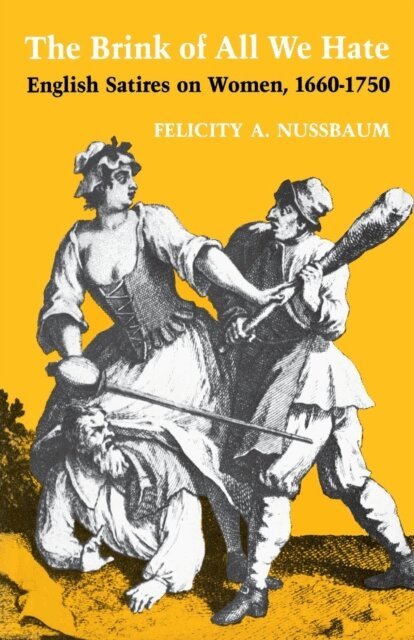
"Is it not monstrous, that our Seducers should be our Accusers? Will they not employ Fraud, nay often Force to gain us? What various Arts, what Stratagems, what Wiles will they use for our Destruction? But that once accomplished, every opprobrious Term with which our Language so plentifully abounds, shall be bestowed on us, even by the very Villains who have wronged us" -- Laetitia Pilkington, Memoirs (1748).In her scandalous Memoirs, Laetitia Pilkington spoke out against the English satires of the Restoration and eighteenth century, which employed "every opprobrious term" to chastise women. In The Brink of All We Hate, Felicity Nussbaum documents and groups those opprobrious terms in order to identify the conventions of the satires, to demonstrate how those conventions create a myth, to provide critical readings of poetic texts in the antifeminist tradition, and to draw some conclusions about the basic nature of satire. Nussbaum finds that the English tradition of antifeminist satire draws on a background that includes Hesiod, Horace, Ovid, and Juvenal, as well as the more modern French tradition of La Bruyere and Boileau and the late seventeenth-century English pamphlets by Gould, Fige, and Ames. The tradition was employed by the major figures of the golden age of satire -- Samuel Butler, Dryden, Swift, Addison, and Pope.Examining the elements of the tradition of antifeminist satire and exploring its uses, from the most routine to the most artful, by the various poets, Nussbaum reveals a clearer context in which many poems of the Restoration and eighteenth century will be read anew.