Foner - Böcker
Visar alla böcker från författaren Foner. Handla med fri frakt och snabb leverans.
2 produkter
2 produkter
970 kr
Skickas inom 3-6 vardagar
Since its publication in 1976, Tom Paine and Revolutionary America has been recognized as a classic study of the career of the foremost political pamphleteer of the Age of Revolution, and a model of how to integrate the political, intellectual, and social history of the struggle for American independence. Foner skillfully brings together an account of Paine's remarkable career with a careful examination of the social worlds within which he operated, in Great Britain, France, and especially the United States. He explores Paine's political and social ideas and the way he popularized them by pioneering a new form of political writing, using simple, direct language and addressing himself to a reading public far broader than previous writers had commanded. He shows which of Paine's views remained essentially fixed throughout his career, while directing attention to the ways his stance on social questions evolved under the pressure of events. This enduring work makes clear the tremendous impact Paine's writing exerted on the American Revolution, and suggests why he failed to have a similar impact during his career in revolutionary France.It also offers new insights into the nature and internal tensions of the republican outlook that helped to shape the Revolution. In a new preface, Foner discusses the origins of this book and the influences of the 1960s and 1970s on its writing. He also looks at how Paine has been adopted by scholars and politicians of many stripes, and has even been called the patron saint of the Internet.
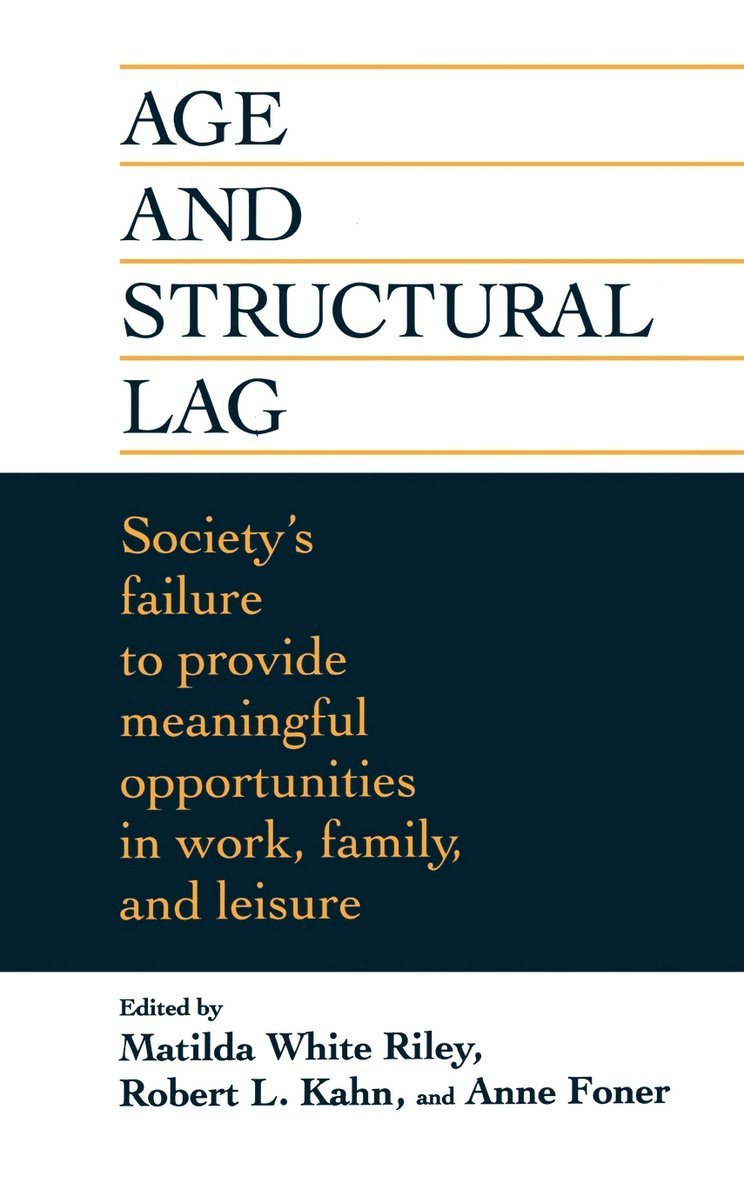
Age and Structural Lag
Society's Failure to Provide Meaningful Opportunities in Work, Family, and Leisure
Inbunden, Engelska, 1994
2 981 kr
Skickas inom 7-10 vardagar
"In society at large, lives have been drastically altered over this century--as a consequence of increased longevity, advances in science and education, the gender revolution, improvements in public health, and other historical trends and events--but numerous inflexible social structures, roles, and norms have lagged behind. There is a mismatch or imbalance between the transformation of the aging process from birth to death and the role opportunities or places in the social structure that could foster and reward people at the various stages of their lives. While the twentieth century has experienced a revolution in human development and aging, there has been no comparable revolution in the role structures of society to keep pace with the changes in the ways people grow up and grow old. The lag involves not only institutional and organizational arrangements, but also the many aspects of culture that, in addition to being internalized by people, are built into role expectations and societal mores and laws. For the future, then, structural changes will be needed if people are to find opportunities to spread leisure and work, as well as education, more evenly over the life course, and to make room for family affairs." --from Age and Structural Lag