Frank Palmeri – författare
Visar alla böcker från författaren Frank Palmeri. Handla med fri frakt och snabb leverans.
4 produkter
4 produkter
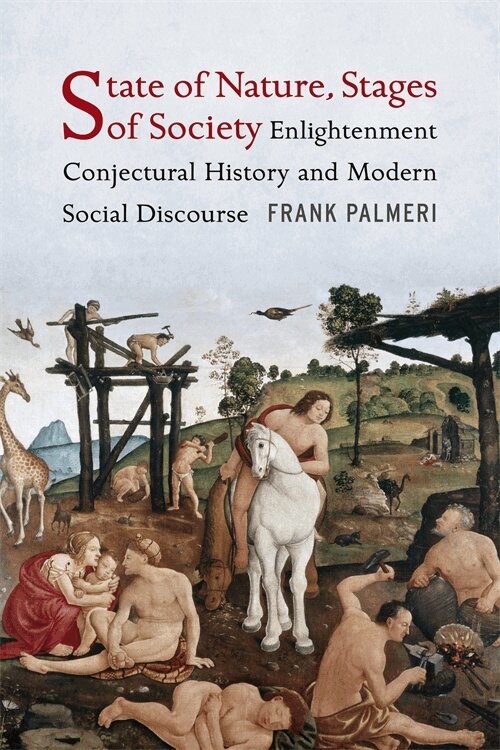
State of Nature, Stages of Society
Enlightenment Conjectural History and Modern Social Discourse
Inbunden, Engelska, 2016
640 kr
Skickas inom 7-10 vardagar
Frank Palmeri sees the conjectural histories of Rousseau, Hume, Herder, and other Enlightenment philosophers as a template for the development of the social sciences in the nineteenth and early twentieth centuries. Without documents or memorials, these thinkers, he argues, employed conjecture to formulate a naturalistic account of society's commercial and secular progression. Palmeri finds evidence of speculative frameworks in the political economy of Malthus, Martineau, Mill, and Marx. He traces the influence of speculative thought in the development of anthropology and ethnography in the 1860s, the foundational sociology of Comte and Spencer, and the sociology of religion pioneered by Weber, Durkheim, and Freud. Conjectural histories reveal a surprising ambivalence toward progress, modernity, and secularization among leading thinkers of the time, an attitude that affected texts as varied as Darwin's Descent of Man, Nietzsche's Genealogy of Morality, and the novels of Walter Scott, George Eliot, and H.G. Wells.Establishing the critical value of conjectural thinking in the study of modern forms of knowledge, Palmeri concludes his investigation with its return in the work of Foucault and in recent histories on early religion, political organization, and material life.
239 kr
Skickas inom 10-15 vardagar
Virtually all theories of satire define it as a criticism of contemporary society. Some argue that satire criticizes the present in favor of a standard of values that has been superseded, and thus that satire is generally backward-looking and conservative. While this is often true of poetic satire, in this study Frank Palmeri asserts that narrative satire performs a different function, that it parodies both the established view of the world and that of its opponents, offering its own distinctive critical perspective.This theory of satire builds on the idea of dialogical parody in the work of Russian theorist Mikhail Bakhtin, while revising Bakhtin's estimate of carnival. In Palmeri's view, the carnivalesque offers only an inverted mirror image of authoritative discourse, while parodic narrative satire suggests an alternative to both the official world and its inverted opposite.Palmeri applies this theory of narrative satire to five works of world literature, each of which has generated sharp controversy about the genre to which it rightly belongs: Petronius' Satyricon, Jonathan Swift's A Tale of a Tub, Edward Gibbon's Decline and Fall of the Roman Empire, Herman Melville's The Confidence-Man, and Thomas Pynchon's The Crying of Lot 49. He analyzes the features that link these works and shows how the changing pairs of alternatives that are parodied in these satires reflect changes in the terms of social and cultural oppositions.Satire in Narrative will appeal to comparatists, specialists in eighteenth-century and American literature, and others interested in theories of genre and the relations between literary forms and social history.
Humans and Other Animals in Eighteenth-Century British Culture
Representation, Hybridity, Ethics
Inbunden, Engelska, 2006
2 508 kr
Skickas inom 10-15 vardagar
Combining historical and interpretive work, this collection examines changing perceptions of and relations between human and nonhuman animals in Britain over the long eighteenth century. Persistent questions concern modes of representing animals and animal-human hybrids, as well as the ethical issues raised by the human uses of other animals. From the animal men of Thomas Rowlandson to the part animal-part human creature of Victor Frankenstein, hybridity serves less as a metaphor than as a metonym for the intersections of humans and other animals. The contributors address such recurring questions as the implications of the Enlightenment project of naming and classifying animals, the equating of non-European races and nonhuman animals in early ethnographic texts, and the desire to distinguish the purely human from the entirely nonhuman animal. Gulliver's Travels and works by Mary and Percy Shelley emerge as key texts for this study. The volume will be of interest to scholars and students who work in animal, colonial, gender, and cultural studies; and will appeal to general readers concerned with the representation of animals and their treatment by humans.
Humans and Other Animals in Eighteenth-Century British Culture
Representation, Hybridity, Ethics
Häftad, Engelska, 2020
664 kr
Skickas inom 10-15 vardagar
Combining historical and interpretive work, this collection examines changing perceptions of and relations between human and nonhuman animals in Britain over the long eighteenth century. Persistent questions concern modes of representing animals and animal-human hybrids, as well as the ethical issues raised by the human uses of other animals. From the animal men of Thomas Rowlandson to the part animal-part human creature of Victor Frankenstein, hybridity serves less as a metaphor than as a metonym for the intersections of humans and other animals. The contributors address such recurring questions as the implications of the Enlightenment project of naming and classifying animals, the equating of non-European races and nonhuman animals in early ethnographic texts, and the desire to distinguish the purely human from the entirely nonhuman animal. Gulliver's Travels and works by Mary and Percy Shelley emerge as key texts for this study. The volume will be of interest to scholars and students who work in animal, colonial, gender, and cultural studies; and will appeal to general readers concerned with the representation of animals and their treatment by humans.