Frederick Burwick - Böcker
Visar alla böcker från författaren Frederick Burwick. Handla med fri frakt och snabb leverans.
18 produkter
18 produkter
2 680 kr
Skickas inom 7-10 vardagar
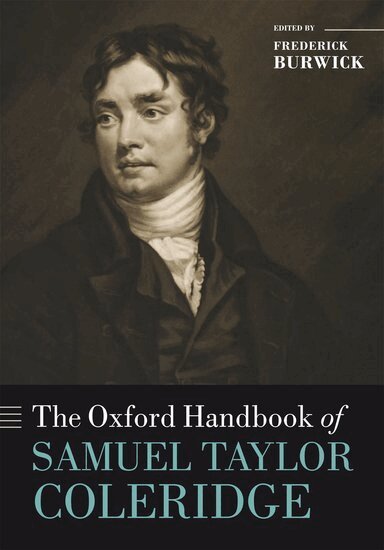
A practical and comprehensive reference work, the Oxford Handbook provides the best single-volume source of original scholarship on all aspects of Coleridge's diverse writings. Thirty-seven chapters, bringing together the wisdome of experts from across the world, present an authoritative, in-depth, and up-to-date assessment of a major author of British Romanticism. The book is divided into sections on Biography, Prose Works, Poetic Works, Sources and Influences, and Reception. The Coleridge scholar today has ready access to a range of materials previously available only in library archives on both sides of the Atlantic. The Bollingen edition, of the Collected Works of Samuel Taylor Coleridge, forty years in production was completed in 2002. The Coleridge Notebooks (1957-2002) were also produced during this same period, five volumes of text with an additional five companion volumes of notes. The Clarendon Press of Oxford published the letters in six volumes (1956-1971). To take full advantage of the convenient access and new insight provided by these volumes, the Oxford Handbook examines the entire range and complexity of Coleridge's career. It analyzes the many aspects of Coleridge's literary, critical, philosophical, and theological pursuits, and it furnishes both students and advanced scholars with the proper tools for assimilating and illuminating Coleridge's rich and varied accomplishments, as well as offering an authoritative guide to the most up-to-date thinking about his achievements.
3 524 kr
Skickas inom 5-8 vardagar
The major work of German literature, Johann Wolfgang von Goethe's Faust (1808), was translated into English by one of Britain's most capable mediators of German literature and philosophy, Samuel Taylor Coleridge. Goethe himself twice referred to Coleridge's translation of his Faust. Goethe's character wrestles with the very metaphysical and theological problems that preoccupied Coleridge: the meaning of the Logos, the apparent opposition of theism and pantheism. Coleridge, the poet of tormented guilt, of the demonic and the supernatural, found himself on familiar ground in translating Faust. Because his translation reveals revisions and reworkings of Coleridge's earlier works, his Faust contributes significantly to the understanding of Coleridge's entire oeuvre. Coleridge began, but soon abandoned, the translation in 1814, returning to the task in 1820. At Coleridge's own insistence, it was published anonymously in 1821, illustrated with 27 line engravings copied by Henry Moses after the original plates by Moritz Retzsch. His publisher, Thomas Boosey, brought out another edition in 1824. Although several critics recognized that it was Coleridge's work, his role as translator was obscured because of its anonymous publication. Coleridge himself declared that he 'never put pen to paper as translator of Faust', and subsequent generations mistakenly attributed the translation to George Soane, a minor playwright, who had actually commenced translating for a rival press. This edition of Coleridge's translation provides the textual and documentary evidence of his authorship, and presents his work in the context of other contemporary efforts at translating Goethe's Faust.
729 kr
Skickas inom 7-10 vardagar
A practical and comprehensive reference work, the Oxford Handbook provides the best single-volume source of original scholarship on all aspects of Coleridge's diverse writings. Thirty-seven chapters, bringing together the wisdome of experts from across the world, present an authoritative, in-depth, and up-to-date assessment of a major author of British Romanticism. The book is divided into sections on Biography, Prose Works, Poetic Works, Sources and Influences, and Reception. The Coleridge scholar today has ready access to a range of materials previously available only in library archives on both sides of the Atlantic. The Bollingen edition, of the Collected Works of Samuel Taylor Coleridge, forty years in production was completed in 2002. The Coleridge Notebooks (1957-2002) were also produced during this same period, five volumes of text with an additional five companion volumes of notes. The Clarendon Press of Oxford published the letters in six volumes (1956-1971). To take full advantage of the convenient access and new insight provided by these volumes, the Oxford Handbook examines the entire range and complexity of Coleridge's career. It analyzes the many aspects of Coleridge's literary, critical, philosophical, and theological pursuits, and it furnishes both students and advanced scholars with the proper tools for assimilating and illuminating Coleridge's rich and varied accomplishments, as well as offering an authoritative guide to the most up-to-date thinking about his achievements.
589 kr
Skickas inom 7-10 vardagar
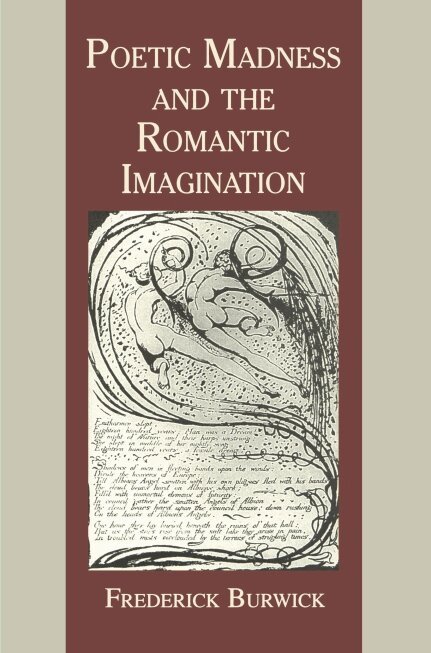
Using as his starting point the historical notion that poets may be, at least in moments of inspiration, "out of their senses," Frederick Burwick here explores the theoretical implications of inspiration as furor poeticus, particularly as that concept was presented during the latter eighteenth and early nineteenth centuries. Drawing on social and medical attitudes toward madness and the so-called poetic rapture, Burwick addresses the appeal to poetic madness in critical theory, the thematization of the mad poet in literature, and the reception of mad poets. With a mad king on the throne of England, mad prophets in the marketplace, and mad poets in their midst, many writers of this period, not surprisingly, used their fiction to explore the conditions of madness. In discussing the mad poet as a character in Romantic literature, Burwick examines the reception and representation of the Italian poet Torquato Tasso in Goethe's play and in the poetry and criticism of the Schlegels, Byron, Shelley, Peacock, and Hazlitt. In his commentary on narratives of madness, Burwick discusses Nodier's Jean-François les bas-bleus, Hoffmann's Der goldne Topf, Shelley's Julian and Maddalo, and Blake's account of the struggle between Los and Urizen. The final section interprets the visual strategies adopted by Hölderlin, Nerval, and Clare in relating their visionary experiences.
777 kr
Skickas inom 5-8 vardagar
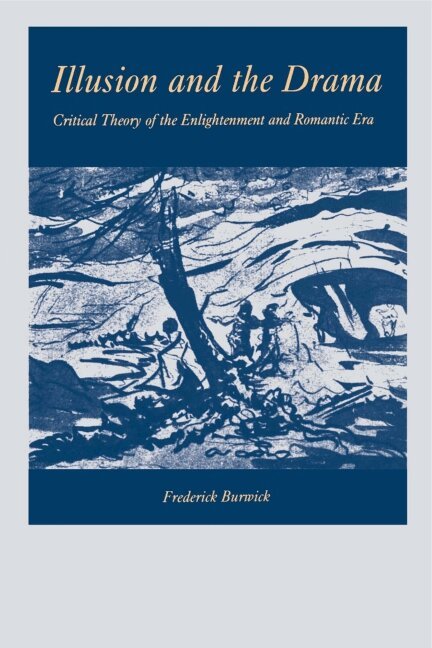
Burwick examines the debate over illusion from Johnson to Coleridge in England, Diderot to Stendhal in France, and Lessing to A. W. Schlegel in Germany.Although few critics still define illusion in contrast to reality, the essential distinction is between illusion as perceived reality and as hallucination or delusion. The concept of illusion as debated in contemporary critical theory has been shaped by developments that took place during the transition from Enlightenment to Romantic thought. Burwick provides a commentary on illusion in contemporary criticism, emphasizing the ways in which such critics as Husserl and Heidegger, Gadamer and Gombrich, Derrida, and Adorno have dealt with the subjective dimensions of aesthetic response. He describes two extreme positions that were asserted in the eighteenth century, the “perfect illusion” in which the work of art is perceived as reality and the insistence on a skeptical distance. He deals with various arguments that locate the source of illusion in the acting, in the audience, in the play, in the imagination, and in the staging effects.Burwick devotes a chapter to two of the foremost Romantic critics of the drama Samuel Taylor Coleridge and August Wilhelm Schlegel. After clarifying the prominent issues discussed by their contemporaries and immediate predecessors, he shows the radical differences between the criticism of Schlegel and Coleridge, thus dispelling the charge that Coleridge’s lectures on Shakespeare are marred by plagiarism of Schlegel’s ideas.
577 kr
Skickas inom 5-8 vardagar
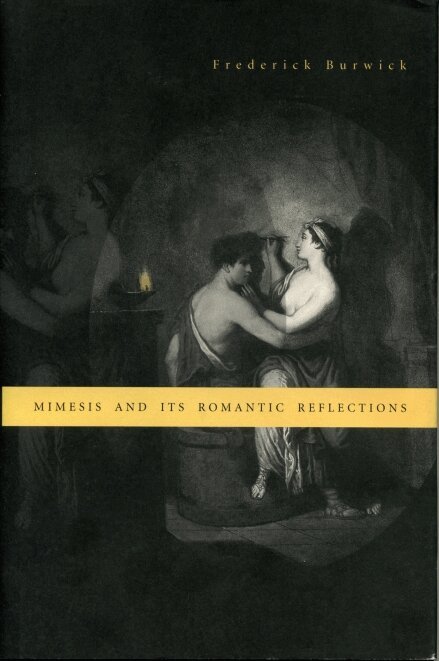
In Romantic theories of art and literature, the notion of mimesis—defined as art’s reflection of the external world—became introspective and self-reflexive as poets and artists sought to represent the act of creativity itself. Frederick Burwick seeks to elucidate this Romantic aesthetic, first by offering an understanding of key Romantic mimetic concepts and then by analyzing manifestations of the mimetic process in literary works of the period.Burwick explores the mimetic concepts of "art for art's sake," "Idem et Alter," and "palingenesis of mind as art" by drawing on the theories of Philo of Alexandria, Aristotle, Immanuel Kant, Friedrich Schiller, Friederich Wilhelm Joseph von Schelling, Thomas De Quincey, and Germaine de Staël. Having established the philosophical bases of these key mimetic concepts, Burwick analyzes manifestations of mimesis in the literature of the period, including ekphrasis in the work of Thomas De Quincey, mirrored images in the poems of Samuel Taylor Coleridge and William Wordsworth, and the twice-told tale in the novels of Charles Brockden Brown, E. T. A. Hoffmann, and James Hogg. Although artists of this period have traditionally been dismissed in discussions of mimesis, Burwick demonstrates that mimetic concepts comprised a major component of the Romantic aesthetic.
1 299 kr
Skickas inom 7-10 vardagar
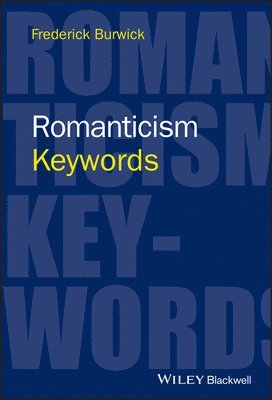
To gain an understanding of any literary era, one should be exposed to the language of its time and place in history. This is especially critical when considering the innovations in creativity introduced during Europe’s Romantic era. Romanticism: Keywords offers readers an invaluable collection of 73 key terms most frequently discussed by authors of the Romantic period – and most often deliberated and debated by contemporary critics and literary historians of the era. From Abolition and Allegory through Madness and Monsters to Vision and Vampires, each entry is accompanied by an in-depth description of the term’s direct meaning and connotations in relation to its usage and thought in British literary culture. Collectively, the terms represent a time capsule of the ideas and concerns that shaped the literature of an age of revolution, social and political reconstruction, impassioned individualism, and probing subjectivity. In introducing and defining the terms that characterized the era, Romanticism: Keywords is an indispensable resource for developing a conceptual understanding of Romantic aesthetics – and provides deep insights into the political, social, and cultural climate of one of the most expressive periods of Western literary history.
626 kr
Skickas inom 7-10 vardagar
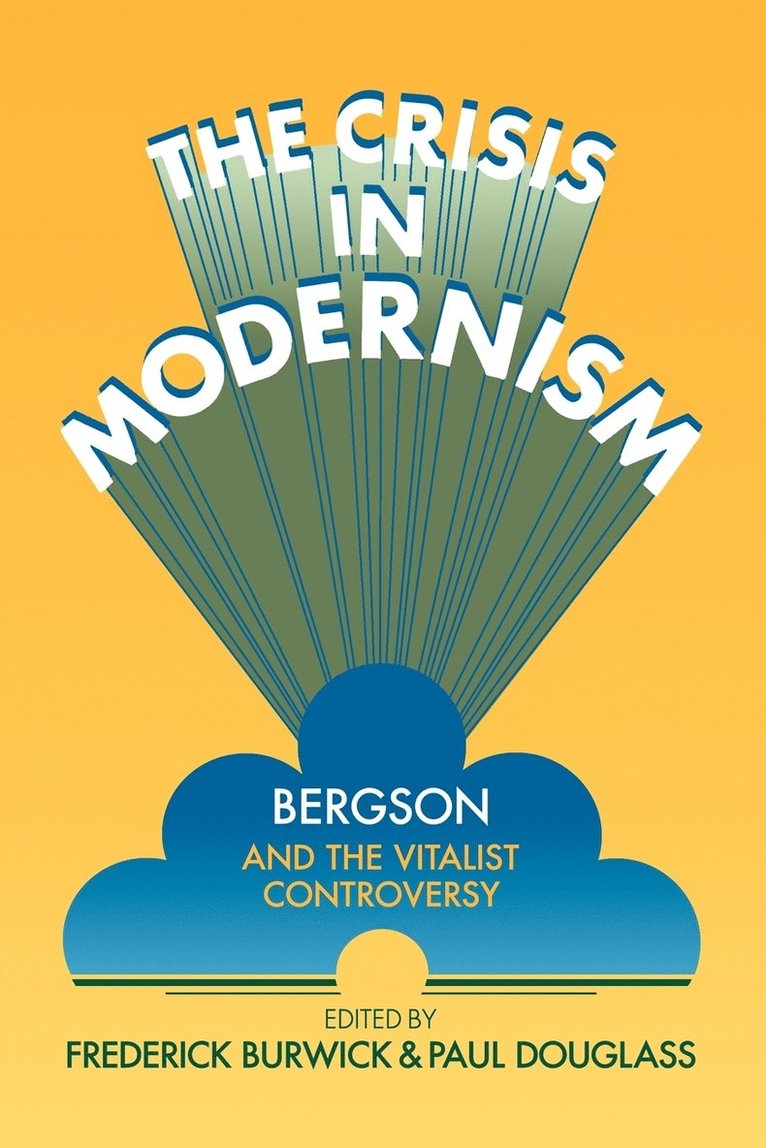
The Modernist movement has been regarded as representing a crisis point in Western thought. This volume looks at that crisis in terms of its reinterpretation of ideas concerning vitalism: the animation of the universe, whether spiritual or based in physical energies, of the universe. Beginning with vitalism's historical background in the enlightenment and the nineteenth century, and moving through scientific, philosophical and literary disciplines, the contributors chart the progress of vitalism and its influence on modernist thought. The focal point is the work of Henri Bergson, whose part in this powerful reinterpretation had a considerable bearing on European and American intellectual life, and yet led to a vehement rejection of his work. A previously untranslated and little-known essay by Bakhtin will be of special interest in this stimulating collection, which includes original contributions from leading scholars in literature, the history of science, biology and philosophy, and comprises a wide-ranging reassessment of 'the perpetual crises of modernity'.
690 kr
Skickas inom 7-10 vardagar
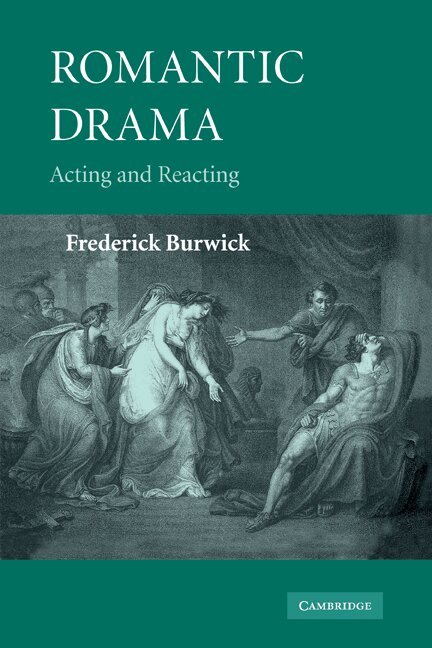
Drama in the Romantic period underwent radical changes affecting theatre performance, acting, and audience. Theatres were rebuilt and expanded to accommodate larger audiences, and consequently acting styles and the plays themselves evolved to meet the expectations of the new audiences. This book examines manifestations of change in acting, stage design, setting, and the new forms of drama. Actors exercised a persistent habit of stepping out of their roles, whether scripted or not. Burwick traces the radical shifts in acting style from Garrick to Kemble and Siddons, and to Kean and Macready, adding a new dimension to understanding the shift in cultural sensibility from early to later Romantic literature. Eye-witness accounts by theatre-goers and critics attending plays at the major playhouses of London, the provinces, and on the Continent are provided, allowing readers to identify with the experience of being in the theatre during this tumultuous period.
977 kr
Skickas inom 7-10 vardagar
Drama in the Romantic period underwent radical changes affecting theatre performance, acting, and audience. Theatres were rebuilt and expanded to accommodate larger audiences, and consequently acting styles and the plays themselves evolved to meet the expectations of the new audiences. This book examines manifestations of change in acting, stage design, setting, and the new forms of drama. Actors exercised a persistent habit of stepping out of their roles, whether scripted or not. Burwick traces the radical shifts in acting style from Garrick to Kemble and Siddons, and to Kean and Macready, adding a new dimension to understanding the shift in cultural sensibility from early to later Romantic literature. Eye-witness accounts by theatre-goers and critics attending plays at the major playhouses of London, the provinces, and on the Continent are provided, allowing readers to identify with the experience of being in the theatre during this tumultuous period.
1 228 kr
Skickas inom 7-10 vardagar
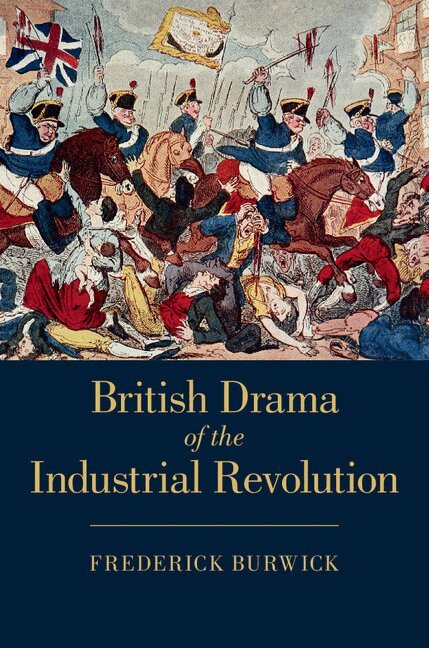
Between the advent of the French Revolution and the short-lived success of the Chartist Movement, overworked and underpaid labourers struggled to achieve solidarity and collective bargaining. That history has been told in numerous accounts of the age, but never before has it been told in terms of the theatre of the period. To understand the play lists of a theatre, it is crucial to examine the community which that theatre serves. In the labouring-class communities of London and the provinces, the performances were adapted to suit the local audiences, whether weavers, or miners, or field workers. Examining the conditions and characteristics of representative provincial theatres from the 1790s to 1830s, Frederick Burwick argues that the meaning of a play changes with every change in the performance location. As contributing factors in that change, Burwick attends to local political and cultural circumstances as well as to theatrical activities and developments elsewhere.
1 854 kr
Skickas inom 3-6 vardagar
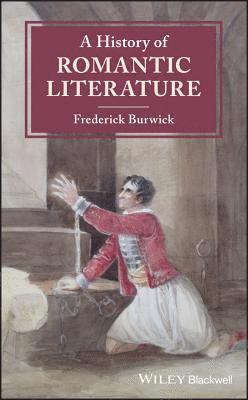
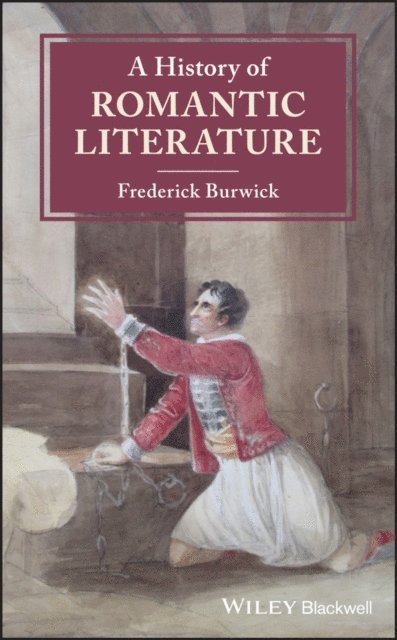
Historical Narrative Offers Introduction to Romanticism by Placing Key Figures in Overall Social Context Going beyond the general literary survey, A History of Romantic Literature examines the literatures of sensibility and intensity as well as the aesthetic dimensions of horror and terror, sublimity and ecstasy, by providing a richly integrated account of shared themes, interests, innovations, rivalries and disputes among the writers of the late eighteenth and early nineteenth centuries.Drawing from the assemblage theory, Prof. Burwick maintains that the literature of the period is inseparable from prevailing economic conditions and ongoing political and religious turmoil, as well as developments in physics, astronomy, music and art. Thus, rather than deal with authors as if they worked in isolation from society, he identifies and describes their interactions with their communities and with one another, as well as their responses to current events. By connecting seemingly scattered and random events such as the bank crisis of 1825, he weaves the coincidental into a coherent narrative of the networking that informed the rise and progress of Romanticism. Notable features of the book include: A strong narrative structure divided into four major chronological periods: Revolution, 1789-1798; Napoleonic Wars, 1799-1815; Riots, 1815-1820; Reform, 1821-1832Thorough coverage of major and minor figures and institutions of the Romantic movement (including Mary Wollstonecraft, Elizabeth Montague and the Bluestockings, Lord Byron, John Keats, Letitia Elizabeth Landon etc.)Emphasis on the influence of social networks among authors, such as informal dinners and teas, clubs, salons and more formal institutionsWith its extensive coverage and insightful analysis set within a lively historical narrative, History of Romantic Literature is highly recommended for courses on British Romanticism at both undergraduate and post-graduate levels. It will also prove a highly useful reference for advanced scholars pursuing their own research.
Del 5 - Wiley-Blackwell Encyclopedia of Literature
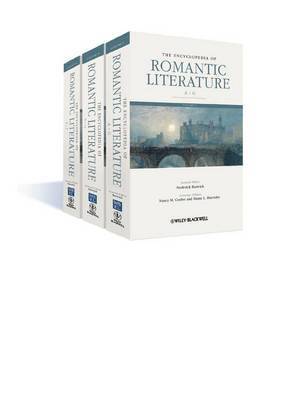
Encyclopedia of Romantic Literature, 3 Volume Set
Inbunden, Engelska, 2012
6 566 kr
Skickas inom 11-20 vardagar
The Encyclopedia of Romantic Literature is an authoritative three-volume reference work that covers British artistic, literary, and intellectual movements between 1780 and 1830, within the context of European, transatlantic and colonial historical and cultural interaction. Comprises over 275 entries ranging from 1,000 to 6,500 words arranged in A-Z format across three fully cross-referenced volumesWritten by an international cast of leading and emerging scholarsEntries explore genre development in prose, poetry, and drama of the Romantic period, key authors and their works, and key themesAlso available online as part of the Wiley-Blackwell Encyclopedia of Literature, providing 24/7 access and powerful searching, browsing and cross-referencing capabilities
1 519 kr
Skickas inom 10-15 vardagar
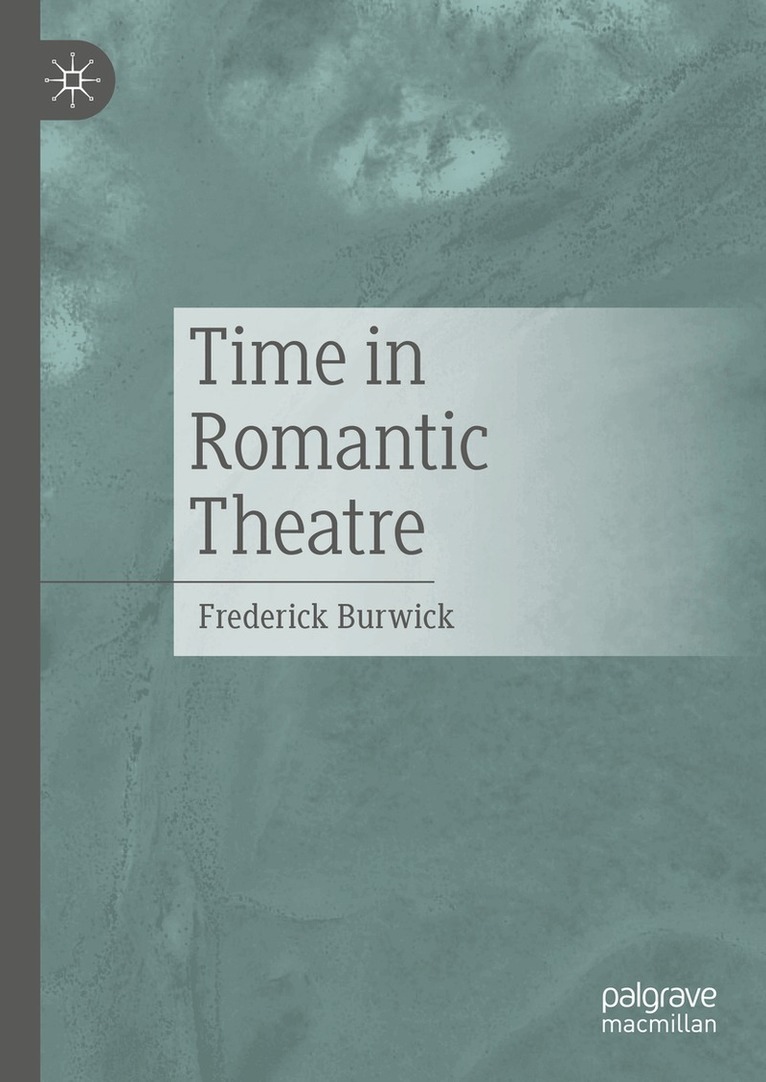
The shift in temporal modalities of Romantic Theatre was the consequence of internal as well as external developments: internally, the playwright was liberated from the old imperative of “Unity of Time” and the expectation that the events of the play must not exceed the hours of a single day; externally, the new social and cultural conformance to the time-keeping schedules of labour and business that had become more urgent with the industrial revolution. In reviewing the theatre of the Romantic era, this monograph draws attention to the ways in which theatre reflected the pervasive impact of increased temporal urgency in social and cultural behaviour. The contribution this book makes to the study of drama in the early nineteenth century is a renewed emphasis on time as a prominent element in Romantic dramaturgy, and a reappraisal of the extensive experimentation on how time functioned.
1 519 kr
Skickas inom 10-15 vardagar
The shift in temporal modalities of Romantic Theatre was the consequence of internal as well as external developments: internally, the playwright was liberated from the old imperative of “Unity of Time” and the expectation that the events of the play must not exceed the hours of a single day; externally, the new social and cultural conformance to the time-keeping schedules of labour and business that had become more urgent with the industrial revolution. In reviewing the theatre of the Romantic era, this monograph draws attention to the ways in which theatre reflected the pervasive impact of increased temporal urgency in social and cultural behaviour. The contribution this book makes to the study of drama in the early nineteenth century is a renewed emphasis on time as a prominent element in Romantic dramaturgy, and a reappraisal of the extensive experimentation on how time functioned.
2 169 kr
Skickas inom 3-6 vardagar
No detailed description available for "The Damnation of Newton".
2 876 kr
Skickas inom 7-10 vardagar
Reflecting Senses
Perception and Appearance in Literature, Culture and the Arts
Inbunden, Engelska, 1995
2 414 kr
Skickas inom 7-10 vardagar
No detailed description available for "Reflecting Senses".