Gail Fine – författare
Visar alla böcker från författaren Gail Fine. Handla med fri frakt och snabb leverans.
19 produkter
The Oxford Handbook of Plato
Av Gail Fine
Inbunden, 2019
2717 kr
Lägg i varukorg
Plato is the best known, and continues to be the most widely studied, of all the ancient Greek philosophers. The updated and original essays in the second edition of The Oxford Handbook of Plato provide in-depth discussions of a variety of topics and dialogues, all serving several functions at …
The Oxford Handbook of Plato
Second Edition
Av Gail Fine
Häftad, 2023
751 kr
Lägg i varukorg
Plato is the best known, and continues to be the most widely studied, of all the ancient Greek philosophers. The updated and original essays in the second edition of The Oxford Handbook of Plato provide in-depth discussions of a variety of topics and dialogues, all serving several functions at …
Oxford Handbook of Plato
Second Edition
Av Gail Fine
E-bok, 2019
550 kr
Lägg i varukorg
Plato is the best known, and continues to be the most widely studied, of all the ancient Greek philosophers. The updated and original essays in the second edition of The Oxford Handbook of Plato provide in-depth discussions of a variety of topics and dialogues, all serving several functions at …
Oxford Handbook of Plato
Second Edition
Av Gail Fine
E-bok, 2019
550 kr
Lägg i varukorg
Plato is the best known, and continues to be the most widely studied, of all the ancient Greek philosophers. The updated and original essays in the second edition of The Oxford Handbook of Plato provide in-depth discussions of a variety of topics and dialogues, all serving several functions at …
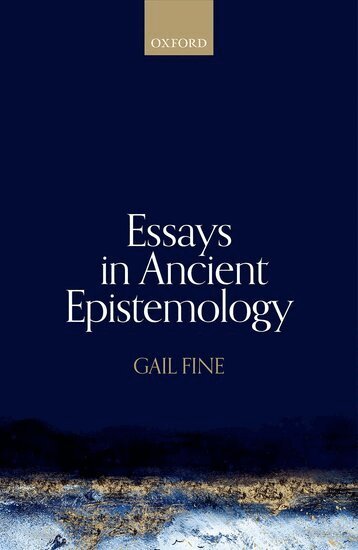
Essays in Ancient Epistemology
Av Gail Fine
E-bok, 2021
1420 kr
Lägg i varukorg
Focusing primarily on Plato, Aristotle, and the Pyrrhonian skeptics, Fine discusses the following questions, among others: does Socrates, in the Apology , claim to know that he knows nothing? How do Plato and Aristotle conceive of doxa and epistêmê ? Are doxa and epistêmê belief and knowledge …
Possibility of Inquiry
Meno's Paradox from Socrates to Sextus
Av Gail Fine
E-bok, 2014
440 kr
Lägg i varukorg
Gail Fine presents an original interpretation of a compelling puzzle in ancient philosophy. Meno''s Paradox, which is first formulated in Plato''s Meno , challenges the very possibility of inquiry. Plato replies with the theory of recollection, according to which we all had prenatal knowledge of …
The Oxford Handbook of Plato
Inbunden, 2008
3269 kr
Lägg i varukorg
The Oxford Handbooks series is a major new initiative in academic publishing. Each volume offers an authoritative and state-of-the-art survey of current thinking and research in a particular area. Specially commissioned essays from leading international figures in the discipline give critical …
On Ideas
Aristotle's Criticism of Plato's Theory of Forms
Av Gail Fine
Häftad, 1995
1564 kr
Lägg i varukorg
The Peri ideon (On Ideas) is the only work in which Aristotle systematically sets out and criticizes arguments for the existence of Platonic forms. Gail Fine presents the first full-length treatment in English of this important but neglected work . She asks how, and how well, and why and with what …
Essays in Ancient Epistemology
Av Gail Fine
Inbunden, 2021
2119 kr
Lägg i varukorg
Focusing primarily on Plato, Aristotle, and the Pyrrhonian skeptics, Fine discusses the following questions, among others: does Socrates, in the Apology, claim to know that he knows nothing? How do Plato and Aristotle conceive of doxa and epistêmê? Are doxa and epistêmê belief and knowledge as we …
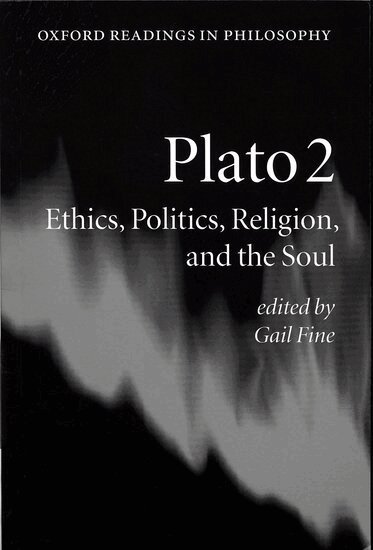
Plato 2
Ethics, Politics, Religion, and the Soul
Av Gail Fine
Häftad, 1999
991 kr
Lägg i varukorg
The aim of the series is to bring together important recent writing in major areas of philosophical inquiry, selected from a variety of sources, mostly. The editor of each volume contributes an introductory essay on the items chosen and on the questions with which they deal. A selective …
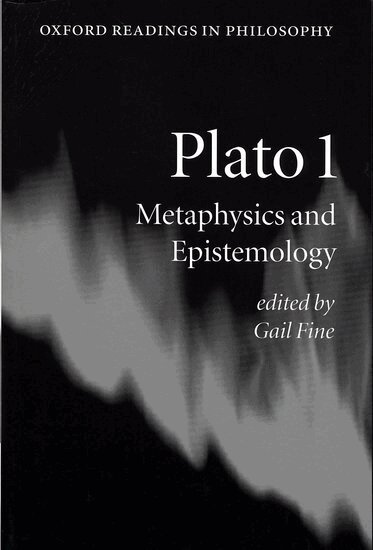
Plato 1
Metaphysics and Epistemology
Av Gail Fine
Häftad, 1999
936 kr
Lägg i varukorg
The aim of the series is to bring together important recent writing in major areas of philosophical inquiry, selected from a variety of sources. The editor of each volume contributes an introductory essay on the items chosen and on the questions with which they deal. A selective bibliography is …
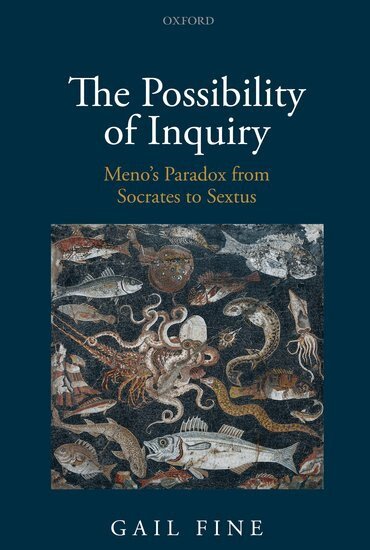
The Possibility of Inquiry
Meno's Paradox from Socrates to Sextus
Av Gail Fine
Häftad, 2018
599 kr
Lägg i varukorg
Gail Fine presents an original interpretation of a compelling puzzle in ancient philosophy. Meno's Paradox, which is first formulated in Plato's Meno, challenges the very possibility of inquiry. Plato replies with the theory of recollection, according to which we all had prenatal knowledge of some …
Plato on Knowledge and Forms
Selected Essays
Av Gail Fine
Inbunden, 2003
3576 kr
Lägg i varukorg
This text brings together a set of connected essays by Gail Fine, in her main area of research since the late 1970s: Plato's metaphysics and epistemology. She discusses central issues in Plato's metaphysics and epistemology, issues concerning the nature and extent of knowledge, and its relation to …
Plato on Knowledge and Forms
Selected Essays
Av Gail Fine
Häftad, 2003
1408 kr
Lägg i varukorg
Plato on Knowledge and Forms brings together a set of connected essays by Fine, written over a period of twenty-five years, on Plato's metaphysics and epistemology. It also includes a previously unpublished introductory essay, which pulls together connected threads, responds to some criticisms of …
The Possibility of Inquiry
Meno's Paradox from Socrates to Sextus
Av Gail Fine
Inbunden, 2014
2145 kr
Lägg i varukorg
Gail Fine presents an original interpretation of a compelling puzzle in ancient philosophy. Meno's Paradox, which is first formulated in Plato's Meno, challenges the very possibility of inquiry. Plato replies with the theory of recollection, according to which we all had prenatal knowledge of some …
Oxford Handbook of Plato
Av Gail Fine
E-bok, 2008
807 kr
Lägg i varukorg
Plato is the best known, and continues to be the most widely studied, of all the ancient Greek philosophers. The twenty-one commissioned articles in The Oxford Handbook of Plato provide in-depth and up-to-date discussions of a variety of topics and dialogues. The result is a useful state-of-the-art …
The Oxford Handbook of Plato
Av Gail Fine
Häftad, 2011
1170 kr
Lägg i varukorg
Plato is the best known, and continues to be the most widely studied, of all the ancient Greek philosophers. The twenty-one commissioned articles in The Oxford Handbook of Plato provide in-depth and up-to-date discussions of a variety of topics and dialogues. The result is a useful state-of-the-art …
Oxford Handbook of Plato
Av Gail Fine
E-bok, 2008
807 kr
Lägg i varukorg
Plato is the best known, and continues to be the most widely studied, of all the ancient Greek philosophers. The twenty-one commissioned articles in The Oxford Handbook of Plato provide in-depth and up-to-date discussions of a variety of topics and dialogues. The result is a useful state-of-the-art …
Aristotle: Introductory Readings
Häftad, 1996
279 kr
Tillfälligt slut
Drawn from the translations and editorial aids of Irwin and Fine's Aristotle, Selections (Hackett Publishing Co., 1995), this anthology will be most useful to instructors who must try to do justice to Aristotle in a semester-long ancient-philosophy survey, but it will also be appropriate for a …