
Gary Becker – författare
Visar alla böcker från författaren Gary Becker. Handla med fri frakt och snabb leverans.
5 produkter
5 produkter
Häftad, Engelska, 1998
251 kr
Skickas inom 3-6 vardagar
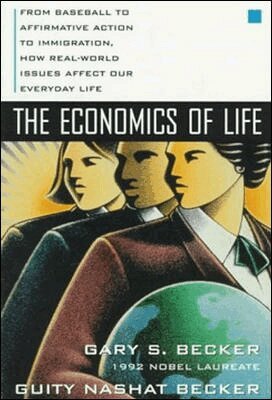
'...the 1992 Nobel laureate demonstrates his well-known talent for extending ever further the frontiers of economics...in these pieces, the real world is very much at hand' - "Business Week". 'Becker goes tot he root of the problem...brims with fresh insights' - "The Wall Street Journal". 1992 Nobel Prize winner Gary S. Becker is one of the few modern economists to apply economic theory to human behavior. His provocative world-view states that our daily actions and choices are influenced more than we know by market forces and economic incentives.In "The Economics of Life", Gary Becker and historian Guity Nashat Becker have collected the best of the economist's popular work from his monthly "Business Week" column along with introductions that bring each topic into present-day focus. Extending well beyond the traditional range of economics, these 138 essays provocatively address modern issues including: the changing role of women in modern economics, crime, immigration, drugs, discrimination against minorities, and many other topics.From legalizing drugs to auctioning off immigration rights, the Beckers do not shy away from advocating controversial changes in public policy and personal behavior. They will set you thinking and perhaps change your mind about the connections between economics and life, liberty, and the pursuit of happiness.
Häftad, Engelska, 2007
786 kr
Skickas inom 10-15 vardagar
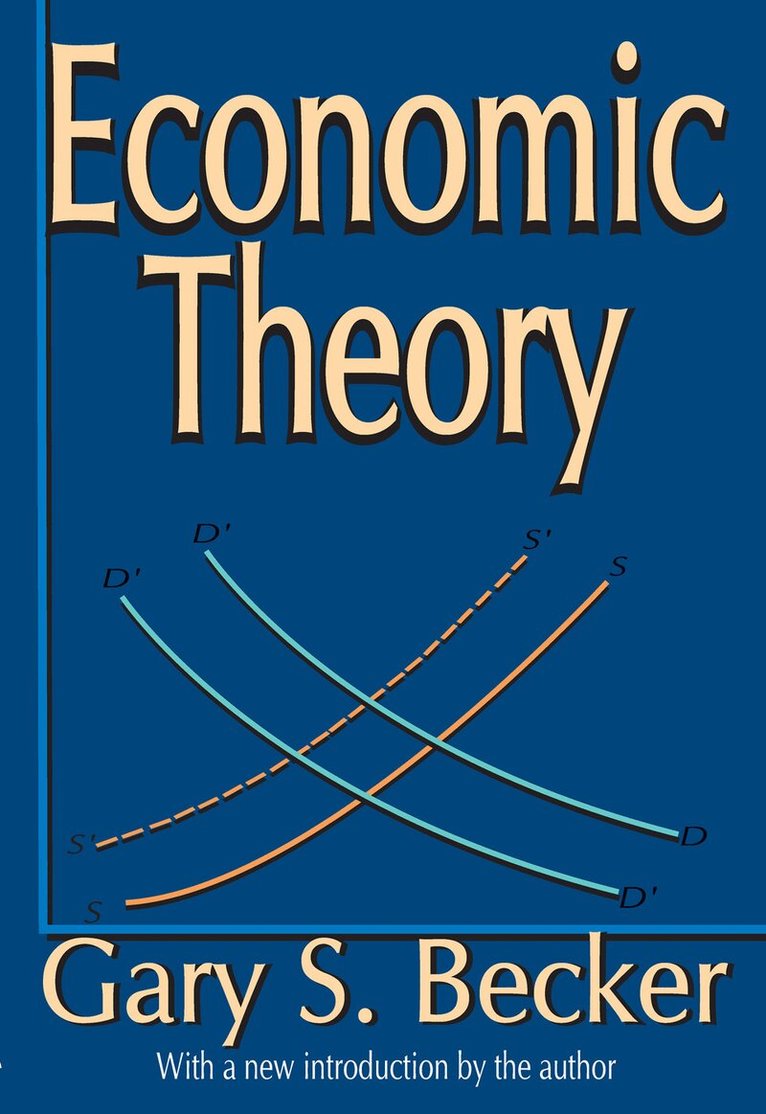
Others might have called this book Micro Theory or Price Theory. Becker's choice of Economic Theory as the title for his book reflects his deep belief that there is only one kind of economic theory, not separate theories for micro problems, macro problems, non-market decisions, and so on. Indeed, as he notes, the most promising development in recent years in the literature on large scale economic problems such as unemployment has been the increasing reliance on utility maximization, a concept generally identified with microeconomics.Microeconomics is the subject matter of this volume, but it is emphatically not confined to microeconomics in the literal sense of micro units like firms or households. Becker's main interest is in market behavior of aggregations of firms and households. Although important inferences are drawn about individual firms and households, the author tries to understand aggregate responses to changes in basic economic parameters like tax rates, tariff schedules, technology, or antitrust provisions. His discussion is related to the market sector in industrialized economies, but the principles developed are applied to other sectors and different kinds of choices.Becker argues that economic analysis is essential to understand much of the behavior traditionally studied by sociologists, anthropologists, and other social scientists. The broad definition of economics in terms of scarce means and competing ends is taken seriously and should be a source of pride to economists since it provides insights into a wide variety of problems. Practically all statements proved mathematically are also provided geometrically or verbally in the body of the text.
Häftad, Engelska, 1999
680 kr
Skickas inom 10-15 vardagar
Bertrand de Jouvenel (1903-1987) was known in the United States primarily as a political scientist. His best-known works--On Power, Sovereignty, and The Pure Theory of Politics--all made distinctive contributions to our understanding of the modern state, and to the creation of a political science capable of civilizing that state. His work in the field of economics is relatively unknown in the United States, but like many writers in the contemporary field of political economy, de Jouvenel is not interested in expanding the claims of economy at the expense of polity. On the contrary, his thinking is governed by the oldest and most fundamental of political concerns, the definition of the good life.The good life is not a product of the marketplace, but of deliberate and collective decision--that is, a task for thoughtful citizens and statesmen, and not simply the sum of millions of separate and amoral "consumer preferences." De Jouvenel is well known for his opposition to the distended state, but he was no anarchist. His eloquent warnings to keep the state in its proper sphere were accompanied by a richly sophisticated discussion of what the proper sphere is--an aspect of his work that comes through very clearly in this volume.Written between 1952 and 1980, the essays range from a discussion of technology to reflections on such fundamental economic concepts as "amenity" and "welfare." They include the deeply theoretical as well as the practical and the concrete. All are informed by de Jouvenel's insistence that a science which seeks to understand the production and distribution of "goods" must be concerned in the first place with the good itself. Economics and the Good Life is a companion volume to The Nature of Politics: Selected Essays of Bertrand de Jouvenel. Like the earlier volume, this collection is accompanied by an editor's introduction that places the essays in the wider context of de Jouvenel's work. This work is essential to the libraries of economists, political theorists, historians, and sociologists.
Inbunden, Engelska, 2017
2 484 kr
Skickas inom 10-15 vardagar
Others might have called this book Micro Theory or Price Theory. Becker's choice of Economic Theory as the title for his book reflects his deep belief that there is only one kind of economic theory, not separate theories for micro problems, macro problems, non-market decisions, and so on. Indeed, as he notes, the most promising development in recent years in the literature on large scale economic problems such as unemployment has been the increasing reliance on utility maximization, a concept generally identified with microeconomics.Microeconomics is the subject matter of this volume, but it is emphatically not confined to microeconomics in the literal sense of micro units like firms or households. Becker's main interest is in market behavior of aggregations of firms and households. Although important inferences are drawn about individual firms and households, the author tries to understand aggregate responses to changes in basic economic parameters like tax rates, tariff schedules, technology, or antitrust provisions. His discussion is related to the market sector in industrialized economies, but the principles developed are applied to other sectors and different kinds of choices.Becker argues that economic analysis is essential to understand much of the behavior traditionally studied by sociologists, anthropologists, and other social scientists. The broad definition of economics in terms of scarce means and competing ends is taken seriously and should be a source of pride to economists since it provides insights into a wide variety of problems. Practically all statements proved mathematically are also provided geometrically or verbally in the body of the text.
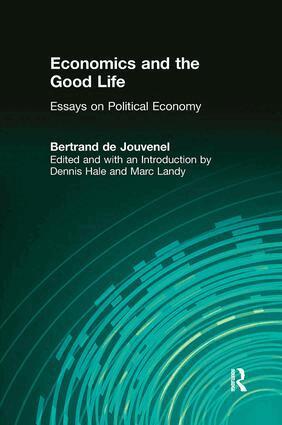
Inbunden, Engelska, 2017
2 201 kr
Skickas inom 10-15 vardagar
Bertrand de Jouvenel (1903-1987) was known in the United States primarily as a political scientist. His best-known works--On Power, Sovereignty, and The Pure Theory of Politics--all made distinctive contributions to our understanding of the modern state, and to the creation of a political science capable of civilizing that state. His work in the field of economics is relatively unknown in the United States, but like many writers in the contemporary field of political economy, de Jouvenel is not interested in expanding the claims of economy at the expense of polity. On the contrary, his thinking is governed by the oldest and most fundamental of political concerns, the definition of the good life.The good life is not a product of the marketplace, but of deliberate and collective decision--that is, a task for thoughtful citizens and statesmen, and not simply the sum of millions of separate and amoral "consumer preferences." De Jouvenel is well known for his opposition to the distended state, but he was no anarchist. His eloquent warnings to keep the state in its proper sphere were accompanied by a richly sophisticated discussion of what the proper sphere is--an aspect of his work that comes through very clearly in this volume.Written between 1952 and 1980, the essays range from a discussion of technology to reflections on such fundamental economic concepts as "amenity" and "welfare." They include the deeply theoretical as well as the practical and the concrete. All are informed by de Jouvenel's insistence that a science which seeks to understand the production and distribution of "goods" must be concerned in the first place with the good itself. Economics and the Good Life is a companion volume to The Nature of Politics: Selected Essays of Bertrand de Jouvenel. Like the earlier volume, this collection is accompanied by an editor's introduction that places the essays in the wider context of de Jouvenel's work. This work is essential to the libraries of economists, political theorists, historians, and sociologists.