
Bertrand de Jouvenel – författare
Visar alla böcker från författaren Bertrand de Jouvenel. Handla med fri frakt och snabb leverans.
7 produkter
7 produkter
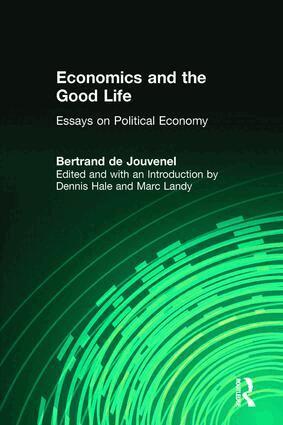
Häftad, Engelska, 1999
680 kr
Skickas inom 10-15 vardagar
Bertrand de Jouvenel (1903-1987) was known in the United States primarily as a political scientist. His best-known works--On Power, Sovereignty, and The Pure Theory of Politics--all made distinctive contributions to our understanding of the modern state, and to the creation of a political science capable of civilizing that state. His work in the field of economics is relatively unknown in the United States, but like many writers in the contemporary field of political economy, de Jouvenel is not interested in expanding the claims of economy at the expense of polity. On the contrary, his thinking is governed by the oldest and most fundamental of political concerns, the definition of the good life.The good life is not a product of the marketplace, but of deliberate and collective decision--that is, a task for thoughtful citizens and statesmen, and not simply the sum of millions of separate and amoral "consumer preferences." De Jouvenel is well known for his opposition to the distended state, but he was no anarchist. His eloquent warnings to keep the state in its proper sphere were accompanied by a richly sophisticated discussion of what the proper sphere is--an aspect of his work that comes through very clearly in this volume.Written between 1952 and 1980, the essays range from a discussion of technology to reflections on such fundamental economic concepts as "amenity" and "welfare." They include the deeply theoretical as well as the practical and the concrete. All are informed by de Jouvenel's insistence that a science which seeks to understand the production and distribution of "goods" must be concerned in the first place with the good itself. Economics and the Good Life is a companion volume to The Nature of Politics: Selected Essays of Bertrand de Jouvenel. Like the earlier volume, this collection is accompanied by an editor's introduction that places the essays in the wider context of de Jouvenel's work. This work is essential to the libraries of economists, political theorists, historians, and sociologists.
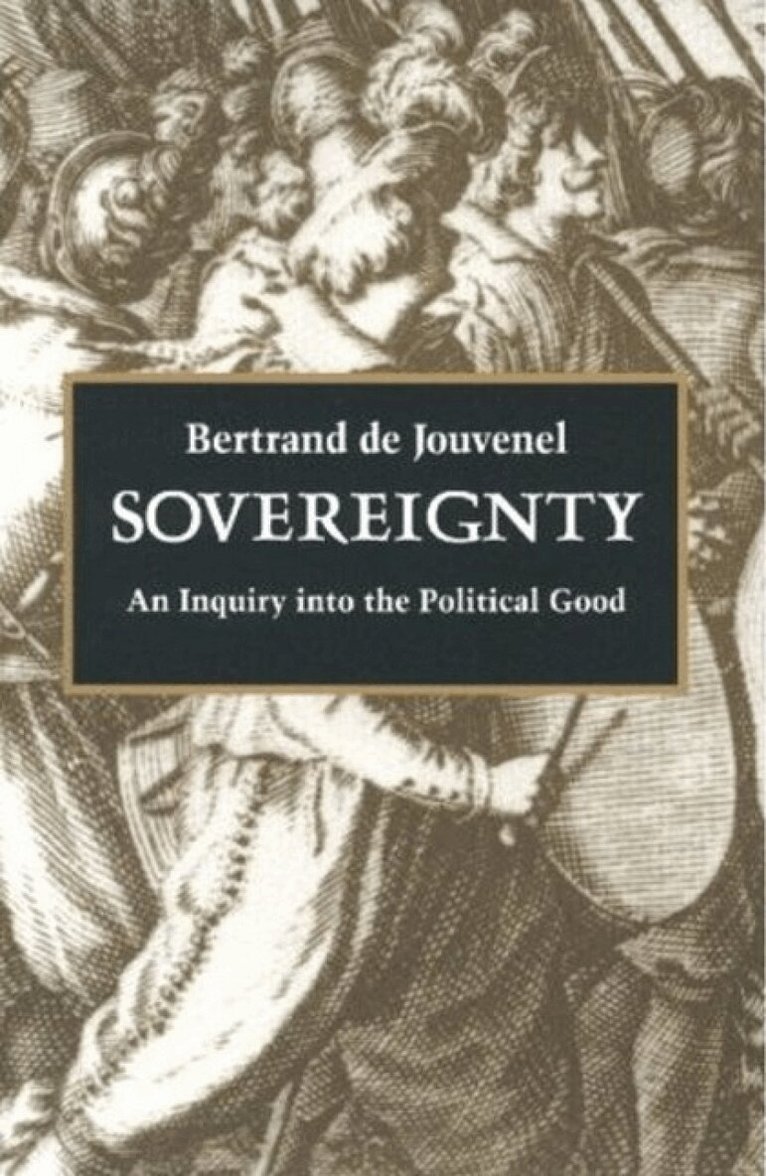
Häftad, Engelska, 1997
225 kr
Skickas inom 3-6 vardagar
Häftad, Engelska, 2012
395 kr
Skickas inom 7-10 vardagar
Bertrand de Jouvenel (1903-1987) was a renowned French philosopher and political economist. In Sovereignty he turned his attention to the relationship between the distribution of power and the creation of an ethical society. More specifically, he was concerned with the potential confusion of the body politic resulting from the development of increasingly dynamic and nebulous social conditions. The text is written in an exploratory fashion, reflecting the authorial perception of an ambiguity in modern political structures. This translated Cambridge edition, which was first published in 1957, was derived from a 1955 French original. It constitutes an important contribution to post-war political theory that will remain of value to anyone with an interest in questions relating to political structures and the nature of authority.
Inbunden, Engelska, 2017
2 201 kr
Skickas inom 10-15 vardagar
Bertrand de Jouvenel (1903-1987) was known in the United States primarily as a political scientist. His best-known works--On Power, Sovereignty, and The Pure Theory of Politics--all made distinctive contributions to our understanding of the modern state, and to the creation of a political science capable of civilizing that state. His work in the field of economics is relatively unknown in the United States, but like many writers in the contemporary field of political economy, de Jouvenel is not interested in expanding the claims of economy at the expense of polity. On the contrary, his thinking is governed by the oldest and most fundamental of political concerns, the definition of the good life.The good life is not a product of the marketplace, but of deliberate and collective decision--that is, a task for thoughtful citizens and statesmen, and not simply the sum of millions of separate and amoral "consumer preferences." De Jouvenel is well known for his opposition to the distended state, but he was no anarchist. His eloquent warnings to keep the state in its proper sphere were accompanied by a richly sophisticated discussion of what the proper sphere is--an aspect of his work that comes through very clearly in this volume.Written between 1952 and 1980, the essays range from a discussion of technology to reflections on such fundamental economic concepts as "amenity" and "welfare." They include the deeply theoretical as well as the practical and the concrete. All are informed by de Jouvenel's insistence that a science which seeks to understand the production and distribution of "goods" must be concerned in the first place with the good itself. Economics and the Good Life is a companion volume to The Nature of Politics: Selected Essays of Bertrand de Jouvenel. Like the earlier volume, this collection is accompanied by an editor's introduction that places the essays in the wider context of de Jouvenel's work. This work is essential to the libraries of economists, political theorists, historians, and sociologists.
Inbunden, Engelska, 2017
2 412 kr
Skickas inom 10-15 vardagar
Commissions of experts regularly meet to reply to questions such as: What will be the population of the country, or even of our planet, in ten, fifteen or twenty-five years? In what proportion will production have increased, what modifications will its composition and utilizations have undergone? The attraction of efforts to forecast the future continues. That is a fact. How does it proceed? That is a problem, one on which de Jouvenel focuses on in this book.The Art of Conjecture clearly explains what the "study of the future" can mean. De Jouvenel emphasizes the logical and political problems of forecasting and discusses methods in economics, sociology, and political science by which the future can be studied. More importantly, he discusses the fallacies to which the "study of the future" is peculiarly likely to give rise. The author argues that it is natural and necessary for the population to have visions of the future. Without this, he states, we would only be able to set one opinion of the future against another. If the origins and meanings of these predictions remained obscure, only the event could decide among the opinions.If any man can be said to have created the serious "study of the future" in our time, it is Bertrand de Jouvenel. Futuribles, a periodical he created, continues to represent a major turning point in contemporary social science. Jouvenel aimed to show how "the art of conjecture" could inform prudential judgment and allow citizens and statesmen to detect troubles before they arise.
Häftad, Engelska, 2012
776 kr
Skickas inom 10-15 vardagar
Commissions of experts regularly meet to reply to questions such as: What will be the population of the country, or even of our planet, in ten, fifteen or twenty-five years? In what proportion will production have increased, what modifications will its composition and utilizations have undergone? The attraction of efforts to forecast the future continues. That is a fact. How does it proceed? That is a problem, one on which de Jouvenel focuses on in this book.The Art of Conjecture clearly explains what the "study of the future" can mean. De Jouvenel emphasizes the logical and political problems of forecasting and discusses methods in economics, sociology, and political science by which the future can be studied. More importantly, he discusses the fallacies to which the "study of the future" is peculiarly likely to give rise. The author argues that it is natural and necessary for the population to have visions of the future. Without this, he states, we would only be able to set one opinion of the future against another. If the origins and meanings of these predictions remained obscure, only the event could decide among the opinions.If any man can be said to have created the serious "study of the future" in our time, it is Bertrand de Jouvenel. Futuribles, a periodical he created, continues to represent a major turning point in contemporary social science. Jouvenel aimed to show how "the art of conjecture" could inform prudential judgment and allow citizens and statesmen to detect troubles before they arise.
Häftad, Franska, 2022
508 kr
Skickas inom 3-6 vardagar