Genevieve Liveley - Böcker
Visar alla böcker från författaren Genevieve Liveley. Handla med fri frakt och snabb leverans.
7 produkter
7 produkter
1 400 kr
Skickas inom 5-8 vardagar
This volume explores the extraordinary contribution that classical poetics has made to twentieth and twenty-first century theories of narrative, aiming not to argue that modern narratologies simply present 'old wine in new wineskins', but rather to identify the diachronic affinities shared between ancient and modern stories about storytelling. By recognizing that modern narratologists bring a particular expertise to bear upon ancient literary theory, and by interrogating ancient and modern narratologies through the mutually imbricating dynamics of their reception, it seeks to arrive at a better understanding of both. Each chapter selects a key moment in the history of narratology on which to focus, providing an overview of significant phases before offering detailed analyses of core theories and texts, from the Russian formalists and Chicago school neo-Aristotelians, through the prestructuralists, structuralists, and poststructuralists, up to the latest unnatural and antimimetic narratologists. The reception history that thus unfolds offers some remarkable plot twists and yields valuable insights into the interpretation of some notoriously difficult ancient works. Plato in the Republic is unmasked as an unreliable narrator and theorist, while Aristotle's On Poets reveals a rare glimpse of the philosopher putting narrative theory into practice in the role of storyteller. Horace's Ars Poetica and the works of ancient scholia by critics and commentators evince a rhetorically conceived poetics and sophisticated reader-response-based narratology which indicate a keen interest in audience affect and cognition - anticipating the cognitive turn in narratology's most recent postclassical phase.
405 kr
Skickas inom 7-10 vardagar
This volume explores the extraordinary contribution that classical poetics has made to twentieth and twenty-first century theories of narrative, aiming not to argue that modern narratologies simply present 'old wine in new wineskins', but rather to identify the diachronic affinities shared between ancient and modern stories about storytelling. By recognizing that modern narratologists bring a particular expertise to bear upon ancient literary theory, and by interrogating ancient and modern narratologies through the mutually imbricating dynamics of their reception, it seeks to arrive at a better understanding of both. Each chapter selects a key moment in the history of narratology on which to focus, providing an overview of significant phases before offering detailed analyses of core theories and texts, from the Russian formalists and Chicago school neo-Aristotelians, through the prestructuralists, structuralists, and poststructuralists, up to the latest unnatural and antimimetic narratologists. The reception history that thus unfolds offers some remarkable plot twists and yields valuable insights into the interpretation of some notoriously difficult ancient works. Plato in the Republic is unmasked as an unreliable narrator and theorist, while Aristotle's On Poets reveals a rare glimpse of the philosopher putting narrative theory into practice in the role of storyteller. Horace's Ars Poetica and the works of ancient scholia by critics and commentators evince a rhetorically conceived poetics and sophisticated reader-response-based narratology which indicate a keen interest in audience affect and cognition - anticipating the cognitive turn in narratology's most recent postclassical phase.
3 558 kr
Skickas inom 10-15 vardagar
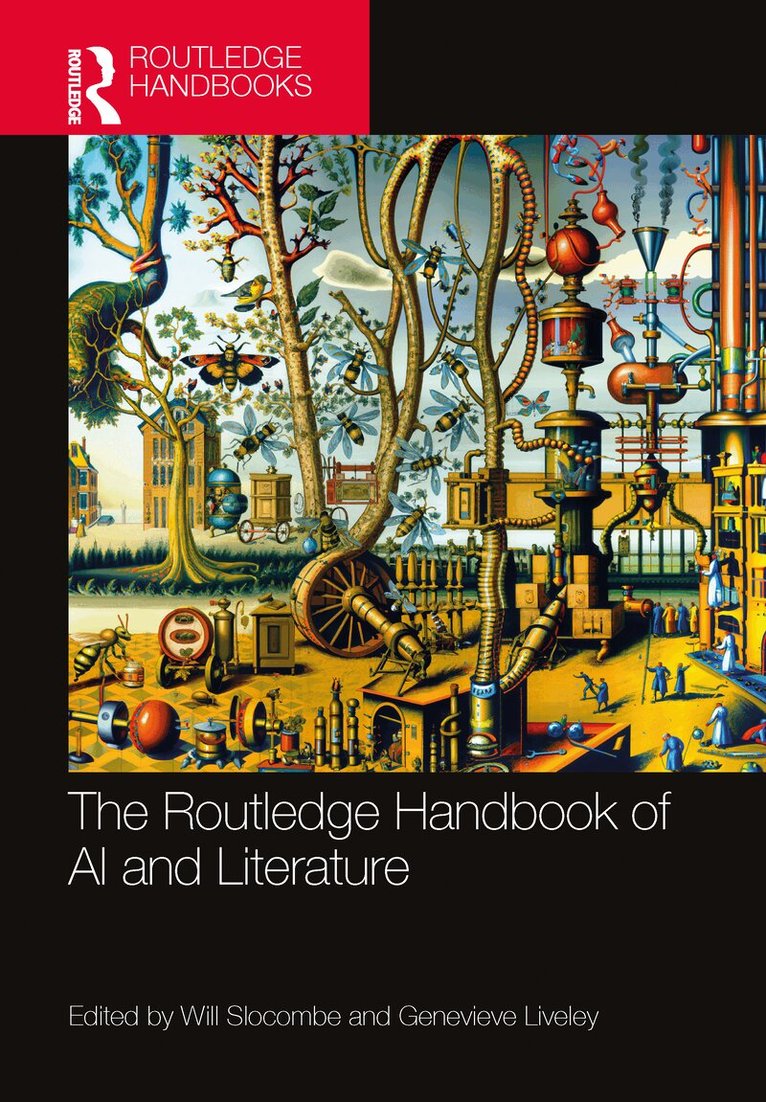
The Routledge Handbook of AI and Literature provides an invaluable resource for those interested in deepening their understanding of the variety of theories and approaches available when AI is studied or deployed in literary contexts. It also illustrates ways in which AI researchers can use literary lenses to better understand the sociotechnical dynamics and cultural imaginaries shaping human interactions with AI.Both AI and literature are understood in their broadest senses here. The book incorporates chapters that deal with Large Language Models, Generative AI, transformer architectures, story generators, and computational analysis. Literary case studies embrace performance, poetry, comics, as well as prose, and span a wide range of historical periods, from the ancient world to contemporary science fiction and Generative AI poetry.The Handbook brings together early career contributors, as well as some of the best-known names in the digital humanities and computational literary studies. It offers a fresh perspective on the past, present, and future of AI and literature that will appeal to students and scholars with relevant interests across a range of subjects, including AI Engineering, Classics, Computing, Digital Humanities, English, Ethics, Film and Television, Law, and Narratology.
579 kr
Skickas inom 7-10 vardagar
Provides the necessary context to read elegiac and lyric poetry, designed for novice and experienced Classics and Latin students alikeA Guide to Latin Elegy and Lyric explores the language of Latin poetry while helping readers understand the socio-cultural context of the remarkable period of Roman literary history in which the poetry was composed. With an innovative approach to this important area of classical scholarship, the authors treat elegy alongside lyric as they cover topics such as the Hellenistic influences on Augustan poetry, the key figures that shaped the elegiac tradition of Rome, the motifs of militia amoris ("the warfare of love") and servitium amoris (“the slavery of love”) in Latin love elegy, and more.Organized into ten chapters, the book begins with an introduction to the literary, political, and social contexts of the Augustan Age. The next six chapters each focus on an individual lyric and elegiac poet—Catullus, Horace, Tibullus, Propertius, Ovid, and Sulpicia—followed by a survey of several lesser-known poets and post-Augustan elegy and lyric. The text concludes with a discussion of major tropes and themes in Latin elegy and lyric, and an overview and analysis of key critical approaches in current scholarship. This volume: Includes full translations alongside the Latin throughout the text to illustrate discussionsAnalyzes recurring themes and tropes found in Latin poetry such as sexuality and gender, politics and patronage, myth and religion, wealth and poverty, empire, madness, magic, and witchcraftReviews modern critical approaches to elegiac and lyric poetry including autobiographical realism, psychoanalysis, narratology, reception, and decolonizationIncludes helpful introductory sections: "How to Read a Latin Elegiac or Lyric Poem" and "How to Teach a Latin Elegiac and Lyric Poem"Provides information about each poet, an in-depth discussion of some of their poetry, and cultural and historical backgroundFeatures a dedicated chapter on Sulpicia, offering readers an ancient female viewpoint on sex and gender, politics, and patronagePart of the acclaimed Blackwell Guides to Classical Literature series, A Guide to Latin Elegy and Lyric is the perfect text for both introductory and advanced courses in Latin elegy and lyric, accessible for students reading the poetry in translation, as well as for those experienced in Latin with an interest in learning a different approach to the subject.
407 kr
Skickas inom 10-15 vardagar
This book is an essential companion for undergraduate students studying Ovid and this popular epic Latin poem. Perhaps no other classical text has proved its versatility so much as Ovid's epic poem. A staple of undergraduate courses in Classical Studies, Latin, English, and Comparative Literature, "Metamorphoses" is arguably one of the most important, canonical Latin texts and certainly among the most widely read and studied. Ovid's "Metamorphoses: A Reader's Guide" is the ideal companion to this epic classical text offering guidance on: literary, historical, and cultural context; key themes; reading the text; reception and influence; and further reading. "Continuum Reader's Guides" are clear, concise and accessible introductions to key texts in literature and philosophy. Each book explores the themes, context, criticism, and influence of key works, providing a practical introduction to close reading, guiding students towards a thorough understanding of the text. They provide an essential, up-to-date resource, ideal for undergraduate students.
1 698 kr
Skickas inom 10-15 vardagar
This is an essential companion for undergraduate students studying Ovid and this popular epic Latin poem. Perhaps no other classical text has proved its versatility so much as Ovid's epic poem. A staple of undergraduate courses in Classical Studies, Latin, English and Comparative Literature, "Metamorphoses" is arguably one of the most important, canonical Latin texts and certainly among the most widely read and studied. "Ovid's 'Metamorphoses': A Reader's Guide" is the ideal companion to this epic classical text offering guidance on: literary, historical and cultural context; key themes; reading the text; reception and influence; and, further reading. "Continuum Reader's Guides" are clear, concise and accessible introductions to key texts in literature and philosophy. Each book explores the themes, context, criticism and influence of key works, providing a practical introduction to close reading, guiding students towards a thorough understanding of the text. They provide an essential, up-to-date resource, ideal for undergraduate students.
423 kr
Skickas inom 10-15 vardagar
The most prolific of Roman poets, Ovid was born in 43 BC and died in exile on the Black Sea in 17 AD, banished by the Emperor Augustus. As well as his famous Metamorphoses (the subject of another book in this series) he produced a large body of elegiac poetry, the Amores, Ars Amatoria, Remedia Amoris, Heroides, Fasti, Tristia and Ex Ponto, all of which are accessibly discussed here in Genevieve Liveley's important re-evaluation of the poet's politics, poetics and erotics. She examines the impact on Ovid of Augustus' programmes for social and political reform, the role of genre, allusion and intertextuality in his writings, and the tensions underlying his representations of gender and sexuality. Finally she assesses responses to Ovid's elegiac works by later love poets and writers, and reflects on the continued relevance and readability of his work for a twenty-first century audience.