Georg Meggle - Böcker
Visar alla böcker från författaren Georg Meggle. Handla med fri frakt och snabb leverans.
9 produkter
9 produkter
Del 79 - Studies in Linguistics and Philosophy
Speech Acts, Mind, and Social Reality
Discussions with John R. Searle
Inbunden, Engelska, 2002
1 064 kr
Skickas inom 10-15 vardagar
Speech acts, mind and social reality - these are the main topics in the work of John R. Searle, one of the leading philosophical figures of modern times. How language is based on intentionality, how intentionality in turn is to be explicated by means of distinctions discovered in speech act theory, and how language and intentionality are both related to social facts and institutions - these are questions to be tackled in this volume. The contributions result from discussions on and with John R. Searle, containing Searle's own latest views - including his seminal ideas on rationality in action. The collection provides a basis for advanced seminar debates in philosophy of language, philosophy of mind, and social philosophy, and will also stimulate some further research on all of the three main topics.
Del 1 - Perspektiven der Analytischen Philosophie/Perspectives in Analytical Philosophy
Analyomen / Analyomen
Proceedings of the 1st Conference "Perspectives in Analytical Philosophy"
Inbunden, Tyska, 1994
4 026 kr
Skickas inom 5-8 vardagar
2 278 kr
Skickas inom 7-10 vardagar
No detailed description available for "Logic, Epistemology, Philosophy of Science".
2 482 kr
Skickas inom 7-10 vardagar
No detailed description available for "Philosophy of Mind, Practical Philosophy, Miscellanea".
1 370 kr
Skickas inom 5-8 vardagar
3 156 kr
Skickas inom 7-10 vardagar
No detailed description available for "Actions, Norms, Values".
1 440 kr
Skickas inom 5-8 vardagar
In der Semantik, der Lehre von der Bedeutung unserer kommunikativen Zeichen, gibt es zwei Paradigmen. Dem realistischen Paradigma zufolge bestehen Bedeutungen von Zeichen in ihrer Zuordnung zu den Dingen, die sie bezeichnen, dem pragmatischen Paradigma zufolge dagegen in ihrem Gebrauch. Schon Wittgenstein hat darauf aufmerksam gemacht, dass dieser bedeutungsrelevante „Gebrauch“ zwei Bedeutungen, d.h. Gebrauchsweisen kennt: eine regelianistische, die der Frage entspricht, wie ein Zeichen (richtig) gebraucht wird, und eine instrumentalistische, die zunächst fragt, wozu - zu welchem Zweck - das betreffende Zeichen als Mittel verwendet wird. Das Buch verfolgt das Ideal einer großen Synthese in drei Schritten. (1) Es beginnt instrumentalistisch, indem es zunächst eine allgemeine Theorie des kommunikativen Handelns entwickelt. (2) Dann rekonstruiert es eine bestimmte Form des Regelianismus auf dieser instrumentalistischen Basis. (3) Schließlich zeigt es, wie sich für eine einfache logische Sprache sogar die realistische Semantik auf dieser handlungstheoretischen Basis rechtfertigen lässt. Das Buch liefert demnach erstmals den Rahmen für eine Theorie der Bedeutung im strengen Sinne einer Bedeutungs-Logik.
2 206 kr
Skickas inom 5-8 vardagar
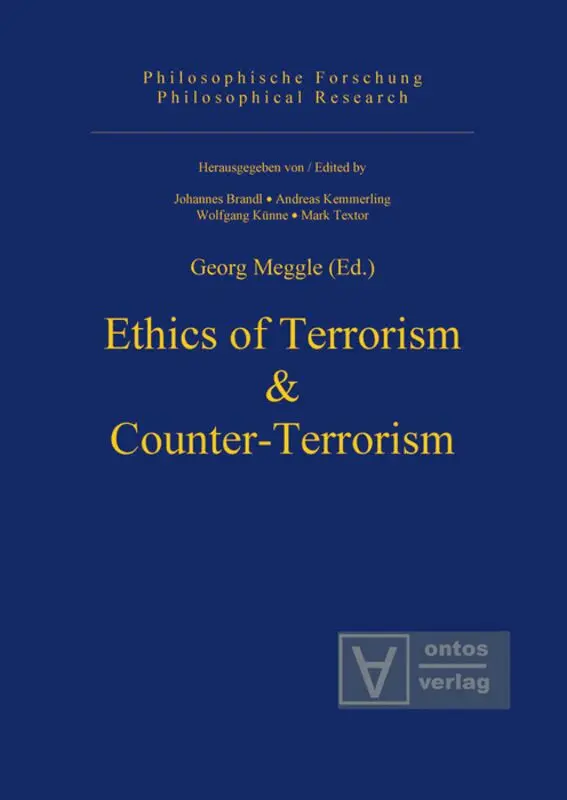
We are supposed to wage war against Terrorism - but exactly what we are fighting against in this war, there is nearly no consensus about. And, much worse, nearly nobody cares about this conceptual disaster - the main thing being, whether or not you are taking sides with the good guys. This volume is an analytical attempt to end this disaster. What is Terrorism? Are terrorist acts to be defined exclusively on the basis of the characteristics of the respective actions? Or should we restrict such actions to acts performed by non-state organisations? And, most important, is terrorism already by its very nature to be morally condemned? But, having a clear idea of what Terrorism is, would be only the beginning. Rational moral assessment still needs two further components: The relevant facts; and the relevant values and norms. Now, in a field where systematic disinformation has been even proclaimed to be the official policy, facts are obviously very hard to get at. This volume is mainly interested in Ethics: What's wrong with Terrorism? And what is morally right or morally wrong, respectively, with all the different means of Counter-Terrorism? What are the moral boundaries for waging war agains terrorism? What are the right ways of dealing with terrorists? And what about the alleged anti-terrorism wars on Afghanistan and Iraq? With contributions from Marcelo Dascal, Tomis Kapitan, Daniel Messelken, Seumas Miller, Olaf L. Mueller, Igor Primoratz, Charles P. Webel, Per Bauhn, Rüdiger Bittner, C. A. J. (Tony) Coady, Haig Khatchadourian, Georg Meggle, Peter Simpson, Carolin Emcke, Ralf Groetker, Laurence Lustgarten, Thomas Mertens, Aleksandar Pavkovic, Filimon Peonidis, Janna Thompson, Véronique Zanetti
2 072 kr
Skickas inom 3-6 vardagar
Humanitarian Interventions - that sounds nice; much nicer than wars, battles and use of military force. Foremost, the phrase makes you think of the delivery of sanitary goods, medication, of soup-kitchens. Here we are not supposed to think of interventions of this kind; we have to have humanitarian interventions in mind which are humanitarian intervention-wars. (I) At exactly what point is the use of military force a humanitarian intervention? What is the humanitarian aspect of those interventions? Their occasion? Their motive? Their alleged as well as their actual consequences? (II) At exactly what point are humanitarian intervention-wars morally justifiable? Are they justifiable even if they are wars of aggression breaching international law? And finally: (III) Was the war which was presented to us as the paradigmatic example of a humanitarian-intervention-war, that is: the war in Kosovo in the spring of 1999 (with over 37,000 bombing missions), really justifiable as a humanitarian intervention? Many of us wanted to believe so at the time. Does our ex ante judgement hold today in an ex post reflection? And which lessons for the future should we learn from the success or failure of this humanitarian war? These are the questions proposed in this book; therefore, it is concerned with problems of semantics (part I), problems of moral assessment (part II) and with the moral, legal and political conclusions we draw from our experiences with the war in Kosovo, our primary example of a humanitarian intervention (part III). International experts in the areas of philosophy, international law, sociology and peace studies debated these questions vigorously for several days. This is the resulting volume.