George Perkovich – författare
Visar alla böcker från författaren George Perkovich. Handla med fri frakt och snabb leverans.
6 produkter
6 produkter
415 kr
Skickas inom 10-15 vardagar
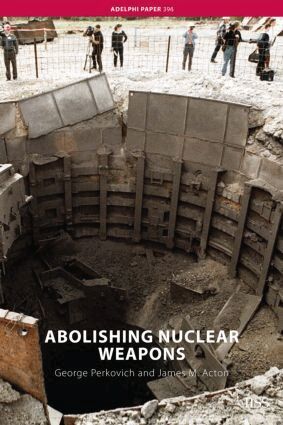
Nuclear disarmament is firmly back on the international agenda. But almost all current thinking on the subject is focused on the process of reducing the number of weapons from thousands to hundreds. This rigorous analysis examines the challenges that exist to abolishing nuclear weapons completely, and suggests what can be done now to start overcoming them. The paper argues that the difficulties of 'getting to zero' must not preclude many steps being taken in that direction. It thus begins by examining steps that nuclear-armed states could take in cooperation with others to move towards a world in which the task of prohibiting nuclear weapons could be realistically envisaged. The remainder of the paper focuses on the more distant prospect of prohibiting nuclear weapons, beginning with the challenge of verifying the transition from low numbers to zero. It moves on to examine how the civilian nuclear industry could be managed in a nuclear-weapons-free world so as to prevent rearmament. The paper then considers what political-security conditions would be required to make a nuclear-weapons ban enforceable and explores how enforcement might work in practice. Finally, it addresses the latent capability to produce nuclear weapons that would inevitably exist after abolition, and asks whether this is a barrier to disarmament, or whether it can be managed to meet the security needs of a world newly free of the bomb.
299 kr
Skickas inom 7-10 vardagar
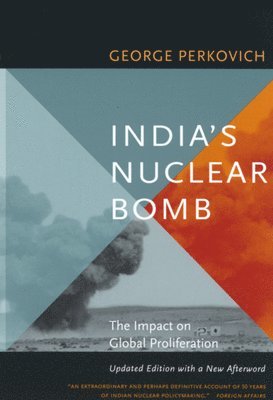
In May 1998, India shocked the world - and many of its own citizens - by detonating five nuclear weapons in the Rajasthan desert. Why did India bid for nuclear weapon status at a time when 149 nations had signed a ban on nuclear testing? What drove India's new Hindu nationalist government to depart from decades of nuclear restraint, a control that no other nation with similar capacities had displayed? How has U.S. nonproliferation policy affected India's decision making? "India's Nuclear Bomb" is the definitive, comprehensive history of how the world's largest democracy, has grappled with the twin desires to have and to renounce the bomb. Each chapter contains significant historical revelations drawn from scores of interviews with India's key scientists, military leaders, diplomats and politicians, and from declassified U.S. government documents and interviews with U.S. officials. Perkovich teases out the cultural and ethical concerns and vestiges of colonialism that underlie India's seemingly paradoxical stance.India's nuclear history challenges leading theories of why nations pursue and hang onto nuclear weapons, raising important questions for international relations theory and security studies. So, too, the blasts in Rajasthan have shaken the foundations of the international nonproliferation system. With the end of the Cold War and an even more chaotic international scene, Perkovich's analysis of an alternative model is timely, sobering, and vital.
202 kr
Skickas inom 5-8 vardagar
2 453 kr
Skickas inom 10-15 vardagar
Nuclear disarmament is firmly back on the international agenda. But almost all current thinking on the subject is focused on the process of reducing the number of weapons from thousands to hundreds. This rigorous analysis examines the challenges that exist to abolishing nuclear weapons completely, and suggests what can be done now to start overcoming them. The paper argues that the difficulties of 'getting to zero' must not preclude many steps being taken in that direction. It thus begins by examining steps that nuclear-armed states could take in cooperation with others to move towards a world in which the task of prohibiting nuclear weapons could be realistically envisaged. The remainder of the paper focuses on the more distant prospect of prohibiting nuclear weapons, beginning with the challenge of verifying the transition from low numbers to zero. It moves on to examine how the civilian nuclear industry could be managed in a nuclear-weapons-free world so as to prevent rearmament. The paper then considers what political-security conditions would be required to make a nuclear-weapons ban enforceable and explores how enforcement might work in practice. Finally, it addresses the latent capability to produce nuclear weapons that would inevitably exist after abolition, and asks whether this is a barrier to disarmament, or whether it can be managed to meet the security needs of a world newly free of the bomb.
1 161 kr
Skickas inom 7-10 vardagar
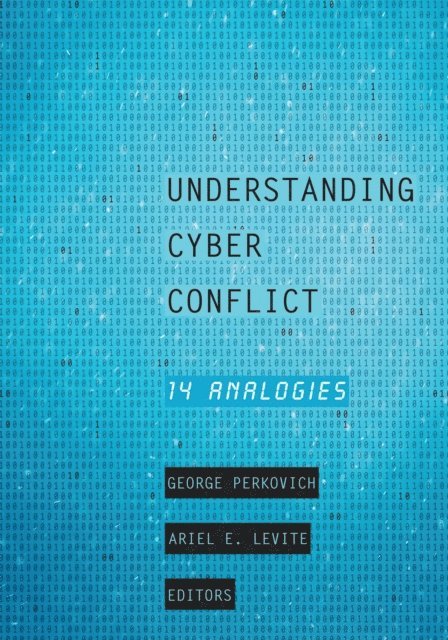
Cyber weapons and the possibility of cyber conflict-including interference in foreign political campaigns, industrial sabotage, attacks on infrastructure, and combined military campaigns-require policymakers, scholars, and citizens to rethink twenty-first-century warfare. Yet because cyber capabilities are so new and continually developing, there is little agreement about how they will be deployed, how effective they can be, and how they can be managed. Written by leading scholars, the fourteen case studies in this volume will help policymakers, scholars, and students make sense of contemporary cyber conflict through historical analogies to past military-technological problems. The chapters are divided into three groups. The first-What Are Cyber Weapons Like?-examines the characteristics of cyber capabilities and how their use for intelligence gathering, signaling, and precision striking compares with earlier technologies for such missions. The second section-What Might Cyber Wars Be Like?-explores how lessons from several wars since the early nineteenth century, including the World Wars, could apply-or not-to cyber conflict in the twenty-first century.The final section-What Is Preventing and/or Managing Cyber Conflict Like?-offers lessons from past cases of managing threatening actors and technologies.
390 kr
Skickas inom 7-10 vardagar
Cyber weapons and the possibility of cyber conflict-including interference in foreign political campaigns, industrial sabotage, attacks on infrastructure, and combined military campaigns-require policymakers, scholars, and citizens to rethink twenty-first-century warfare. Yet because cyber capabilities are so new and continually developing, there is little agreement about how they will be deployed, how effective they can be, and how they can be managed. Written by leading scholars, the fourteen case studies in this volume will help policymakers, scholars, and students make sense of contemporary cyber conflict through historical analogies to past military-technological problems. The chapters are divided into three groups. The first-What Are Cyber Weapons Like?-examines the characteristics of cyber capabilities and how their use for intelligence gathering, signaling, and precision striking compares with earlier technologies for such missions. The second section-What Might Cyber Wars Be Like?-explores how lessons from several wars since the early nineteenth century, including the World Wars, could apply-or not-to cyber conflict in the twenty-first century.The final section-What Is Preventing and/or Managing Cyber Conflict Like?-offers lessons from past cases of managing threatening actors and technologies.