
James Acton – författare
Visar alla böcker från författaren James Acton. Handla med fri frakt och snabb leverans.
5 produkter
5 produkter
415 kr
Skickas inom 10-15 vardagar
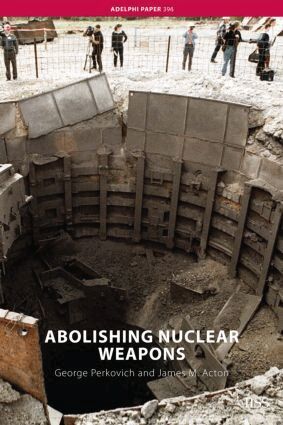
Nuclear disarmament is firmly back on the international agenda. But almost all current thinking on the subject is focused on the process of reducing the number of weapons from thousands to hundreds. This rigorous analysis examines the challenges that exist to abolishing nuclear weapons completely, and suggests what can be done now to start overcoming them. The paper argues that the difficulties of 'getting to zero' must not preclude many steps being taken in that direction. It thus begins by examining steps that nuclear-armed states could take in cooperation with others to move towards a world in which the task of prohibiting nuclear weapons could be realistically envisaged. The remainder of the paper focuses on the more distant prospect of prohibiting nuclear weapons, beginning with the challenge of verifying the transition from low numbers to zero. It moves on to examine how the civilian nuclear industry could be managed in a nuclear-weapons-free world so as to prevent rearmament. The paper then considers what political-security conditions would be required to make a nuclear-weapons ban enforceable and explores how enforcement might work in practice. Finally, it addresses the latent capability to produce nuclear weapons that would inevitably exist after abolition, and asks whether this is a barrier to disarmament, or whether it can be managed to meet the security needs of a world newly free of the bomb.
Deterrence During Disarmament
Deep Nuclear Reductions and International Security
Häftad, Engelska, 2011
292 kr
Skickas inom 10-15 vardagar
There is a broad sense in both Russia and the United States that deep nuclear reductions—a goal endorsed by both governments—would constitute a risky step into the unknown and could undermine international security. However, until now, the reasons behind these concerns—and whether they are justified—have not been properly explored. Based on a series of interviews with opinion formers in both Russia and the United States, this Adelphi maps out these concerns as they relate to the effectiveness of deterrence (including extended deterrence), the possible incentives to use nuclear weapons first in a crisis, the potential for rearmament and nuclear multipolarity. Contrary to popular belief, there is evidence against which these fears can be assessed. The practical experience of deterrence at low numbers that was acquired by the Soviet Union and the United States early in the Cold War, as well as by other nuclear-armed states, is highly relevant. Based on this experience and insights from deterrence theory, this Adelphi concludes that most of the challenges associated with low numbers are not really a consequence of arsenal size and, accordingly, that there are good reasons to believe that deep reductions would not undermine international security.

204 kr
Skickas inom 5-8 vardagar
2 453 kr
Skickas inom 10-15 vardagar
Nuclear disarmament is firmly back on the international agenda. But almost all current thinking on the subject is focused on the process of reducing the number of weapons from thousands to hundreds. This rigorous analysis examines the challenges that exist to abolishing nuclear weapons completely, and suggests what can be done now to start overcoming them. The paper argues that the difficulties of 'getting to zero' must not preclude many steps being taken in that direction. It thus begins by examining steps that nuclear-armed states could take in cooperation with others to move towards a world in which the task of prohibiting nuclear weapons could be realistically envisaged. The remainder of the paper focuses on the more distant prospect of prohibiting nuclear weapons, beginning with the challenge of verifying the transition from low numbers to zero. It moves on to examine how the civilian nuclear industry could be managed in a nuclear-weapons-free world so as to prevent rearmament. The paper then considers what political-security conditions would be required to make a nuclear-weapons ban enforceable and explores how enforcement might work in practice. Finally, it addresses the latent capability to produce nuclear weapons that would inevitably exist after abolition, and asks whether this is a barrier to disarmament, or whether it can be managed to meet the security needs of a world newly free of the bomb.
Deterrence During Disarmament
Deep Nuclear Reductions and International Security
Inbunden, Engelska, 2017
2 453 kr
Skickas inom 10-15 vardagar
There is a broad sense in both Russia and the United States that deep nuclear reductions—a goal endorsed by both governments—would constitute a risky step into the unknown and could undermine international security. However, until now, the reasons behind these concerns—and whether they are justified—have not been properly explored. Based on a series of interviews with opinion formers in both Russia and the United States, this Adelphi maps out these concerns as they relate to the effectiveness of deterrence (including extended deterrence), the possible incentives to use nuclear weapons first in a crisis, the potential for rearmament and nuclear multipolarity. Contrary to popular belief, there is evidence against which these fears can be assessed. The practical experience of deterrence at low numbers that was acquired by the Soviet Union and the United States early in the Cold War, as well as by other nuclear-armed states, is highly relevant. Based on this experience and insights from deterrence theory, this Adelphi concludes that most of the challenges associated with low numbers are not really a consequence of arsenal size and, accordingly, that there are good reasons to believe that deep reductions would not undermine international security.