Gerald Warnecke – författare
Visar alla böcker från författaren Gerald Warnecke. Handla med fri frakt och snabb leverans.
8 produkter
8 produkter
1 257 kr
Skickas inom 7-10 vardagar
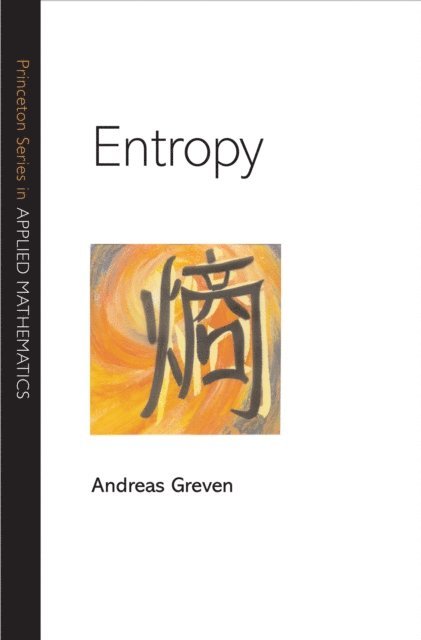
The concept of entropy arose in the physical sciences during the nineteenth century, particularly in thermodynamics and statistical physics, as a measure of the equilibria and evolution of thermodynamic systems. Two main views developed: the macroscopic view formulated originally by Carnot, Clausius, Gibbs, Planck, and Caratheodory and the microscopic approach associated with Boltzmann and Maxwell. Since then both approaches have made possible deep insights into the nature and behavior of thermodynamic and other microscopically unpredictable processes. However, the mathematical tools used have later developed independently of their original physical background and have led to a plethora of methods and differing conventions. The aim of this book is to identify the unifying threads by providing surveys of the uses and concepts of entropy in diverse areas of mathematics and the physical sciences. Two major threads, emphasized throughout the book, are variational principles and Ljapunov functionals. The book starts by providing basic concepts and terminology, illustrated by examples from both the macroscopic and microscopic lines of thought.In-depth surveys covering the macroscopic, microscopic and probabilistic approaches follow. Part I gives a basic introduction from the views of thermodynamics and probability theory. Part II collects surveys that look at the macroscopic approach of continuum mechanics and physics. Part III deals with the microscopic approach exposing the role of entropy as a concept in probability theory, namely in the analysis of the large time behavior of stochastic processes and in the study of qualitative properties of models in statistical physics. Finally in Part IV applications in dynamical systems, ergodic and information theory are presented. The chapters were written to provide as cohesive an account as possible, making the book accessible to a wide range of graduate students and researchers. Any scientist dealing with systems that exhibit entropy will find the book an invaluable aid to their understanding.
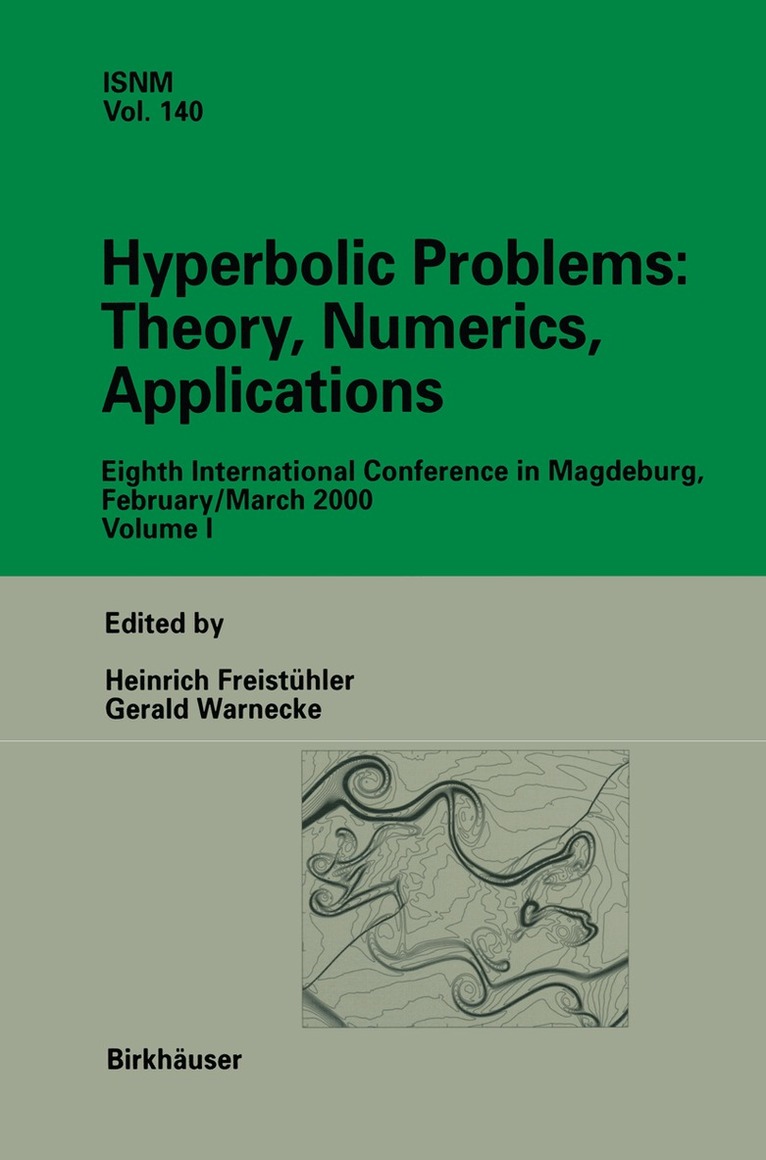
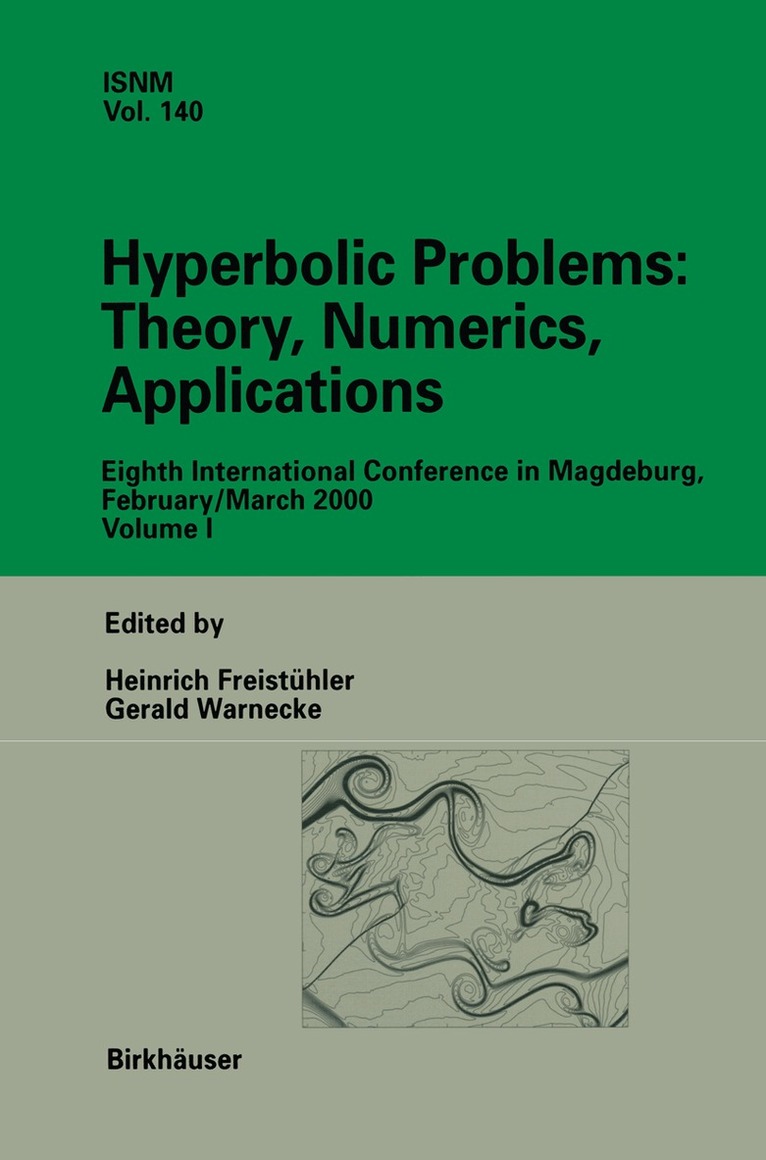
Hyperbolic Problems: Theory, Numerics, Applications
Eighth International Conference in Magdeburg, February/March 2000 Volume 1
Häftad, Engelska, 2012
1 062 kr
Skickas inom 10-15 vardagar
The Eighth International Conference on Hyperbolic Problems - Theory, Nu merics, Applications, was held in Magdeburg, Germany, from February 27 to March 3, 2000. It was attended by over 220 participants from many European countries as well as Brazil, Canada, China, Georgia, India, Israel, Japan, Taiwan, und the USA. There were 12 plenary lectures, 22 further invited talks, and around 150 con tributed talks in parallel sessions as well as posters. The speakers in the parallel sessions were invited to provide a poster in order to enhance the dissemination of information. Hyperbolic partial differential equations describe phenomena of material or wave transport in physics, biology and engineering, especially in the field of fluid mechanics. Despite considerable progress, the mathematical theory is still strug gling with fundamental open problems concerning systems of such equations in multiple space dimensions. For various applications the development of accurate and efficient numerical schemes for computation is of fundamental importance. Applications touched in these proceedings concern one-phase and multiphase fluid flow, phase transitions, shallow water dynamics, elasticity, extended ther modynamics, electromagnetism, classical and relativistic magnetohydrodynamics, cosmology. Contributions to the abstract theory of hyperbolic systems deal with viscous and relaxation approximations, front tracking and wellposedness, stability ofshock profiles and multi-shock patterns, traveling fronts for transport equations. Numerically oriented articles study finite difference, finite volume, and finite ele ment schemes, adaptive, multiresolution, and artificial dissipation methods.
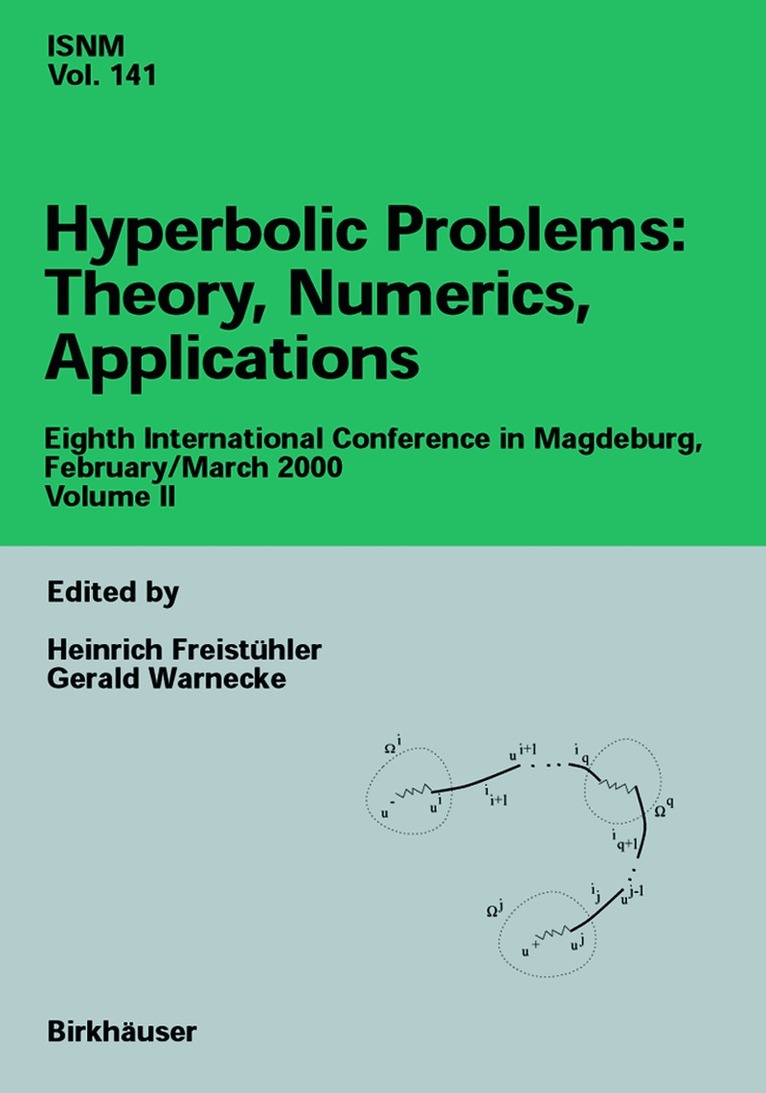
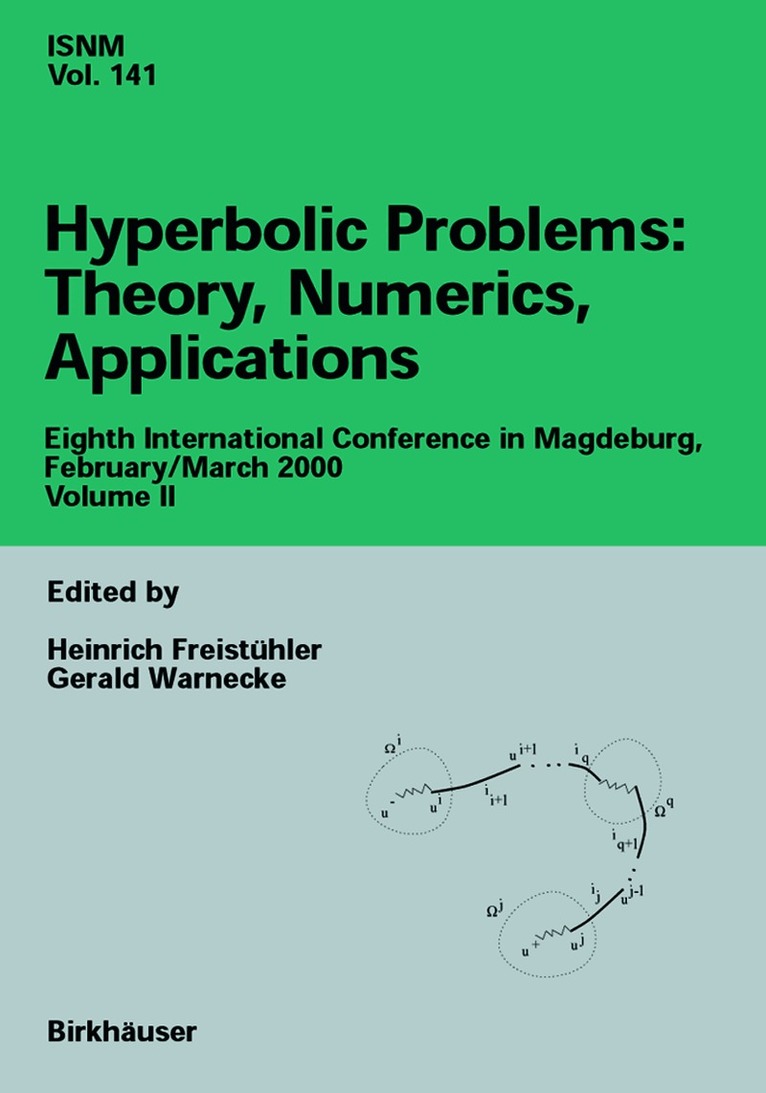
Hyperbolic Problems: Theory, Numerics, Applications
Eighth International Conference in Magdeburg, February/March 2000 Volume II
Häftad, Engelska, 2012
1 062 kr
Skickas inom 10-15 vardagar
Hyperbolic partial differential equations describe phenomena of material or wave transport in physics, biology and engineering, especially in the field of fluid mechanics. The mathematical theory of hyperbolic equations has recently made considerable progress. Accurate and efficient numerical schemes for computation have been and are being further developed.This two-volume set of conference proceedings contains about 100 refereed and carefully selected papers. The books are intended for researchers and graduate students in mathematics, science and engineering interested in the most recent results in theory and practice of hyperbolic problems.Applications touched in these proceedings concern one-phase and multiphase fluid flow, phase transitions, shallow water dynamics, elasticity, extended thermodynamics, electromagnetism, classical and relativistic magnetohydrodynamics, cosmology. Contributions to the abstract theory of hyperbolic systems deal with viscous and relaxation approximations, front tracking and wellposedness, stability of shock profiles and multi-shock patterns, traveling fronts for transport equations. Numerically oriented articles study finite difference, finite volume, and finite element schemes, adaptive, multiresolution, and artificial dissipation methods.
1 062 kr
Skickas inom 10-15 vardagar
The priority research program Analysis and Numerics for Conservation Laws was funded by the German research foundation Deutsche Forschungsgemeinschaft (DFG) for a period of six years starting in 1997. The diversity of topics, represented in the present book, was one of the strengths of the research program. Research groups of very different background, most of which were interacting for the first time, contributed to this interdisciplinary work.The present book contains contributions from interlinked participating projects ranging from the analysis of hyperbolic systems of first order partial differential equations, the development of improved numerical methods for these equations to applications in astrophysics and engineering. It aims at conveying their results achieved in the program to readers outside of their own particular field. The book contains a large number of figures and a number of color plates. The reader can find an up-to-date presentation of many current research topics in the field.
1 062 kr
Skickas inom 10-15 vardagar
Whatdoasupernovaexplosioninouterspace,?owaroundanairfoil and knocking in combustion engines have in common? The physical and chemical mechanisms as well as the sizes of these processes are quite di?erent. So are the motivations for studying them scienti?cally. The super- 8 nova is a thermo-nuclear explosion on a scale of 10 cm. Astrophysicists try to understand them in order to get insight into fundamental properties of the universe. In ?ows around airfoils of commercial airliners at the scale of 3 10 cm shock waves occur that in?uence the stability of the wings as well as fuel consumption in ?ight. This requires appropriate design of the shape and structure of airfoils by engineers. Knocking occurs in combustion, a chemical 1 process, and must be avoided since it damages motors. The scale is 10 cm and these processes must be optimized for e?ciency and environmental conside- tions. The common thread is that the underlying ?uid ?ows may at a certain scale of observation be described by basically the same type of hyperbolic s- tems of partial di?erential equations in divergence form, called conservation laws. Astrophysicists, engineers and mathematicians share a common interest in scienti?c progress on theory for these equations and the development of computational methods for solutions of the equations. Due to their wide applicability in modeling of continua, partial di?erential equationsareamajor?eldofresearchinmathematics. Asubstantialportionof mathematical research is related to the analysis and numerical approximation of solutions to such equations. Hyperbolic conservation laws in two or more spacedimensionsstillposeoneofthemainchallengestomodernmathematics.
Hyperbolic Problems: Theory, Numerics, Applications
Eighth International Conference in Magdeburg, February/March 2000 Volume 1
Inbunden, Engelska, 2002
1 062 kr
Skickas inom 10-15 vardagar
Hyperbolic partial differential equations describe phenomena of material or wave transport in physics, biology and engineering, especially in the field of fluid mechanics. The mathematical theory of hyperbolic equations has made considerable progress and accurate and efficient numerical schemes for computation have been, and are being, further developed. This volume is part of a two-volume set of conference proceedings which contains about 100 refereed and carefully selected papers on hyperbolic problems. Applications covered include: one-phase and multiphase fluid flow; phase transitions; shallow-water dynamics; elasticity; extended thermodynamics; electromagnetism; classical and relativistic magnetohydrodynamics; and cosmology. Contributions to the abstract theory of hyperbolic systems deal with viscous and relaxation approximations, front tracking and wellposedness, stability of shock profiles and multi-shock patterns, and travelling fronts for transport equations. Numerically oriented articles study finite difference, finite volume and finite element schemes, adaptive, multiresolution and artificial dissipation methods.The book is intended for researchers and graduate students in mathematics, science and engineering.
Hyperbolic Problems: Theory, Numerics, Applications
Eighth International Conference in Magdeburg, February/March 2000 Volume II
Inbunden, Engelska, 2002
1 062 kr
Skickas inom 10-15 vardagar
Hyperbolic partial differential equations describe phenomena of material or wave transport in physics, biology and engineering, especially in the field of fluid mechanics. The mathematical theory of hyperbolic equations has made considerable progress and accurate and efficient numerical schemes for computation have been, and are being, further developed. This volume is part of a two-volume set of conference proceedings containing about 100 refereed and carefully selected papers on hyperbolic problems. Applications covered include: one-phase and multiphase fluid flow; phase transitions; shallow-water dynamics; elasticity; extended thermodynamics; electromagnetism; classical and relativistic magnetohydrodynamics; and cosmology. Contributions to the abstract theory of hyperbolic systems deal with viscous and relaxation approximations, front tracking and wellposedness, stability of shock profiles and multi-shock patterns, and travelling fronts for transport equations. Numerically oriented articles study finite difference, finite volume and finite element schemes, adaptive, multiresolution and artificial dissipation methods.The book is intended for researchers and graduate students in mathematics, science and engineering.
Hyperbolic Problems: Theory, Numerics, Applications
Eighths International Conference in Magdeburg, February/ March 2000, Set Volumes I, II
Inbunden, Engelska, 2002
1 062 kr
Skickas inom 10-15 vardagar
Hyperbolic partial differential equations describe phenomena of material or wave transport in physics, biology and engineering, especially in the field of fluid mechanics. The mathematical theory of hyperbolic equations has made considerable progress and accurate and efficient numerical schemes for computation have been, and are being, further developed. This two-volume set of conference proceedings contains about 100 refereed and carefully selected papers on hyperbolic problems. Applications covered include: one-phase and multiphase fluid flow; phase transitions; shallow-water dynamics; elasticity; extended thermodynamics; electromagnetism; classical and relativistic magnetohydrodynamics; and cosmology. Contributions to the abstract theory of hyperbolic systems deal with viscous and relaxation approximations, front tracking and wellposedness, stability of shock profiles and multi-shock patterns, and travelling fronts for transport equations. Numerically oriented articles study finite difference, finite volume and finite element schemes, adaptive, multiresolution and artificial dissipation methods.The book is intended for researchers and graduate students in mathematics, science and engineering.