Giancarlo Maiorino - Böcker
Visar alla böcker från författaren Giancarlo Maiorino. Handla med fri frakt och snabb leverans.
6 produkter
6 produkter
607 kr
Skickas inom 5-8 vardagar
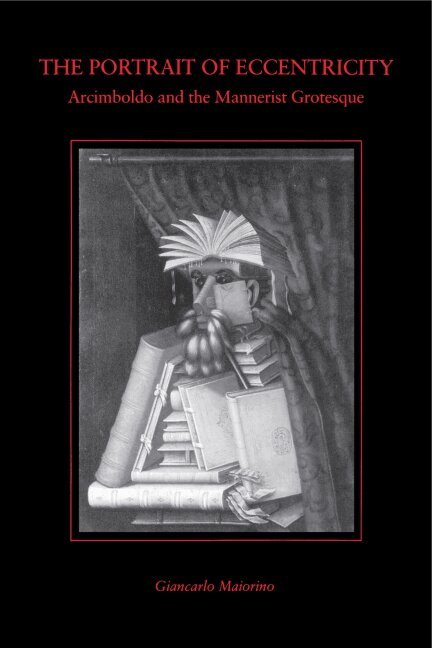
In this companion to his The Cornucopian Mind and the Baroque Unity of the Arts, Maiorino examines the links between Renaissance and the modern versions of the Groteseque.In this interdisciplinary study, the term "eccentricity" refers to styles of playful extravagance. Maiorino focuses on the rhetorical figures of excess employed by a critic-historian (Giorgio Vasari), on the willful artificiality of a painter (Giuseppe Arcimboldo), and on the programmatic and interpretive commentary of a theorist (Gregorio Comanini).Maiorino draws subtle and persuasive connections between the images he discusses and the grotesque "face" of sixteenth-century poetics and rhetoric. He sets the mannerist and the grotesque against the philosophical seriousness of Renaissance humanism, interpreting them as a celebration of the ludic and fantastic possibilities of art itself. Aiming at pleasure rather than instruction, this art plays on the boundaries of the natural and the artificial, the credible and the impossible, taking delight in parody, excess, disjunction, and exaggeration.
517 kr
Skickas inom 5-8 vardagar
This comparative and interdisciplinary study focuses on a cluster of epoch-making themes that emerged in the late sixteenth century. Michelangelo and Giordano Bruno are taken as the founding fathers of the Baroque, and we see that beyond the Alps their lessons were echoed in Montaigne, Cervantes, and the Counter-Reformation culture of the Mediterranean basin. Maiorino shows that the common denominator that links the origins of the Baroque to its maturity is the concept of form as "process," which is then articulated into chapters on the formative unity of the arts, art forms at the threshold, and the development from humanist perfection to Baroque perfectibility. Such an evolution in literature and the arts is situated in relation to the age of explorations (Columbus), scientific inventions (the telescope), and the fundamental shift from the enclosed Ptolemic system to the open universe of the Copernican revolution.At the Baroque point of origin, the inner vitality of Michelangelo's emphasis on creation as "process" rather than completed act taught a crucial lesson to Baroque artists. Their response to the infinite and open universe of the "New Science" was one that took part to be as dynamic and metamorphic as life itself. It is in the context of "open" forms within an "open" universe that this study moves from Michelangelo to Bruno. His poetics of immeasurable abundance set "process" at the very core of the Baroque art, thought, and science. Applied to the forms of art, growth and metamorphosis are linked to what Maiorino calls (borrowing from Mikhail Bakhtin) the Baroque chronotope of formation, which refers to forms responding to the dynamics of space-time interactions. Such interactions were exhaustive and even tested the boundaries between reality and fiction, creation and denial, conformity and criticism from picaresque Spain to middle-class Holland. And it is the painting of a Dutch artist—Rembrandt's Aristotle Contemplating the Bust of Homer— that is taken as a symbol of the Baroque reconciliation of humanist learning with human or humane understanding. Such a humanizing attitude also marked the final transformation of humanist ideals of perfection into the Baroque experience of human perfectibility.This book will be of importance to all scholars concerned with the history of ideas, cultural history, and the Baroque in literature and art.
1 080 kr
Skickas inom 7-10 vardagar
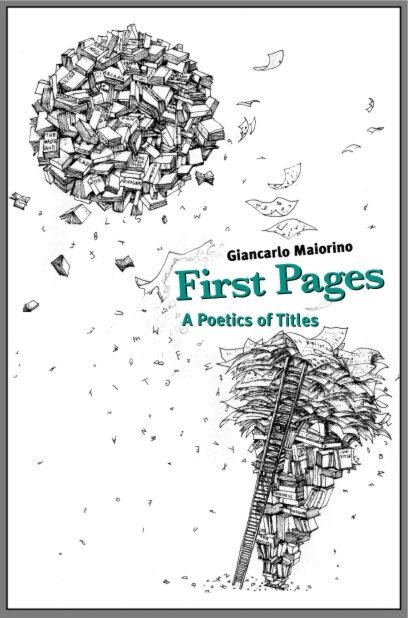
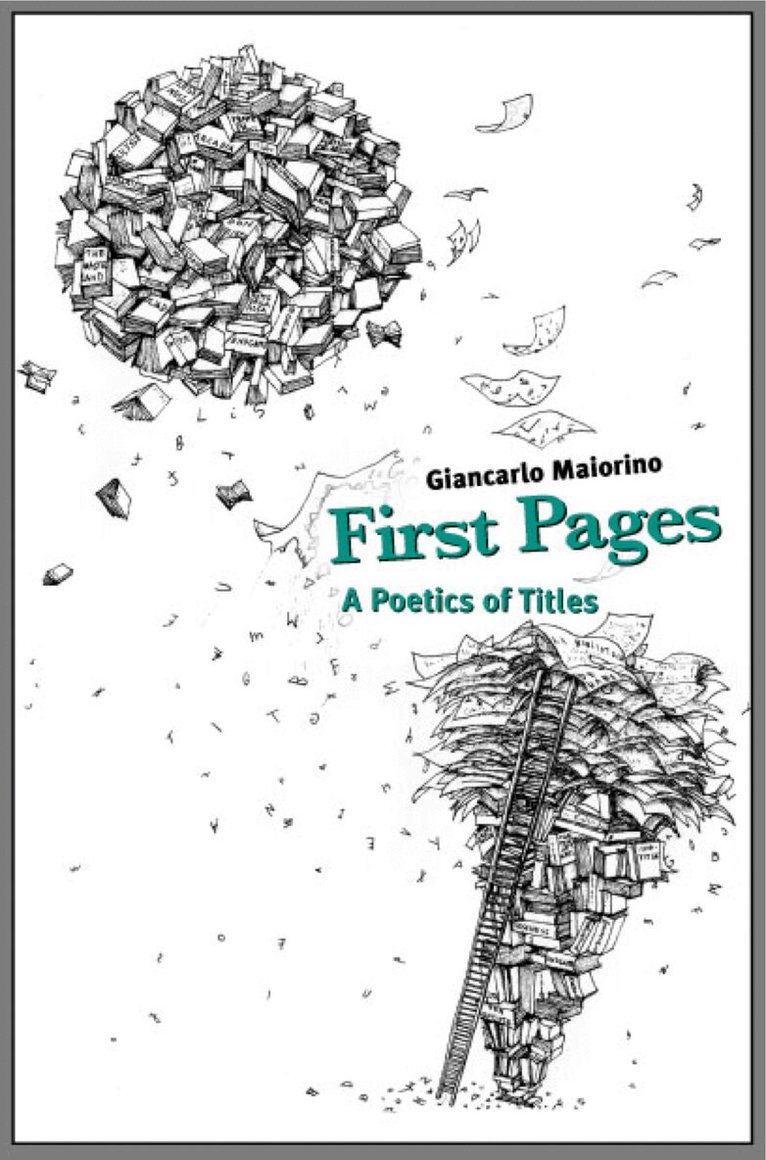
“Titology,” a term first coined in 1977 by literary critic Harry Levin, is the field of literary studies that focuses on the significance of a title in establishing the thematic developments of the pages that follow. While the term has been used in the literary community for thirty years, this book presents for the first time a thoroughly developed theoretical discussion on the significance of the title as a foundation for scholarly criticism. Though Maiorino acknowledges that many titles are superficial and “indexical,” there exists a separate and more complex class of titles that do much more than simply decorate a book’s spine. To prove this argument, Maiorino analyzes a wide range of examples from the modern era through high modernism to postmodernism, with writings spanning the globe from Spain and France to Germany and America. By examining works such as Essais, The Waste Land, Ulysses, and Don Quixote, First Pages proves the power of the title to connect the reader to the thematic, cultural, and literary context of the writing as a whole. Much like a façade to a building, the title page serves as the frontispiece of literature, a sign that offers perspective and demands interpretation.
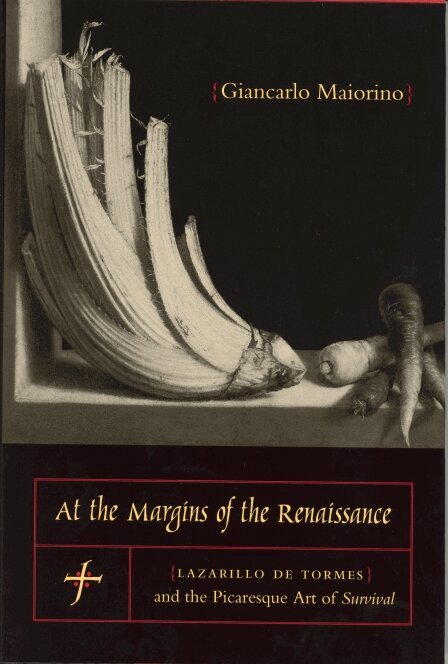
At the Margins of the Renaissance
Lazarillo de Tormes and the Picaresque Art of Survival
Häftad, Engelska, 2012
577 kr
Skickas inom 5-8 vardagar
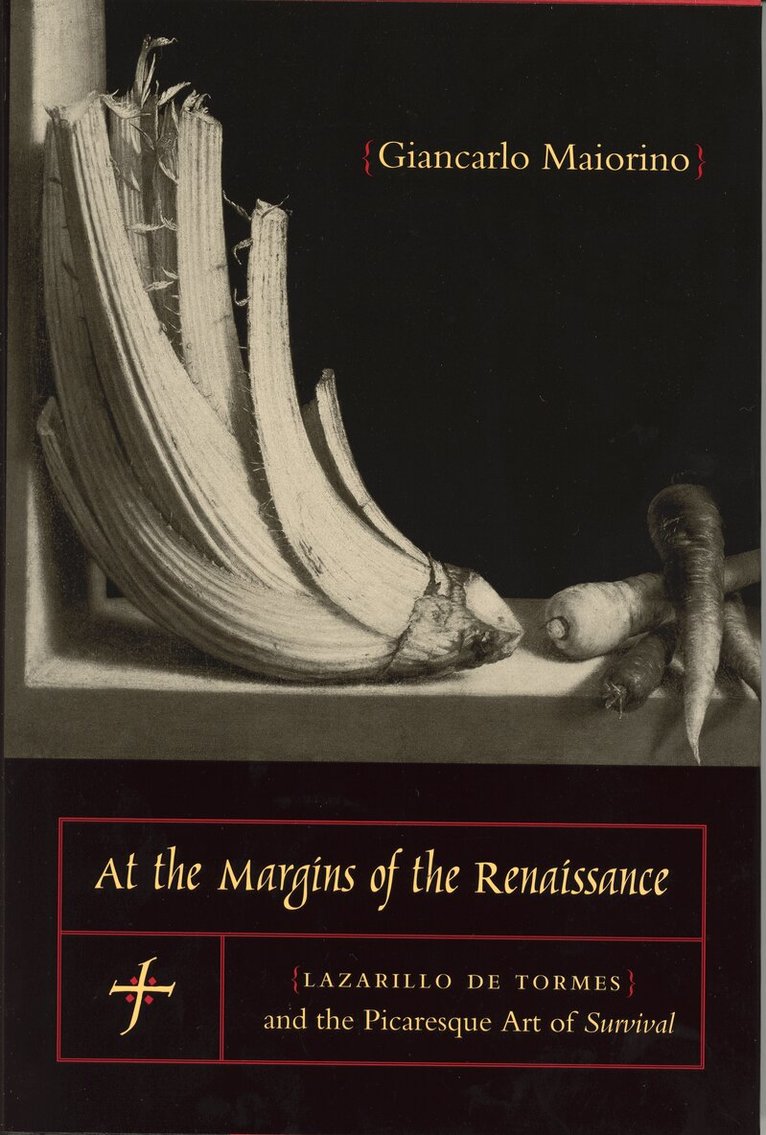
Published anonymously in 1554, Lazarillo de Tormes upset all the strict hierarchies that governed art and society during the Renaissance. It traces the adventures not of a nobleman or ancient hero, but rather of an ordinary man who struggles for survival in a cruel, corrupt society after growing up under the care of a blind beggar. Giancarlo Maiorino treats this picaresque narrative as a prism for exploring econopoetics, a term he uses to foreground the ways in which literary and economic modes of production feed off one another. His approach introduces readers to the turbulent world of common people of Renaissance Spain even as it affords abundant insights into the historical significance of this literary classic.Although literary historians generally connect the rise of the novel to the needs of the middle classes of England, Maiorino demonstrates that its deepest roots are in the culture of indigence that developed at the peripheries of Renaissance society and challenged—even parodied—its authoritarian ambitions. Seen in this light, Lazarillo de Tormes emerges as a key text in understanding the novel's purchase on visions of escape from authority into alternative modes of existence.Maiorino grounds his far-reaching arguments in recent theories of textuality and the practices of everyday life. His book will be important reading for all those concerned with the Renaissance, Spanish history and culture, and, more generally, theories of the novel.
497 kr
Skickas inom 5-8 vardagar
“Titology,” a term first coined in 1977 by literary critic Harry Levin, is the field of literary studies that focuses on the significance of a title in establishing the thematic developments of the pages that follow. While the term has been used in the literary community for thirty years, this book presents for the first time a thoroughly developed theoretical discussion on the significance of the title as a foundation for scholarly criticism. Though Maiorino acknowledges that many titles are superficial and “indexical,” there exists a separate and more complex class of titles that do much more than simply decorate a book’s spine. To prove this argument, Maiorino analyzes a wide range of examples from the modern era through high modernism to postmodernism, with writings spanning the globe from Spain and France to Germany and America. By examining works such as Essais, The Waste Land, Ulysses, and Don Quixote, First Pages proves the power of the title to connect the reader to the thematic, cultural, and literary context of the writing as a whole. Much like a façade to a building, the title page serves as the frontispiece of literature, a sign that offers perspective and demands interpretation.
747 kr
Skickas inom 11-20 vardagar
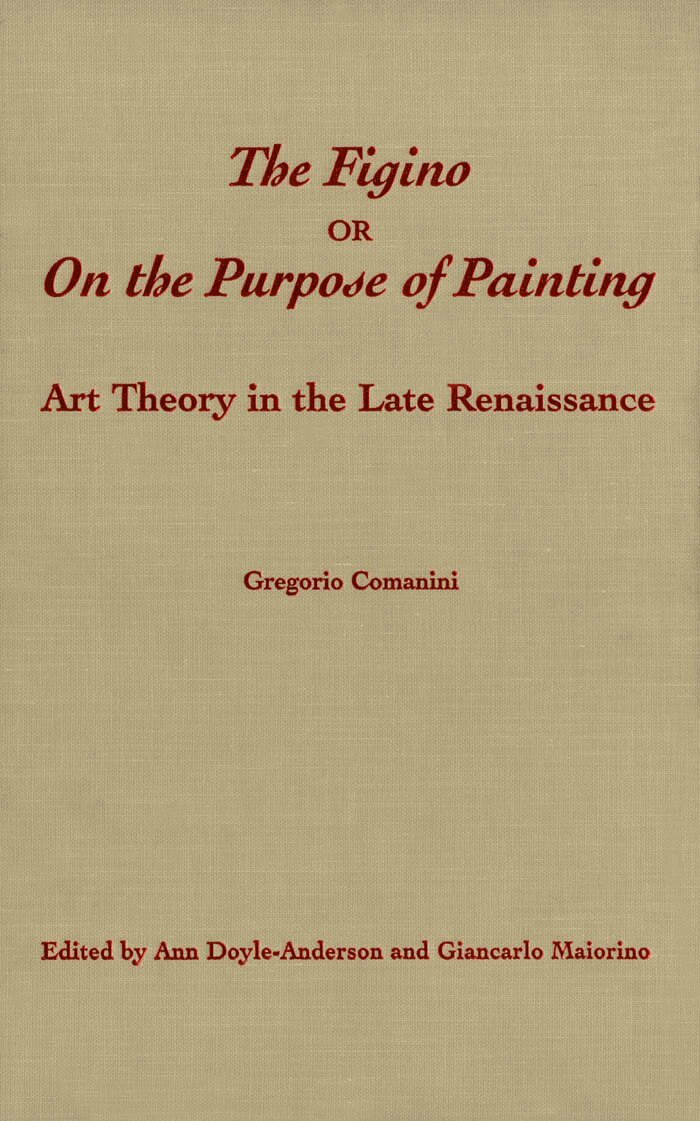
Of the many treatises written in Italy during the Counter-Reformation, none is more illustrative of the intellectual fermentation of the period than Comanini's work on the purpose of painting, Il Figino overo del fine della Pittura (1591). Although the importance of Il Figino has long been recognized, the text has remained largely inaccessible to many scholars throughout the world. This first complete English translation will make the work available to those readers for the first time.In Il Figino, Comanini addresses all of the most hotly debated aesthetic issues of the time, drawing on an array of classical, medieval and Renaissance sources, including Plato, Aristotle, Horace, Mazzoni, Tasso and Paleotti. The editor and translator provide copious notes which clarify Comanini's aesthetic and theological references, as well as a lucid introduction that places the issues and debates in context. Comanini's impressive erudition makes his treatise an excellent barometer of the state of scholarship in the Counter-Reformation era. This translation is a long-overdue addition to the field of Renaissance studies.