Graham J. Leuschke – författare
Visar alla böcker från författaren Graham J. Leuschke. Handla med fri frakt och snabb leverans.
4 produkter
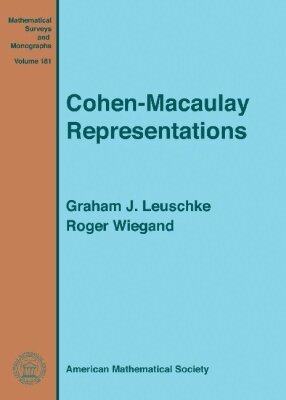
Cohen-Macaulay Representations
Av Graham J. Leuschke, Roger Wiegand
Inbunden, 2012
1542 kr
Lägg i varukorg
This book is a comprehensive treatment of the representation theory of maximal Cohen-Macaulay (MCM) modules over local rings. This topic is at the intersection of commutative algebra, singularity theory, and representations of groups and algebras. Two introductory chapters treat the …
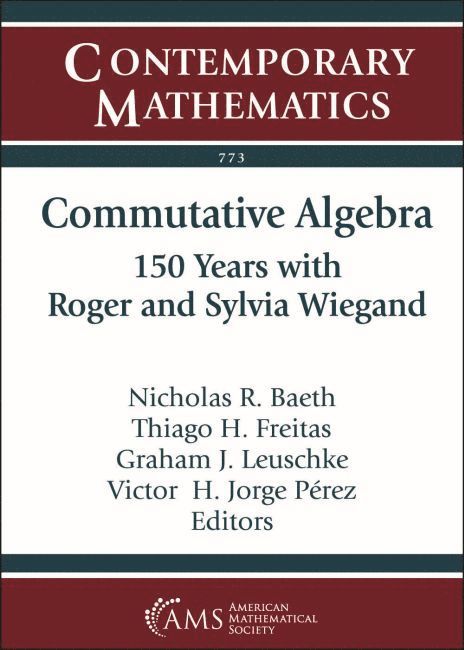
Commutative Algebra
150 Years with Roger and Sylvia Wiegand
Av Nicholas R. Baeth, Thiago H. Freitas m. fl.
Häftad, 2022
1458 kr
Lägg i varukorg
This volume contains the combined Proceedings of the Second International Meeting on Commutative Algebra and Related Areas (SIMCARA) held from July 22-26, 2019, at the Universidade de Sao Paulo, Sao Carlos, Brazil, and the AMS Special Session on Commutative Algebra, held from September 14-15, 2019, …
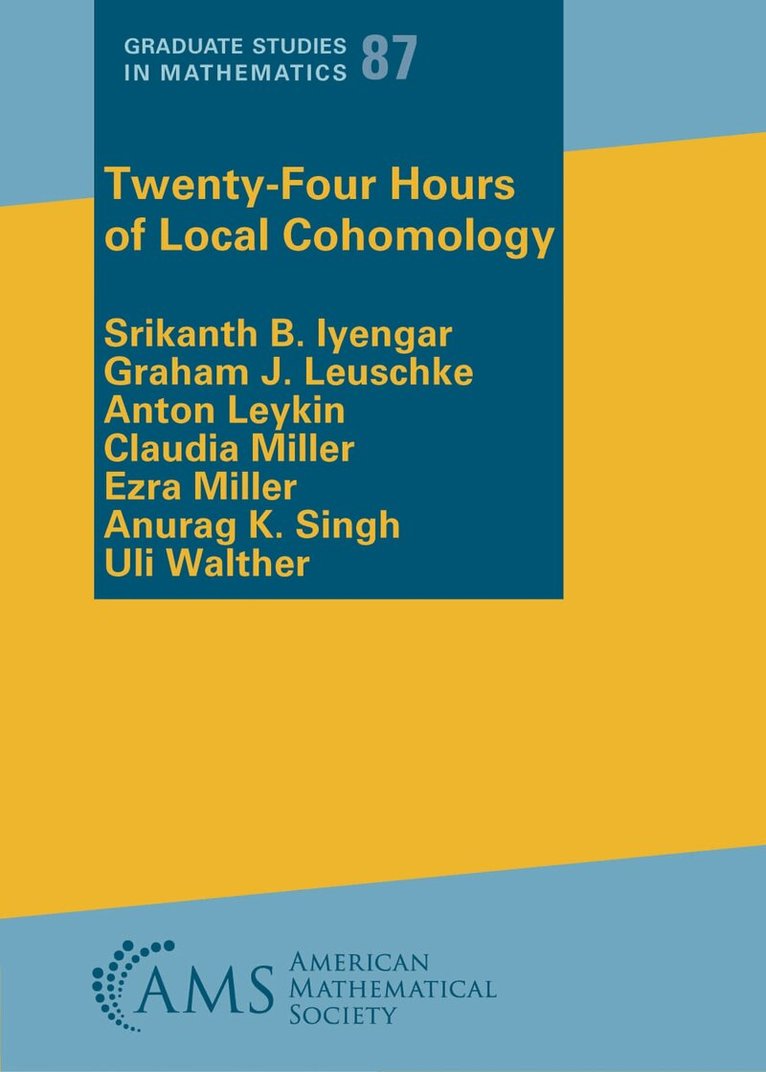
Twenty-Four Hours of Local Cohomology
Av Srikanth B. Iyengar, Graham J. Leuschke m. fl.
Häftad, 2007
1067 kr
Lägg i varukorg
This book is aimed to provide an introduction to local cohomology which takes cognizance of the breadth of its interactions with other areas of mathematics. It covers topics such as the number of defining equations of algebraic sets, connectedness properties of algebraic sets, connections to sheaf …
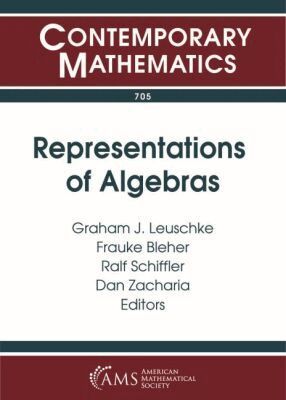
Representations of Algebras
Av Graham J. Leuschke, Frauke Bleher m. fl.
Häftad, 2018
1556 kr
Tillfälligt slut
This volume contains the proceedings of the 17th Workshop and International Conference on Representations of Algebras (ICRA 2016), held from August 10-19, 2016, at Syracuse University, Syracuse, NY.Included are three survey articles based on short courses in the areas of commutative algebraic …