Gregory D. S. Anderson – författare
Visar alla böcker från författaren Gregory D. S. Anderson. Handla med fri frakt och snabb leverans.
4 produkter
Auxiliary Verb Constructions
E-bok, 2006
722 kr
Lägg i varukorg
This is the most comprehensive survey ever published of auxiliary verb constructions, as in ''he could have been going to drink it'' and ''she does eat cheese''. Drawing on a database of over 800 languages Dr Anderson examines their morphosyntactic forms and semantic roles. He investigates and …
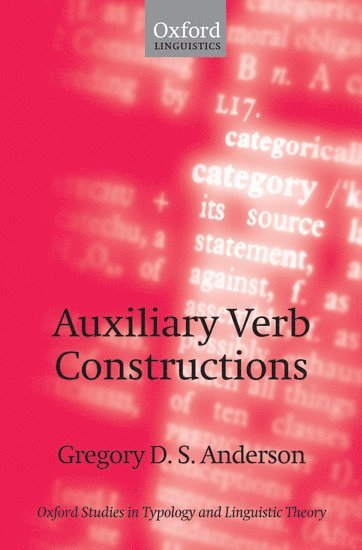
Auxiliary Verb Constructions
Häftad, 2009
936 kr
Lägg i varukorg
This is the most comprehensive survey ever published of auxiliary verb constructions (as in, for example, 'he could have been going to drink it' and 'she does eat cheese'). Drawing on a database of over 800 languages Dr Anderson examines their morphosyntactic forms and semantic roles, and …
Munda Verb
Typological Perspectives
Inbunden, 2007
2306 kr
Lägg i varukorg
The Munda Verb is a unique book on the typology of the verb in the Munda language family, and the first of its kind on any language family of the Indian subcontinent. The author painstakingly works out nearly all the details of the morphology of the verb in each modern Munda language and offers a …
Munda Verb
Typological Perspectives
E-bok, 2011
2241 kr
Lägg i varukorg
The Munda Verb is a unique book on the typology of the verb in the Munda language family, and the first of its kind on any language family of the Indian subcontinent. The author painstakingly works out nearly all the details of the morphology of the verb in each modern Munda language and offers a …